Works for
2 of 3 advertised claims delivered
Evens skin toneTranexamic acid, Resveratrol dimethyl ether + 2 moreStrong evidence
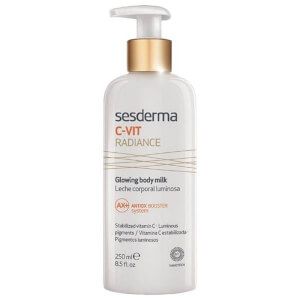
“Formulated using light-reflecting pigments, the milk gives dull skin a healthier-looking glow while added Vitamin C brightens your complexion for an all-over even tone.”
This product can help reduce hypepigmentation and even out the skin tone because it contains the following effective ingredients: tranexamic acid
The following ingredient (ingredients) in this product might be helpful, but there is no evidence to confirm that it actually can help even out the skin tone: resveratrol dimethyl ether.
Keep in mind that you would need to apply any topical skincare targetted at hypigmentation consistently for a couple of months to get a result. No topical skincare product can help get rid of hyperpigmentation (including post-acne marks and age spots) instantly.
MoisturizingGlycerin, Sodium hyaluronate + 13 moreGood evidence
“Make sure your skin glows from head to toe with the Sesderma C-VIT Radiance Body Milk , a lightweight lotion that nourishes your skin and helps to unlock your natural luminosity.”
This product can help improve hydration of the skin with the two types of ingredients.
The first type is called “humectants”:
these ingredients help attract water.
When humectants are on the surface of the skin, they “pull in” the moisture from the outside environment, or from
within deeper layers of the skin. The following ingredients in this product do the job:
glycerin, sodium hyaluronate.
This product also contains ingredients called “occlusives”. They help reduce the speed with which our skin loses moisture to the outside environment. These ingredients also help soften the upper layer of the skin, so it feels less tight and nicer to the touch. The following ingredients in this product do the job: sesamum indicum seed oil, c10-18 triglycerides.
Anti-aging3-o-ethyl ascorbic acid, Tocopherol + 1 moreLimited evidence
“You’ll be treated to a silky-smooth finish that’s thoroughly hydrated and free from dry patches, working to reduce the impact of signs of premature ageing.”
This product does not contain ingredients that are able to reduce fine lines and wrinkles or help with skin elasticity, but it can improve the look of the skin temporarily through moisturization. Well-moisturized skin might also be able to repair the sun damage better.
This ingredient ginkgo biloba leaf extract might be able to help neutralize free radicals in skin and help it fight off some of the sun damage.
Anti-oxidationNot advertised by the brand · Quercetin, Ginkgo biloba leaf extract + 5 moreModerate evidence
This product contains antioxidants (ginkgo biloba leaf extract, quercetin) that might be able to help neutralize free radicals in skin to lessen the damage it gets from the UV light (sun). There is not enough evidence to confirm their effectiveness in skin though.
Can it cause trouble?
Irritancy7 strong irritants: Citrus aurantium dulcis fruit extract, Alcohol + 5 more — patch-test recommendedHigh risk
Comedogenic1 ingredient rated 2 or more on the 0–5 pore-clogging scale1 flagged


User reviews
Be the first — your take helps the next person decide.
Ingredients
Filter by role to see what each ingredient is doing.
Water~45–55%
Glycerin~4.8–5.9%
- Irritation risk
- Low
One of the best moisturizing ingredients. Naturally present in skin. It attracts water to the upper layer of the skin working as a humectant
More about GlycerinCyclopentasiloxane~4.1–5%
- Irritation risk
- Low
A silicone that helps improve the product texture and spreadability. Can absorb oil creating a short-term mattifying effect on the skin
More about CyclopentasiloxanePropanediol~3–3.6%
- Irritation risk
- Low
Acts as a solvent for other ingredients. Speeds up the absorption of other ingredients into the skin
More about PropanediolButylene glycol~2.2–2.7%
- Irritation risk
- Low
Used to create a nice product texture and help delivery of other ingredients. Might be somewhat helpful in attracting water to the upper layer of the skin
More about Butylene glycolTriticum vulgare germ extract~1.9–2.3%
- Irritation risk
- Medium
- Comedogenicity
- 3/5
Plant extract that might have moisturizing properties. Avoid if you suffer from wheat or gluten intolerance
More about Triticum vulgare germ extractC10-18 triglycerides~1.5–1.9%
- Irritation risk
- Low
Helps soften the skin and attract water to its upper layer. Helps create nice product texture
More about C10-18 triglyceridesArachidyl alcohol~1.4–1.7%
- Irritation risk
- Low
Used to soften the upper layer of the skin and create a thicker product consistency
More about Arachidyl alcoholTitanium dioxide~1.5–1.9%
- Irritation risk
- Low
Works as a UV filter when used in high concentrations. It is photostable and is effective mostly against the UVB light, with some protection in the UVA range. In small concentrations, used for its ability to improve the color of cosmetic products. Is usually well tolerated by the skin
More about Titanium dioxideBehenyl alcohol~0.9–1.1%
- Irritation risk
- Low
Non-drying alcohol that helps water and oil mix together. Also serves as an emollient
More about Behenyl alcoholMica~0.7–1.05%
- Irritation risk
- Low
Creates an illusion of smoother and more radiant skin tone. Adds shimmer to the skin by reflecting light
More about MicaPropylene glycol~0.45–0.65%
- Irritation risk
- High
Helps oil and water mix together and can enhance the penetration of other ingredients into the skin. It can be irritating
More about Propylene glycolSesamum indicum seed oil~0.45–0.65%
- Irritation risk
- Low
A good moisturizing plant oil. Due to the high linoleic acid content, it helps soften the upper layer of the skin, reduce water loss and support skin barrier function
More about Sesamum indicum seed oilTranexamic acid~0.3–0.55%
- Irritation risk
- Low
An amino acid that is effective in reducing hyperpigmentation and evening out the skin tone. It can also help in skin barrier recovery. It is used to treat melasma, especially with injections and when taken orally
More about Tranexamic acidSodium hyaluronate~0.3–0.55%
- Irritation risk
- Low
One of the best moisturizing ingredients. Attracts water into the upper layer of the skin
More about Sodium hyaluronateResveratrol dimethyl ether~0.3–0.55%
- Irritation risk
- Low
A more stable derivative of anti-oxidant resveratrol. There is not enough research to confirm its efficacy in skin
More about Resveratrol dimethyl etherQuercetin~0.3–0.5%
- Irritation risk
- Low
Might be able to help neutralize free radicals in skin
More about QuercetinGinkgo biloba leaf extract~0.25–0.45%
- Irritation risk
- High
A plant extract that might help neutralize free radicals and reduce inflammation in skin. It can be irritating
More about Ginkgo biloba leaf extractCitrus aurantium dulcis fruit extract~0.2–0.4%
- Irritation risk
- High
A plant extract that is used as a fragrance. Can be irritating and lead to photosensitivity
More about Citrus aurantium dulcis fruit extract3-o-ethyl ascorbic acid~0.2–0.35%
- Irritation risk
- High
A vitamin C derivative that is more stable but less potent than pure form of vitamin C. Can help neutralize free radicals and help reduce hyperpigmentation, but the required concentration is likely to be much higher than for the pure form of vitamin C, limiting the ingredient's effectiveness in products
More about 3-o-ethyl ascorbic acidArachidyl glucoside~0.2–0.35%
Cyclohexasiloxane~0.2–0.4%
- Irritation risk
- Low
A silicone that serves as an emollient. Helps create a nice non-greasy feels
More about CyclohexasiloxaneTocopheryl acetate~0.15–0.3%
- Irritation risk
- Medium
A more stable but less bio-available form of vitamin E compared to Tocopherol. Might help moisturize and protect the skin from free radicals, but mostly used in low concentrations to stabilize other ingredients.
More about Tocopheryl acetateCetyl alcohol~0.2–0.35%
- Irritation risk
- Low
A non-drying alcohol that works to soften the skin and stabilize product formulations helping oil and water mix together
More about Cetyl alcoholCarbomer~0.15–0.25%
- Irritation risk
- Low
Helps create a thicker or gel-like product texture. It is not a surfactant but can be used in gentle cleansing formulations
More about CarbomerTriethanolamine~0.15–0.3%
- Irritation risk
- Medium
Used to adjust pH of the product and can help improve the product's smell
More about TriethanolamineDimethicone/vinyl dimethicone crosspolymer~0.15–0.25%
- Irritation risk
- Low
Used to stabilize product formulations and create a nice product texture
More about Dimethicone/vinyl dimethicone crosspolymerLecithin~0.2–0.35%
- Irritation risk
- Low
Used mostly for creating emulsions - helping oil and water mix together. Helps soften the upper layer of the skin
More about LecithinDisodium edta~0.15–0.25%
Bht~0.15–0.25%
Alcohol~0.15–0.25%
- Irritation risk
- High
Can be drying and contribute to skin irritation. Used in formulars to dissolve other ingredients, create a thinner product consistency or for its antibacterial properties
More about AlcoholPolysorbate 20~0.15–0.3%
Tin oxide~0.25–0.45%
- Irritation risk
- Low
A colorant that can add a pearl-like appearance to the formulation
More about Tin oxideSodium chloride~0.15–0.3%
- Irritation risk
- Low
Used to stabilize mixtures of oil and water, and create thicker, gel-like product textures
More about Sodium chlorideSodium cholate~0.15–0.25%
- Irritation risk
- Low
Retinyl palmitate~0.1–0.2%
- Irritation risk
- High
Three steps removed from the active form of vitamin A - retinoic acid. To have an effect in the skin, it first needs to be converted twice to become the retinoic acid. This means it is less potent than retinol, but could also be less irritating. Once converted to the retinoic acid in the skin, it helps against all signs of aging, improves skin cell turnover and helps fight blemishes and clogged pores. However, in many cosmetic formulations, it is used in a concentration that is too low to have the full effect
More about Retinyl palmitateSodium hydroxide~0.15–0.25%
Tocopherol~0.15–0.3%
- Irritation risk
- Low
Pure form of vitamin E. Can help moisturise and protect the skin from free radicals. Often used to help stabilise other ingredients or the formula itself
More about TocopherolPhenoxyethanol~0.15–0.25%
- Irritation risk
- Low
A preservative. It helps prevent bacterial growth in cosmetic products
More about PhenoxyethanolEthylhexylglycerin~0.15–0.25%
Potassium sorbate~0.1–0.2%
Parfum~0.1–0.2%
- Irritation risk
- High
An aromatic blend of unspecified and possibly irritating ingredients
More about ParfumLimonene~0.1–0.25%
- Irritation risk
- High
A common frangrance that can easily irritate skin, especially if exposed to air, light or heat
More about LimoneneLinalool~0.1–0.2%
Citral~0.05–0.1%
Ci 15985~0.05–0.1%
Ingredient list view
Water, Glycerin, Cyclopentasiloxane, Propanediol, Butylene glycol, Triticum vulgare germ extract, C10-18 triglycerides, Arachidyl alcohol, Titanium dioxide, Behenyl alcohol, Mica, Propylene glycol, Sesamum indicum seed oil, Tranexamic acid, Sodium hyaluronate, Resveratrol dimethyl ether, Quercetin, Ginkgo biloba leaf extract, Citrus aurantium dulcis fruit extract, 3-o-ethyl ascorbic acid, Arachidyl glucoside, Cyclohexasiloxane, Tocopheryl acetate, Cetyl alcohol, Carbomer, Triethanolamine, Dimethicone/vinyl dimethicone crosspolymer, Lecithin, Disodium edta, Bht, Alcohol, Polysorbate 20, Tin oxide, Sodium chloride, Sodium cholate, Retinyl palmitate, Sodium hydroxide, Tocopherol, Phenoxyethanol, Ethylhexylglycerin, Potassium sorbate, Parfum, Limonene, Linalool, Citral, Ci 15985
Compare prices
Retailers ranked by price — lowest first.

Worth comparing, line by line.
Match % combines shared ingredients, the first five ingredients, shared actives and hero ingredients, irritancy (lower counts in the alternative's favour), texture and body area. Only products in the same routine step are compared.
| SesdermaC-VIT Radiance Body MilkYOUR PRODUCT | Farm StayDAILY PERFUME BODY LOTION | REVOLUTION SKINCAREBody Vit C Shimmer Lotion | SaltairVitamin C Body Serum For Brighter Tone & Smooth Skin | Saltair | |
|---|---|---|---|---|
| Match | — | 55% | 51% | 51% |
| Price | $26.13 | $19.80−$6.33 | $12.00−$14.13 | $22.99−$3.14 |
| Shared key ingredients | — | 3 of 10 | 3 of 10 | 2 of 10 |
| Key difference | — | Mineral Oil | Carthamus Tinctorius Seed Oil | Vitamin C |
| Irritancy | High | Medium | High | Low |
| Drying alcohol | Contains drying alcohol | — | — | — |
| View product | Shop | Shop | Shop |

Sources cited in this review
Every concentration estimate and effectiveness label is anchored to one of these 23 studies and safety reviews.
- 1
- 2Wheat in skin caremdedge.com
- 3Surfactants and experimental irritant contact dermatitisncbi.nlm.nih.gov
- 4Propylene Glycolpubmed.ncbi.nlm.nih.gov
- 5Skin-sensitizing and irritant properties of propylene glycolonlinelibrary.wiley.com
- 6

Affiliate links · As an Amazon Associate, WIMJ earns from qualifying purchases.