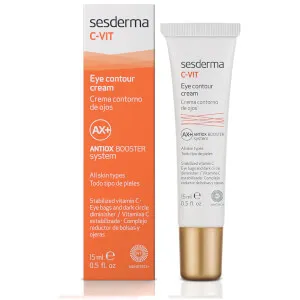
Works for
MoisturizingPalmitoyl tetrapeptide-7, Dipeptide-2 + 15 moreWorks well
“The ingenious eye cream encourages the look of firmer, plumper skin with a rejuvenated glow, allowing you to experience the vibrant, enviable complexion that you truly deserve.”
This product can help improve hydration of the skin with the two types of ingredients.
The first type is called “humectants”:
these ingredients help attract water.
When humectants are on the surface of the skin, they “pull in” the moisture from the outside environment, or from
within deeper layers of the skin. The following ingredients in this product do the job:
glycerin, glycine soja protein.
This product also contains ingredients called “occlusives”. They help reduce the speed with which our skin loses moisture to the outside environment. These ingredients also help soften the upper layer of the skin, so it feels less tight and nicer to the touch. The following ingredients in this product do the job: caprylic/capric triglyceride, cetyl alcohol.
The following ingredients in this product are especially good for supporting the skin barrier and helping with the hydration level: dipeptide-2, palmitoyl dipeptide-5 diaminobutyroyl hydroxythreonine, palmitoyl tetrapeptide-7
Anti-agingPalmitoyl tetrapeptide-7, Palmitoyl dipeptide-5 diaminobutyroyl hydroxythreonine + 3 moreMay help
“The uniquely-blended components within the eye cream encourage the look of an anti-ageing illusion, with the appearance of fine lines, wrinkles and discolouration visibly reduced.”
This product contains dipeptide-2, palmitoyl dipeptide-5 diaminobutyroyl hydroxythreonine, palmitoyl tetrapeptide-7. There is some human evidence that these ingredients help reduce and prevent fine lines and wrinkles and improve skin elasticity and firmness, though it is smaller or less consistent than the evidence for the best anti-aging ingredients.
Evens skin toneResveratrol dimethyl ether, Glycine soja protein + 1 moreNot delivered
“The uniquely-blended components within the eye cream encourage the look of an anti-ageing illusion, with the appearance of fine lines, wrinkles and discolouration visibly reduced.”
This product contains ingredients (glycine soja protein, resveratrol dimethyl ether) that could help reduce hyperpigmentation (for example, post-acne marks or age spots) in theory, but there is not enough evidence that they actually work.
Anti-oxidationSide benefit · Superoxide dismutase, Quercetin + 7 moreWorks well
This product contains antioxidants (superoxide dismutase) that can help neutralize free radicals in skin. By doing so, they can lessen the damage the skin gets from the UV light (sun).
The following ingredients - ginkgo biloba leaf extract, quercetin also can have an antioxidant effect, but there is less evidence to confirm their effectiveness in skin.
Can it cause trouble?
Irritancy7 strong irritants: Melilotus officinalis extract, Citrus aurantium dulcis fruit extract + 5 more — patch-test recommendedHigh risk
Comedogenic1 ingredient rated 2 or more on the 0–5 pore-clogging scale1 flagged


User reviews
Be the first — your take helps the next person decide.
Ingredients
Filter by role to see what each ingredient is doing.
Water~45–55%
Cyclopentasiloxane~6.1–7.5%
- Irritation risk
- Low
A silicone that helps improve the product texture and spreadability. Can absorb oil creating a short-term mattifying effect on the skin
More about CyclopentasiloxanePropanediol~4.1–5%
- Irritation risk
- Low
Acts as a solvent for other ingredients. Speeds up the absorption of other ingredients into the skin
More about PropanediolPentylene glycol~3.2–3.9%
- Irritation risk
- Medium
Used to preserve products, dissolve other ingredients and create a nice product texture
More about Pentylene glycolCaprylic/capric triglyceride~2.5–3%
- Irritation risk
- Medium
A good mix of fatty acids that forms a protective layer on the skin. Improves the shelf life of products. Derived from coconut and glycerin
More about Caprylic/capric triglyceridePropylene glycol~1.9–2.3%
- Irritation risk
- High
Helps oil and water mix together and can enhance the penetration of other ingredients into the skin. It can be irritating
More about Propylene glycolIsostearyl isostearate~1.7–2%
- Irritation risk
- Medium
- Comedogenicity
- 3/5
Helps soften the upper layer of the skin and improve the product texture. It can be comedogenic
More about Isostearyl isostearateGlycerin~1.5–1.8%
- Irritation risk
- Low
One of the best moisturizing ingredients. Naturally present in skin. It attracts water to the upper layer of the skin working as a humectant
More about GlycerinPeg-100 stearate~1.2–1.5%
- Irritation risk
- Low
Helps oil and water mix togehter and creates a nice product texture
More about Peg-100 stearateGlyceryl stearate~0.95–1.2%
- Irritation risk
- Low
An emollient that softens the skin and forms a protective layer on its surface. Helps water and oil mix together
More about Glyceryl stearatePeg-40 hydrogenated castor oil~0.65–1%
- Irritation risk
- Medium
Helps oil and water mix together
More about Peg-40 hydrogenated castor oilGlyceryl behenate~0.6–0.9%
- Irritation risk
- Medium
Used to create a thicker product consistency and help soften the upper layer of the skin
More about Glyceryl behenateCetyl alcohol~0.6–0.9%
- Irritation risk
- Low
A non-drying alcohol that works to soften the skin and stabilize product formulations helping oil and water mix together
More about Cetyl alcoholArachidyl alcohol~0.5–0.75%
- Irritation risk
- Low
Used to soften the upper layer of the skin and create a thicker product consistency
More about Arachidyl alcoholSuperoxide dismutase~0.4–0.6%
- Irritation risk
- Low
An antioxidant enzyme that is naturally present in skin. It can help support skin barrier function and reduce inflammation in skin. It is used in topical medications for inflammatory skin conditions including atopic dermatitis (eczema) and psoriasis. There are three types of natural Superoxide Dismutase in human skin. The compound used in topical treatments and cosmetics are mimics of typically one of these natural variants
More about Superoxide dismutaseResveratrol dimethyl ether~0.4–0.6%
- Irritation risk
- Low
A more stable derivative of anti-oxidant resveratrol. There is not enough research to confirm its efficacy in skin
More about Resveratrol dimethyl etherQuercetin~0.35–0.65%
- Irritation risk
- Low
Might be able to help neutralize free radicals in skin
More about QuercetinPinanediol~0.3–0.6%
- Irritation risk
- Low
Palmitoyl tetrapeptide-7~0.35–0.6%
- Irritation risk
- Low
A type of peptide. Peptides are excellent moisturizers and might be able support collagen production reducing fine lines and wrinkles
More about Palmitoyl tetrapeptide-7Methylsilanol mannuronate~0.25–0.5%
- Irritation risk
- Low
Melilotus officinalis extract~0.25–0.45%
- Irritation risk
- High
A plant extract that might have some anti-oxidant properties. Can be used as a fragrance and can be irritating
More about Melilotus officinalis extractHydrolyzed rice bran protein~0.25–0.45%
- Irritation risk
- Low
Hesperidin methyl chalcone~0.2–0.4%
- Irritation risk
- High
Might help neutralize free radicals in skin. Is claimed to be able to improve the appearance of undereye darkness but evidence is missing. Can be an allergen and cause irritation
More about Hesperidin methyl chalconeGlycine soja protein~0.25–0.5%
- Irritation risk
- Low
A plant extract that helps to attract water to the upper layer of the skin and soften it. It might be helpful in neutralizing free radicals. It might be somewhat helpful for evening out the skin tone. It might be able to support elastin production but solid research is lacking
More about Glycine soja proteinGinkgo biloba leaf extract~0.2–0.4%
- Irritation risk
- High
A plant extract that might help neutralize free radicals and reduce inflammation in skin. It can be irritating
More about Ginkgo biloba leaf extractDipeptide-2~0.2–0.4%
- Irritation risk
- Low
A type of peptide. Peptides are excellent moisturizers and might be able support collagen production reducing fine lines and wrinkles
More about Dipeptide-2Citrus aurantium dulcis fruit extract~0.2–0.4%
- Irritation risk
- High
A plant extract that is used as a fragrance. Can be irritating and lead to photosensitivity
More about Citrus aurantium dulcis fruit extractCamphanediol~0.2–0.4%
- Irritation risk
- Low
3-o-ethyl ascorbic acid~0.2–0.4%
- Irritation risk
- High
A vitamin C derivative that is more stable but less potent than pure form of vitamin C. Can help neutralize free radicals and help reduce hyperpigmentation, but the required concentration is likely to be much higher than for the pure form of vitamin C, limiting the ingredient's effectiveness in products
More about 3-o-ethyl ascorbic acidPalmitoyl dipeptide-5 diaminohydroxybutyrate~0.2–0.4%
- Irritation risk
- Low
Palmitoyl dipeptide-5 diaminobutyroyl hydroxythreonine~0.2–0.4%
- Irritation risk
- Low
Cyclohexasiloxane~0.25–0.5%
- Irritation risk
- Low
A silicone that serves as an emollient. Helps create a nice non-greasy feels
More about CyclohexasiloxaneBehenyl alcohol~0.3–0.5%
- Irritation risk
- Low
Non-drying alcohol that helps water and oil mix together. Also serves as an emollient
More about Behenyl alcoholTocopheryl acetate~0.25–0.45%
- Irritation risk
- Medium
A more stable but less bio-available form of vitamin E compared to Tocopherol. Might help moisturize and protect the skin from free radicals, but mostly used in low concentrations to stabilize other ingredients.
More about Tocopheryl acetateAmmonium acryloyldimethyltaurate/vp copolymer~0.25–0.4%
- Irritation risk
- Low
Increases thickness of a product. Texture enhancer for oil-in-water emulsions
More about Ammonium acryloyldimethyltaurate/vp copolymerLecithin~0.25–0.5%
- Irritation risk
- Low
Used mostly for creating emulsions - helping oil and water mix together. Helps soften the upper layer of the skin
More about LecithinArachidyl glucoside~0.25–0.45%
Alcohol~0.25–0.4%
- Irritation risk
- High
Can be drying and contribute to skin irritation. Used in formulars to dissolve other ingredients, create a thinner product consistency or for its antibacterial properties
More about AlcoholMica~0.25–0.5%
- Irritation risk
- Low
Creates an illusion of smoother and more radiant skin tone. Adds shimmer to the skin by reflecting light
More about MicaTitanium dioxide~0.3–0.55%
- Irritation risk
- Low
Works as a UV filter when used in high concentrations. It is photostable and is effective mostly against the UVB light, with some protection in the UVA range. In small concentrations, used for its ability to improve the color of cosmetic products. Is usually well tolerated by the skin
More about Titanium dioxideTriethanolamine~0.25–0.45%
- Irritation risk
- Medium
Used to adjust pH of the product and can help improve the product's smell
More about TriethanolaminePolysorbate 20~0.25–0.45%
Dimethicone/vinyl dimethicone crosspolymer~0.25–0.4%
- Irritation risk
- Low
Used to stabilize product formulations and create a nice product texture
More about Dimethicone/vinyl dimethicone crosspolymerBht~0.2–0.4%
Glyceryl polyacrylate~0.25–0.45%
- Irritation risk
- Low
Helps to create a nice product texture and spread the product more easily on the skin
More about Glyceryl polyacrylateSteareth-20~0.3–0.55%
Disodium edta~0.2–0.4%
Butylene glycol~0.2–0.4%
- Irritation risk
- Low
Used to create a nice product texture and help delivery of other ingredients. Might be somewhat helpful in attracting water to the upper layer of the skin
More about Butylene glycolSodium chloride~0.25–0.45%
- Irritation risk
- Low
Used to stabilize mixtures of oil and water, and create thicker, gel-like product textures
More about Sodium chlorideSodium cholate~0.2–0.4%
- Irritation risk
- Low
Sodium citrate~0.2–0.4%
- Irritation risk
- Medium
Helps to control the skin's pH level. Maintains the skin's natural film of amino-lactic acids and oils. Helps to preserve products
More about Sodium citrateChlorhexidine digluconate~0.15–0.3%
Citric acid~0.25–0.4%
- Irritation risk
- Medium
Can work as an exfoliant but is typically used to adjust the product pH
More about Citric acidSodium dextran sulfate~0.2–0.4%
- Irritation risk
- Low
Sodium hydroxide~0.2–0.4%
Phenoxyethanol~0.2–0.4%
- Irritation risk
- Low
A preservative. It helps prevent bacterial growth in cosmetic products
More about PhenoxyethanolEthylhexylglycerin~0.2–0.35%
Potassium sorbate~0.2–0.35%
Sodium benzoate~0.15–0.3%
Sorbic acid~0.15–0.3%
Parfum~0.15–0.25%
- Irritation risk
- High
An aromatic blend of unspecified and possibly irritating ingredients
More about ParfumCitronellyl methylcrotonate~0.15–0.25%
- Irritation risk
- Low
Limonene~0.15–0.3%
- Irritation risk
- High
A common frangrance that can easily irritate skin, especially if exposed to air, light or heat
More about LimoneneLinalool~0.15–0.25%
Citral~0.1–0.15%
Ci 15985~0.1–0.15%
Ingredient list view
Water, Cyclopentasiloxane, Propanediol, Pentylene glycol, Caprylic/capric triglyceride, Propylene glycol, Isostearyl isostearate, Glycerin, Peg-100 stearate, Glyceryl stearate, Peg-40 hydrogenated castor oil, Glyceryl behenate, Cetyl alcohol, Arachidyl alcohol, Superoxide dismutase, Resveratrol dimethyl ether, Quercetin, Pinanediol, Palmitoyl tetrapeptide-7, Methylsilanol mannuronate, Melilotus officinalis extract, Hydrolyzed rice bran protein, Hesperidin methyl chalcone, Glycine soja protein, Ginkgo biloba leaf extract, Dipeptide-2, Citrus aurantium dulcis fruit extract, Camphanediol, 3-o-ethyl ascorbic acid, Palmitoyl dipeptide-5 diaminohydroxybutyrate, Palmitoyl dipeptide-5 diaminobutyroyl hydroxythreonine, Cyclohexasiloxane, Behenyl alcohol, Tocopheryl acetate, Ammonium acryloyldimethyltaurate/vp copolymer, Lecithin, Arachidyl glucoside, Alcohol, Mica, Titanium dioxide, Triethanolamine, Polysorbate 20, Dimethicone/vinyl dimethicone crosspolymer, Bht, Glyceryl polyacrylate, Steareth-20, Disodium edta, Butylene glycol, Sodium chloride, Sodium cholate, Sodium citrate, Chlorhexidine digluconate, Citric acid, Sodium dextran sulfate, Sodium hydroxide, Phenoxyethanol, Ethylhexylglycerin, Potassium sorbate, Sodium benzoate, Sorbic acid, Parfum, Citronellyl methylcrotonate, Limonene, Linalool, Citral, Ci 15985
Compare prices
Retailers ranked by price — lowest first.
Affiliate links · As an Amazon Associate, WIMJ earns from qualifying purchases.
Worth comparing, line by line.
Match % combines shared ingredients, the first five ingredients, shared actives and hero ingredients, irritancy (lower counts in the alternative's favour), texture and body area. Only products in the same routine step are compared.
| SesdermaC-VIT Eye Contour CreamYOUR PRODUCT | Dr Dennis GrossC + Collagen Brighten + Firm Eye Cream | Drunk ElephantC-Tango Multivitamin Eye Cream | StriVectinAnti-Wrinkle Intensive Eye Concentrate for Wrinkles Plus | |
|---|---|---|---|---|
| Match | — | 58% | 56% | 50% |
| Price | $44.04 | $65.00+$20.96 | $60.84+$16.80 | $15.00−$29.04 |
| Shared key ingredients | — | 6 of 11 | 7 of 11 | 2 of 11 |
| Key difference | — | Niacinamide | Ascorbyl Glucoside | Adenosine |
| Irritancy | High | Medium | Medium | Medium |
| Drying alcohol | Contains drying alcohol | — | — | — |
| View product | Shop | Shop | Shop |


More alternatives: Filorga OPTIM-EYES 3-in-1 Eye Contour CreamLaboratoire ACM Duolys Eye Contour Cream
Sources cited in this review
Every concentration estimate and effectiveness label is anchored to one of these 22 studies and safety reviews.
- 1Surfactants and experimental irritant contact dermatitisncbi.nlm.nih.gov
- 2Propylene Glycolpubmed.ncbi.nlm.nih.gov
- 3Skin-sensitizing and irritant properties of propylene glycolonlinelibrary.wiley.com
- 4
- 5
- 6

Affiliate links · As an Amazon Associate, WIMJ earns from qualifying purchases.