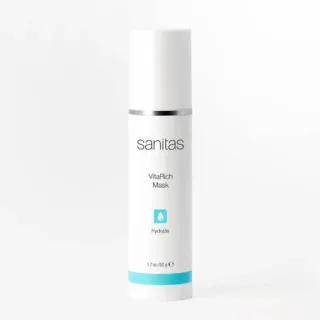
Works for
MoisturizingGlycerin, Sodium pca + 4 moreWorks
“A creamy, nourishing mask for dry skin that infuses rich, fatty emollients and humectants to banish dryness and soothe itchy, flaky skin.”
This product can help improve hydration of the skin with the two types of ingredients.
The first type is called “humectants”:
these ingredients help attract water.
When humectants are on the surface of the skin, they “pull in” the moisture from the outside environment, or from
within deeper layers of the skin. The following ingredients in this product do the job:
glycerin, sodium hyaluronate.
This product also contains ingredients called “occlusives”. They help reduce the speed with which our skin loses moisture to the outside environment. These ingredients also help soften the upper layer of the skin, so it feels less tight and nicer to the touch. The following ingredients in this product do the job: helianthus annuus seed oil, squalane.
Anti-agingSide benefit · Retinyl palmitate, Tetrahexyldecyl ascorbateMay help
This product contains retinyl palmitate. There is some human evidence that this ingredient helps reduce and prevent fine lines and wrinkles and improve skin elasticity and firmness, though it is smaller or less consistent than the evidence for the best anti-aging ingredients.
Evens skin toneSide benefit · Retinyl palmitate, Tetrahexyldecyl ascorbateMay help
The following ingredient (ingredients) in this product might be helpful, but there is no evidence to confirm that it actually works: retinyl palmitate.
Can it cause trouble?
Irritancy2 strong irritants: Retinyl palmitate, Santalum album extractMedium risk
ComedogenicClean of flagged comedogenic ingredientsNone flagged
User reviews
Be the first — your take helps the next person decide.
Ingredients
Filter by role to see what each ingredient is doing.
Water~40–60%
Glycerin~4.3–6.4%
- Irritation risk
- Low
One of the best moisturizing ingredients. Naturally present in skin. It attracts water to the upper layer of the skin working as a humectant
More about GlycerinGlyceryl polyacrylate~3.7–5.5%
- Irritation risk
- Low
Helps to create a nice product texture and spread the product more easily on the skin
More about Glyceryl polyacrylateSodium pca~2.6–3.9%
- Irritation risk
- Low
Naturally present in skin and helps to attract water to its upper layer
More about Sodium pcaSodium hyaluronate~2–3%
- Irritation risk
- Low
One of the best moisturizing ingredients. Attracts water into the upper layer of the skin
More about Sodium hyaluronateSqualane~1.7–2.6%
- Irritation risk
- Low
An oil naturally present in skin. Works as an emollient to soften the skin and form a protective layer on its surface without a greasy feeling.
More about SqualaneTocopheryl acetate~1.3–1.9%
- Irritation risk
- Medium
A more stable but less bio-available form of vitamin E compared to Tocopherol. Might help moisturize and protect the skin from free radicals, but mostly used in low concentrations to stabilize other ingredients.
More about Tocopheryl acetateRetinyl palmitate~1.1–1.6%
- Irritation risk
- High
Three steps removed from the active form of vitamin A - retinoic acid. To have an effect in the skin, it first needs to be converted twice to become the retinoic acid. This means it is less potent than retinol, but could also be less irritating. Once converted to the retinoic acid in the skin, it helps against all signs of aging, improves skin cell turnover and helps fight blemishes and clogged pores. However, in many cosmetic formulations, it is used in a concentration that is too low to have the full effect
More about Retinyl palmitateCholecalciferol~1–1.45%
- Irritation risk
- Low
Tetrahexyldecyl ascorbate~0.8–1.2%
- Irritation risk
- Medium
Being a lipid soluble form of vitamin C, it is more stable than ascorbic acid, but still degrades quickly and needs to be stabilized in a formulation with another ingredient. It is claimed to penetrate skin better than pure vitamin C and have the the similar benefits, but solid studies of its effectiveness are lacking. Is likely to require a higher concentration in a product than pure vitamin C to be effective. It might be able to help reduce pore clogging.
More about Tetrahexyldecyl ascorbateHordeum vulgare extract~0.5–1.2%
- Irritation risk
- Medium
A plant extract that might have some anti-oxidant properties. Avoid if you are sensitive to gluten
More about Hordeum vulgare extractPhytonadione~0.45–1%
- Irritation risk
- Low
Santalum album extract~0.2–0.8%
Phellodendron amurense bark extract~0.2–0.75%
- Irritation risk
- Medium
A plant extract that might have an anti-inflammatory effect
More about Phellodendron amurense bark extractHelianthus annuus seed oil~0.2–0.75%
- Irritation risk
- Low
A great emollient due to its high linoleic acid content. One of the most effective plant oils in helping skin hydration and repairing skin barrier function
More about Helianthus annuus seed oilPolyacrylamide~0.15–0.55%
- Irritation risk
- Medium
Used to improve product texture and help oil and water mix together
More about PolyacrylamideC13-14 isoparaffin~0.15–0.55%
- Irritation risk
- Low
Helps soften the upper layer of the skin, dissolve other ingredients and create a thicker product consistency
More about C13-14 isoparaffinLaureth-7~0.05–0.25%
Ethylhexylglycerin~0.05–0.15%
Methylpropanediol~0.05–0.1%
Caprylhydroxamic acid~0.01–0.05%
Ingredient list view
Water, Glycerin, Glyceryl polyacrylate, Sodium pca, Sodium hyaluronate, Squalane, Tocopheryl acetate, Retinyl palmitate, Cholecalciferol, Tetrahexyldecyl ascorbate, Hordeum vulgare extract, Phytonadione, Santalum album extract, Phellodendron amurense bark extract, Helianthus annuus seed oil, Polyacrylamide, C13-14 isoparaffin, Laureth-7, Ethylhexylglycerin, Methylpropanediol, Caprylhydroxamic acid
Compare prices
Retailers ranked by price — lowest first.

Worth comparing, line by line.
Match % combines shared ingredients, the first five ingredients, shared actives and hero ingredients, irritancy (lower counts in the alternative's favour), texture and body area. Only products in the same routine step are compared.
| Sanitas SkincareVitaRich MaskYOUR PRODUCT | Goldfaden MDRadiance Whip | SkinCeuticalsMoisturize Hydrating B5 Mask | EviDenS de BeautéThe 7 Minutes Brightening Anti-aging Mask | |
|---|---|---|---|---|
| Match | — | 40% | 39% | 38% |
| Price | $33.00 | $37.77+$4.77 | $79.48+$46.48 | — |
| Shared key ingredients | — | 4 of 7 | 3 of 7 | 5 of 7 |
| Key difference | — | Panthenol | Panthenol | Alanine |
| Irritancy | Medium | Low | Low | Medium |
| Drying alcohol | — | — | — | Contains drying alcohol |
| View product | Shop | Shop | Shop |

More alternatives: Balea Retinol Face MaskBotanical Lab Rose Overnight Hydrating Mask
Sources cited in this review
Every concentration estimate and effectiveness label is anchored to one of these 14 studies and safety reviews.
- 1
- 2Hyaluronic acid: A key molecule in skin agingncbi.nlm.nih.gov
- 3
- 4
- 5
- 6Celiac Disease & Skin Care Productsbadgut.org

Affiliate links · As an Amazon Associate, WIMJ earns from qualifying purchases.