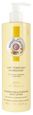
Roger & Gallet Bois d'Orange Invigorating & Hydrating Body Lotion
Works for
1 of 1 advertised claim delivered
Moisturizing14 ingredients credited for this claimGood support
“Bois d'Orange Invigorating & Hydrating Body Lotion”
This product can help improve hydration of the skin with the two types of ingredients.
The first type is called “humectants”:
these ingredients help attract water.
When humectants are on the surface of the skin, they “pull in” the moisture from the outside environment, or from
within deeper layers of the skin. The following ingredients in this product do the job:
glycerin, caprylyl glycol.
This product also contains ingredients called “occlusives”. They help reduce the speed with which our skin loses moisture to the outside environment. These ingredients also help soften the upper layer of the skin, so it feels less tight and nicer to the touch. The following ingredients in this product do the job: myristyl myristate, limnanthes alba seed oil.
Can it cause trouble?
Irritancy7 strong irritants: Alcohol denat., Parfum + 5 more — patch-test recommendedHigh risk
Comedogenic4 ingredients rated 2 or more on the 0–5 pore-clogging scale4 flagged
User reviews
Be the first — your take helps the next person decide.
Ingredients
Filter by role to see what each ingredient is doing.
Water~40–60%
Glycerin~3.9–5.8%
- Irritation risk
- Low
One of the best moisturizing ingredients. Naturally present in skin. It attracts water to the upper layer of the skin working as a humectant
More about GlycerinPropanediol~3.2–4.9%
- Irritation risk
- Low
Acts as a solvent for other ingredients. Speeds up the absorption of other ingredients into the skin
More about PropanediolIsopropyl palmitate~2.5–3.8%
- Irritation risk
- Medium
- Comedogenicity
- 3/5
Helps soften the upper layer of the skin and create a thicker product consistency
More about Isopropyl palmitateAlcohol denat.~2–2.9%
- Irritation risk
- High
Produces temporary toning effect. Can help dissolve other ingredients or preserve products
More about Alcohol denat.Cetyl alcohol~1.6–2.4%
- Irritation risk
- Low
A non-drying alcohol that works to soften the skin and stabilize product formulations helping oil and water mix together
More about Cetyl alcoholParfum~1.3–1.9%
- Irritation risk
- High
An aromatic blend of unspecified and possibly irritating ingredients
More about ParfumMyristyl myristate~1.3–1.9%
- Irritation risk
- Medium
- Comedogenicity
- 3/5
An emollient. Is not recommended for acne-prone skin as it can be comedogenic
More about Myristyl myristateOlea europaea fruit oil~0.95–1.45%
- Irritation risk
- Medium
An emollient that helps soften the skin but is not effective for restoring its barrier function. Might be helpful to calm down inflammation
More about Olea europaea fruit oilPersea gratissima oil~0.6–1.35%
- Irritation risk
- Medium
An emollient that helps soften the skin and could be helpful in repairing its barrier function
More about Persea gratissima oilZea mays starch~0.4–0.9%
- Irritation risk
- Medium
- Comedogenicity
- 3/5
Used to thicken the product's consistency
More about Zea mays starchAloe barbadensis leaf juice~0.2–0.8%
- Irritation risk
- Medium
Traditionally used to treat sunburns, dermatitis and inflammation, but evidence for its effectiveness is lacking. The extract can contain humectants that help attract water into the skin
More about Aloe barbadensis leaf juiceLimonene~0.15–0.5%
- Irritation risk
- High
A common frangrance that can easily irritate skin, especially if exposed to air, light or heat
More about LimoneneCaprylyl glycol~0.15–0.5%
- Irritation risk
- Medium
Helps preserve products and creates a nice product texture
More about Caprylyl glycolCarbomer~0.1–0.45%
- Irritation risk
- Low
Helps create a thicker or gel-like product texture. It is not a surfactant but can be used in gentle cleansing formulations
More about CarbomerLimnanthes alba seed oil~0.15–0.55%
- Irritation risk
- Low
This oil's cmposition is closest to rapeseed oil. It is a very stable oil and serves as an emoillient
More about Limnanthes alba seed oilButyl methoxydibenzoylmethane~0.2–0.8%
- Irritation risk
- Medium
Avobenzone. An organic, or so-called "chemical" UV filter. Protects against both UVA and UVB rays. Needs to be combined with other filters in a formulation to be stable.
More about Butyl methoxydibenzoylmethanePolyglyceryl-3 methylglucose distearate~0.15–0.55%
- Irritation risk
- Medium
Helps water and oil mix together
More about Polyglyceryl-3 methylglucose distearateTocopheryl acetate~0.1–0.45%
- Irritation risk
- Medium
A more stable but less bio-available form of vitamin E compared to Tocopherol. Might help moisturize and protect the skin from free radicals, but mostly used in low concentrations to stabilize other ingredients.
More about Tocopheryl acetateEthylhexyl methoxycinnamate~0.2–0.75%
- Irritation risk
- High
Octinoxate. When used in higher concentrations, works as a sunscreen protecting the skin from UVB rays. When used in lower concentration, helps to preserve the product formulation. Is shown to be harmful to coral reefs - consider avoiding bathing in coral reef areas when wearing a product with this ingredient. It can be irritating
More about Ethylhexyl methoxycinnamateBenzoic acid~0.1–0.35%
Sodium polyacrylate~0.1–0.4%
- Irritation risk
- Low
Used to create a gel-like product texture, as well as to stabilize emulsions
More about Sodium polyacrylatePassiflora edulis seed oil~0.1–0.35%
- Irritation risk
- High
A good emollient helping to soften the skin. Might have some anti-oxidant properties. Adds a fragrance to the product
More about Passiflora edulis seed oilPrunus armeniaca kernel oil~0.1–0.35%
- Irritation risk
- Medium
An emollient that helps soften the skin
More about Prunus armeniaca kernel oilZea mays oil~0.05–0.2%
- Irritation risk
- Low
- Comedogenicity
- 3/5
A good moisturizing plant oil. Due to the high linoleic acid content, it helps soften the upper layer of the skin, reduce water loss and support skin barrier function
More about Zea mays oilOryza sativa bran oil~0.1–0.35%
- Irritation risk
- Low
Helps soften the upper layer of the skin and might have some anti-oxidant properties
More about Oryza sativa bran oilLinalool~0.05–0.15%
C12-13 alkyl lactate~0.05–0.3%
- Irritation risk
- Low
Hexyl cinnamal~0.05–0.15%
Sodium hydroxide~0.05–0.2%
Citral~0.05–0.2%
Benzyl alcohol~0.05–0.15%
- Irritation risk
- High
A preservative. Can be used to mask unpleasant smell. Can be irritating
More about Benzyl alcoholCitrus aurantium dulcis juice~0.05–0.25%
- Irritation risk
- High
Sodium benzoate~0.05–0.15%
Potassium sorbate~0.05–0.2%
Citric acid~0.05–0.15%
- Irritation risk
- Medium
Can work as an exfoliant but is typically used to adjust the product pH
More about Citric acidTocopherol~0.05–0.15%
- Irritation risk
- Low
Pure form of vitamin E. Can help moisturise and protect the skin from free radicals. Often used to help stabilise other ingredients or the formula itself
More about TocopherolBht~0.01–0.05%
Ascorbyl palmitate~0.01–0.05%
- Irritation risk
- Medium
Being a lipid soluble form of vitamin C, it is more stable and can penetrate the skin better than L-Ascorbic acid. It is effective in protecting the skin from free radicals, as well as evening the skin tone, but is less effective in stimulating collagen production compared to L-Ascorbic acid.
More about Ascorbyl palmitateIngredient list view
Water, Glycerin, Propanediol, Isopropyl palmitate, Alcohol denat., Cetyl alcohol, Parfum, Myristyl myristate, Olea europaea fruit oil, Persea gratissima oil, Zea mays starch, Aloe barbadensis leaf juice, Limonene, Caprylyl glycol, Carbomer, Limnanthes alba seed oil, Butyl methoxydibenzoylmethane, Polyglyceryl-3 methylglucose distearate, Tocopheryl acetate, Ethylhexyl methoxycinnamate, Benzoic acid, Sodium polyacrylate, Passiflora edulis seed oil, Prunus armeniaca kernel oil, Zea mays oil, Oryza sativa bran oil, Linalool, C12-13 alkyl lactate, Hexyl cinnamal, Sodium hydroxide, Citral, Benzyl alcohol, Citrus aurantium dulcis juice, Sodium benzoate, Potassium sorbate, Citric acid, Tocopherol, Bht, Ascorbyl palmitate
Compare prices
Retailers ranked by price — lowest first.
Sources cited in this review
Every concentration estimate and effectiveness label is anchored to one of these 7 studies and safety reviews.
- 1
- 2Final Report on the Safety Assessment of Isopropyl Isostearatejournals.sagepub.com
- 3Use of “natural” oils for moisturization: Review of olive, coconut, and sunflower seed oilonlinelibrary.wiley.com
- 4Content of fatty acids in corn (Zea mays L.) oil from Ecuadorresearchgate.net
- 5
- 6Vitamin E in dermatologyncbi.nlm.nih.gov

Affiliate links · As an Amazon Associate, WIMJ earns from qualifying purchases.