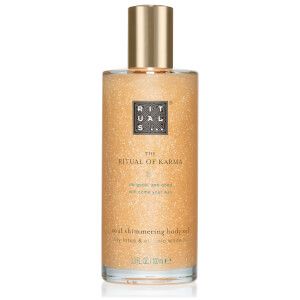
RITUALS The Ritual of Karma Body Shimmer Oil
Works for
1 of 1 advertised claim delivered
Moisturizing11 ingredients credited for this claimGood evidence
“The non-sticky and non-greasy formula feels light and hydrating on the skin with a unique silicone-free dry texture.”
This product can help soften the skin and reduce its moisture loss with emollients and occlusives: caprylic/capric triglyceride, helianthus annuus seed oil.
Keep in mind that this product does not contain effective ingredients to attract water to the upper layer of the skin. This is why an additional product with humectants like glycerin or hyaluronic acid can be helpful (apply it before this product for the best results).
Anti-oxidationNot advertised by the brand · 4 ingredients credited for this claimModerate evidence
This product contains antioxidants (camellia sinensis leaf extract) that might be able to help neutralize free radicals in skin to lessen the damage it gets from the UV light (sun). There is not enough evidence to confirm their effectiveness in skin though.
Can it cause trouble?
Irritancy10 strong irritants: Nelumbo nucifera flower extract, Parfum + 8 more — patch-test recommendedHigh risk
ComedogenicClean of flagged comedogenic ingredientsNone flagged
User reviews
Be the first — your take helps the next person decide.
Ingredients
Filter by role to see what each ingredient is doing.
Ethylhexyl stearate~22–33%
- Irritation risk
- Low
Helps soften the upper layer of the skin
More about Ethylhexyl stearateCaprylic/capric triglyceride~5.6–8.5%
- Irritation risk
- Medium
A good mix of fatty acids that forms a protective layer on the skin. Improves the shelf life of products. Derived from coconut and glycerin
More about Caprylic/capric triglycerideIsohexadecane~3.4–5.1%
- Irritation risk
- Low
Improves the texture of the product and helps soften the skin. Helps oil and water mix together and can be used as a cleansing agent
More about IsohexadecanePolyamide-8~3.8–5.7%
- Irritation risk
- Low
Olea europaea fruit oil~2.7–4%
- Irritation risk
- Medium
An emollient that helps soften the skin but is not effective for restoring its barrier function. Might be helpful to calm down inflammation
More about Olea europaea fruit oilCarthamus tinctorius seed oil~2.1–3.2%
- Irritation risk
- Low
An emollient that helps soften the skin and might help calm down inflammation
More about Carthamus tinctorius seed oilSimmondsia chinensis seed oil~1.8–2.7%
- Irritation risk
- Medium
Softens the upper layer of skin and helps restore the healthy skin barrier. Has shown to help calm down inflammation in skin. It is a stable oil, meaning that it retains its properties even when exposed to air.
More about Simmondsia chinensis seed oilHelianthus annuus seed oil~1.5–2.3%
- Irritation risk
- Low
A great emollient due to its high linoleic acid content. One of the most effective plant oils in helping skin hydration and repairing skin barrier function
More about Helianthus annuus seed oilNelumbo nucifera flower extract~1–1.5%
Camellia sinensis leaf extract~0.9–1.35%
- Irritation risk
- Low
Can contain potent anti-oxidant compounds (abbreviated ECG, GCG, EGC, and EGCG) that might help protect the skin from free radicals. Can help calm down inflammation and has some anti-bacterial properties. Unfortunately, these antioxidants are unstable and lose their effectiveness very quickly in products. The concentration of the antioxidant compounds in the extract also tends to be low to be effective in topical formulation
More about Camellia sinensis leaf extractHelianthus annuus hybrid oil~0.55–1.35%
- Irritation risk
- Low
Helps soften the upper layer of the skin
More about Helianthus annuus hybrid oilTocopherol~0.45–1%
- Irritation risk
- Low
Pure form of vitamin E. Can help moisturise and protect the skin from free radicals. Often used to help stabilise other ingredients or the formula itself
More about TocopherolDihydroxy methylchromonyl palmitate~0.4–0.9%
- Irritation risk
- High
A self-tanning agent. It reacts with amino-acids in the surface of the skin to produce a brown pigment. Often used together with another self-tanning ingredient, dihydroxyacetone
More about Dihydroxy methylchromonyl palmitatePentaerythrityl tetra-di-t-butyl hydroxyhydrocinnamate~0.35–0.85%
- Irritation risk
- Low
Used to increase stability of product formulations
More about Pentaerythrityl tetra-di-t-butyl hydroxyhydrocinnamateParfum~0.3–0.7%
- Irritation risk
- High
An aromatic blend of unspecified and possibly irritating ingredients
More about ParfumBenzyl salicylate~0.3–0.7%
Citral~0.2–0.8%
Citronellol~0.15–0.7%
Hexyl cinnamal~0.2–0.75%
Linalool~0.15–0.65%
Butylphenyl methylpropional~0.15–0.6%
- Irritation risk
- High
A fragrance. Can trigger allergic reactions and be irritating
More about Butylphenyl methylpropionalAlpha-isomethyl ionone~0.15–0.6%
- Irritation risk
- High
A fragrance. Potential allergen and can be irritating
More about Alpha-isomethyl iononeLimonene~0.15–0.55%
- Irritation risk
- High
A common frangrance that can easily irritate skin, especially if exposed to air, light or heat
More about LimoneneSynthetic fluorphlogopite~0.15–0.65%
- Irritation risk
- Low
A mineral that is used as an optical filter (makes the skin looks nicer through light reflection) and to improve the texture of cosmetic products
More about Synthetic fluorphlogopiteSilica~0.3–0.75%
Tin oxide~0.3–0.7%
- Irritation risk
- Low
A colorant that can add a pearl-like appearance to the formulation
More about Tin oxideCi 77491~0.1–0.4%
- Irritation risk
- Low
A red colorant made of iron oxide. Typically is not irritating
More about Ci 77491Iron oxides~0.1–0.35%
- Irritation risk
- Low
An umbrella term for the following three colorants: CI 77491, CI 77492, CI 77499. They might be able to offer some protection against visible light, but the degree of the protection is not clear
More about Iron oxidesCi 77891~0.1–0.3%
- Irritation risk
- Low
Titanium dioxide~0.1–0.4%
- Irritation risk
- Low
Works as a UV filter when used in high concentrations. It is photostable and is effective mostly against the UVB light, with some protection in the UVA range. In small concentrations, used for its ability to improve the color of cosmetic products. Is usually well tolerated by the skin
More about Titanium dioxideIngredient list view
Ethylhexyl stearate, Caprylic/capric triglyceride, Isohexadecane, Polyamide-8, Olea europaea fruit oil, Carthamus tinctorius seed oil, Simmondsia chinensis seed oil, Helianthus annuus seed oil, Nelumbo nucifera flower extract, Camellia sinensis leaf extract, Helianthus annuus hybrid oil, Tocopherol, Dihydroxy methylchromonyl palmitate, Pentaerythrityl tetra-di-t-butyl hydroxyhydrocinnamate, Parfum, Benzyl salicylate, Citral, Citronellol, Hexyl cinnamal, Linalool, Butylphenyl methylpropional, Alpha-isomethyl ionone, Limonene, Synthetic fluorphlogopite, Silica, Tin oxide, Ci 77491, Iron oxides, Ci 77891, Titanium dioxide
Compare prices
Retailers ranked by price — lowest first.
Affiliate links · prices updated regularly · As an Amazon Associate, WIMJ earns from qualifying purchases.
Sources cited in this review
Every concentration estimate and effectiveness label is anchored to one of these 9 studies and safety reviews.
- 1Use of “natural” oils for moisturization: Review of olive, coconut, and sunflower seed oilonlinelibrary.wiley.com
- 2
- 3
- 4Effect of topically applied lipids on surfactant-irritated skinonlinelibrary.wiley.com
- 5
- 6Vitamin E in dermatologyncbi.nlm.nih.gov

Affiliate links · As an Amazon Associate, WIMJ earns from qualifying purchases.