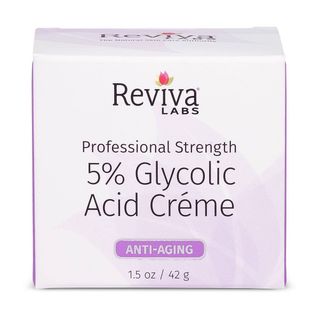
Works for
3 of 3 advertised claims delivered
Evens skin tone2 ingredients credited for this claimStrong support
“It helps diminishes the visible signs of aging, smoothing lines and wrinkles, while helping to brighten discoloration or spots.”
This product can help reduce hypepigmentation and even out the skin tone because it contains the following effective ingredients: glycolic acid
The following ingredient (ingredients) in this product might be helpful, but there is no evidence to confirm that it actually can help even out the skin tone: retinyl palmitate.
Keep in mind that you would need to apply any topical skincare targetted at hypigmentation consistently for a couple of months to get a result. No topical skincare product can help get rid of hyperpigmentation (including post-acne marks and age spots) instantly.
Anti-aging3 ingredients credited for this claimStrong support
“It helps diminishes the visible signs of aging, smoothing lines and wrinkles, while helping to brighten discoloration or spots.”
This product can help reduce and prevent fine lines and wrinkles, improve skin elasticity and firmness because it contains glycolic acid.
These ingredients in the product can also be helpful, even though there is less evidence for their effectiveness: retinyl palmitate.
Keep in mind that it typically takes at least 6 weeks to notice any results because the changes that are needed to improve fine lines and elasticity happen in the deeper layers of the skin. No topical anti-aging product can “erase” wrinkles or fully reverse signs of aging.
Exfoliation2 ingredients credited for this claimStrong support
“Glycolic Acid in a Natural Base Reviva's 5% Glycolic Acid Creme uses 100% glycolic extract in an all-natural base, with no mineral oil or any other petrolatum derivatives, providing a mild and non-drying exfoliating action.”
This product can help exfoliate the skin. In other words, it helps break down the bonds between dead cells on the surface of the skin and speed up the skin turnover. Skin often appears softer and brighter after exfoliation, but overdoing it can result in disrupted skin barrier. The following ingredient is doing the exfoliating job in this product: glycolic acid.
MoisturizingNot advertised by the brand · 11 ingredients credited for this claimGood support
This product can help improve hydration of the skin with the two types of ingredients.
The first type is called “humectants”:
these ingredients help attract water.
When humectants are on the surface of the skin, they “pull in” the moisture from the outside environment, or from
within deeper layers of the skin. The following ingredients in this product do the job:
glycerin, honey.
This product also contains ingredients called “occlusives”. They help reduce the speed with which our skin loses moisture to the outside environment. These ingredients also help soften the upper layer of the skin, so it feels less tight and nicer to the touch. The following ingredients in this product do the job: caprylic/capric triglyceride, helianthus annuus seed oil.
Can it cause trouble?
Irritancy5 strong irritants: Retinyl palmitate, Citrus limon peel oil + 3 more — patch-test recommendedHigh risk
Comedogenic1 ingredient rated 2 or more on the 0–5 pore-clogging scale1 flagged

User reviews
Be the first — your take helps the next person decide.
Ingredients
Filter by role to see what each ingredient is doing.
Water~45–55%
Caprylic/capric triglyceride~6.8–8.3%
- Irritation risk
- Medium
A good mix of fatty acids that forms a protective layer on the skin. Improves the shelf life of products. Derived from coconut and glycerin
More about Caprylic/capric triglycerideGlycolic acid~4.5–5.5%
- Irritation risk
- High
An alpha-hydroxy acid (AHA) that helps to remove the dead skin cells on the surface of the skin reveling a more even, smoother complexation. It is also able to stimulate collagen production with long-term use. Could help to reduce pore congestion. It can be irritating to the skin. Apply sunscreen daily if using products with glycolic acid
More about Glycolic acidGlycol distearate~2.9–3.6%
- Irritation risk
- Medium
Helps water and oil mix together
More about Glycol distearateGlycerin~2.5–3.1%
- Irritation risk
- Low
One of the best moisturizing ingredients. Naturally present in skin. It attracts water to the upper layer of the skin working as a humectant
More about GlycerinCetearyl alcohol~2–2.5%
- Irritation risk
- Low
- Comedogenicity
- 2/5
A non-drying alcohol. Works as an emollient. Helps water and oil mix together and creates a nice product texture
More about Cetearyl alcoholStearic acid~1.8–2.2%
- Irritation risk
- Low
Helps oil and water mix together and works as an emollient
More about Stearic acidTocopherol~1.4–1.7%
- Irritation risk
- Low
Pure form of vitamin E. Can help moisturise and protect the skin from free radicals. Often used to help stabilise other ingredients or the formula itself
More about TocopherolRetinyl palmitate~1.2–1.4%
- Irritation risk
- High
Three steps removed from the active form of vitamin A - retinoic acid. To have an effect in the skin, it first needs to be converted twice to become the retinoic acid. This means it is less potent than retinol, but could also be less irritating. Once converted to the retinoic acid in the skin, it helps against all signs of aging, improves skin cell turnover and helps fight blemishes and clogged pores. However, in many cosmetic formulations, it is used in a concentration that is too low to have the full effect
More about Retinyl palmitateHelianthus annuus seed oil~1–1.2%
- Irritation risk
- Low
A great emollient due to its high linoleic acid content. One of the most effective plant oils in helping skin hydration and repairing skin barrier function
More about Helianthus annuus seed oilOlea europaea fruit oil~0.7–1.1%
- Irritation risk
- Medium
An emollient that helps soften the skin but is not effective for restoring its barrier function. Might be helpful to calm down inflammation
More about Olea europaea fruit oilAloe barbadensis leaf juice powder~0.6–0.85%
- Irritation risk
- Medium
Traditionally used to treat sunburns, dermatitis and inflammation, but evidence for its effectiveness is lacking. The extract can contain humectants that help attract water into the skin
More about Aloe barbadensis leaf juice powderCitrus limon peel oil~0.5–0.75%
Honey~0.45–0.7%
- Irritation risk
- Low
Helps attract water to the skin and might have some anti-bacterial properties. Can be an allergen
More about HoneyRosa damascena extract~0.45–0.65%
- Irritation risk
- High
Oil of a very fragrant pink rose used as fragrance in cosmetics. Extensive research has shown it has mixed benefits. In the pro column, inhaling this flower’s scent seems to have relaxing properties and the plant’s petals contain skin-soothing and antioxidant compounds that can benefit skin. On the flipside, the numerous chemicals that create this rose’s distinctive fragrance pose a risk of causing skin aggravation.
More about Rosa damascena extractCarthamus tinctorius seed oil~0.5–0.75%
- Irritation risk
- Low
An emollient that helps soften the skin and might help calm down inflammation
More about Carthamus tinctorius seed oilSymphytum officinale leaf extract~0.4–0.6%
- Irritation risk
- High
A plant extract that has an anti-bacterial effect
More about Symphytum officinale leaf extractClay~0.4–0.6%
- Irritation risk
- Low
Can absorb oil. There is no research confirming other benefits for the skin
More about ClayChamomilla recutita extract~0.25–0.5%
- Irritation risk
- High
Plant extract that can have healing and anti-inflammatory properties. It is a potential allergen and can be irritating
More about Chamomilla recutita extractDaucus carota sativa root extract~0.25–0.45%
- Irritation risk
- Low
Carrot extract. Might have anti-oxidant properties and be used to add orange color
More about Daucus carota sativa root extractCucurbita pepo seed oil~0.25–0.5%
- Irritation risk
- Low
Helps soften the upper layer of the skin
More about Cucurbita pepo seed oilHamamelis virginiana extract~0.2–0.4%
- Irritation risk
- High
A plant extract that can help calm down inflammation in skin. Can, however, itself be irritating
More about Hamamelis virginiana extractAlcohol~0.15–0.3%
- Irritation risk
- High
Can be drying and contribute to skin irritation. Used in formulars to dissolve other ingredients, create a thinner product consistency or for its antibacterial properties
More about AlcoholPolysorbate 60~0.15–0.3%
Albumen~0.15–0.25%
- Irritation risk
- Low
Xanthan gum~0.1–0.2%
- Irritation risk
- Low
Used to create a thicker product consistency
More about Xanthan gumPotassium sorbate~0.1–0.2%
Ingredient list view
Water, Caprylic/capric triglyceride, Glycolic acid, Glycol distearate, Glycerin, Cetearyl alcohol, Stearic acid, Tocopherol, Retinyl palmitate, Helianthus annuus seed oil, Olea europaea fruit oil, Aloe barbadensis leaf juice powder, Citrus limon peel oil, Honey, Rosa damascena extract, Carthamus tinctorius seed oil, Symphytum officinale leaf extract, Clay, Unknown, Chamomilla recutita extract, Daucus carota sativa root extract, Cucurbita pepo seed oil, Hamamelis virginiana extract, Alcohol, Polysorbate 60, Albumen, Xanthan gum, Potassium sorbate
Compare prices
Retailers ranked by price — lowest first.
Affiliate links · prices updated regularly · As an Amazon Associate, WIMJ earns from qualifying purchases.
Worth comparing, line by line.
Match % combines shared ingredients, the first five ingredients, shared actives and hero ingredients, irritancy (lower counts in the alternative's favour), texture and body area. Only products in the same routine step are compared.
| Reviva5% Glycolic Acid CremeYOUR PRODUCT | ZO Skin HealthExfoliation Accelerator | Paula's choiceSkin Perfecting 8% AHA Lotion | Derma EDeluxe Mini Overnight Peel | |
|---|---|---|---|---|
| Match | — | 58% | 57% | 57% |
| Price | $25.00 | $88.40+$63.40 | $23.60−$1.40 | $5.00−$20.00 |
| Shared key ingredients | — | 5 of 9 | 4 of 9 | 3 of 9 |
| Key difference | — | Lactic Acid | Panthenol | Lactic Acid |
| Irritancy | High | Medium | Low | Medium |
| Drying alcohol | Contains drying alcohol | — | — | — |
| View product | Shop | Shop | Shop |


Sources cited in this review
Every concentration estimate and effectiveness label is anchored to one of these 15 studies and safety reviews.
- 1
- 2Glycolic acid peel therapy – a current reviewncbi.nlm.nih.gov
- 3
- 4
- 5Vitamin E in dermatologyncbi.nlm.nih.gov
- 6Vitamin E and Skin Healthlpi.oregonstate.edu

Affiliate links · As an Amazon Associate, WIMJ earns from qualifying purchases.