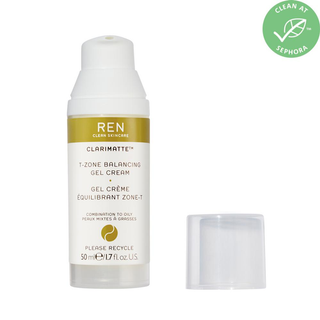
Ren Skincare T-Zone Balancing Gel Cream
Works for
1 of 3 advertised claims delivered
Moisturizing14 ingredients credited for this claimGood support
“T-Zone Balancing Gel Cream”
This product can help improve hydration of the skin with the two types of ingredients.
The first type is called “humectants”:
these ingredients help attract water.
When humectants are on the surface of the skin, they “pull in” the moisture from the outside environment, or from
within deeper layers of the skin. The following ingredients in this product do the job:
glycerin, glucose.
This product also contains ingredients called “occlusives”. They help reduce the speed with which our skin loses moisture to the outside environment. These ingredients also help soften the upper layer of the skin, so it feels less tight and nicer to the touch. The following ingredients in this product do the job: caprylic/capric triglyceride, helianthus annuus seed oil.
Anti-aging1 ingredient credited for this claimLimited support
“Global protection complex Antileukine from Ochroleuca Seaweed, Tocotrienols from Arctic Cranberry Seed Oil, Kaempferol from Candle Tree Leaves and Leghemoglobin from Kudzu Zymbiozome protect the skin against UV induced damage and premature ageing.”
This product does not contain ingredients that are able to reduce fine lines and wrinkles or help with skin elasticity, but it can improve the look of the skin temporarily through moisturization. Well-moisturized skin might also be able to repair the sun damage better.
This ingredient vaccinium macrocarpon seed oil might be able to help neutralize free radicals in skin and help it fight off some of the sun damage.
Anti-blemish1 ingredient credited for this claimWeak support
“Reduces shine and the appearance of blemishes and breakouts.”
Effective ingredients missing or their concentration is too low.
Anti-oxidationNot advertised by the brand · 6 ingredients credited for this claimModerate support
This product contains antioxidants (vaccinium macrocarpon seed oil) that might be able to help neutralize free radicals in skin to lessen the damage it gets from the UV light (sun). There is not enough evidence to confirm their effectiveness in skin though.
Can it cause trouble?
Irritancy6 strong irritants: Lavandula angustifolia oil, Citrus aurantium bergamia fruit oil + 4 more — patch-test recommendedHigh risk
Comedogenic3 ingredients rated 2 or more on the 0–5 pore-clogging scale3 flagged
User reviews
Be the first — your take helps the next person decide.
Ingredients
Filter by role to see what each ingredient is doing.
Water~45–55%
Cetearyl ethylhexanoate~5.6–6.9%
- Irritation risk
- Low
An emollient that helps soften the skin
More about Cetearyl ethylhexanoateGlycerin~4–4.9%
- Irritation risk
- Low
One of the best moisturizing ingredients. Naturally present in skin. It attracts water to the upper layer of the skin working as a humectant
More about GlycerinLauryl laurate~3.1–3.8%
- Irritation risk
- Medium
Helps soften the upper layer of the skin
More about Lauryl laurateCetearyl alcohol~2.3–2.9%
- Irritation risk
- Low
- Comedogenicity
- 2/5
A non-drying alcohol. Works as an emollient. Helps water and oil mix together and creates a nice product texture
More about Cetearyl alcoholTapioca starch~2–2.4%
Salix nigra bark extract~1.7–2%
- Irritation risk
- Medium
A plant extract that might contain salicylic acid
More about Salix nigra bark extractHydroxyacetophenone~1.4–1.7%
Oryzanol~1.2–1.4%
- Irritation risk
- Low
An anti-oxidant that helps stabilize product formulations. Might help neutralise free radicals in skin
More about OryzanolCaprylic/capric triglyceride~1–1.2%
- Irritation risk
- Medium
A good mix of fatty acids that forms a protective layer on the skin. Improves the shelf life of products. Derived from coconut and glycerin
More about Caprylic/capric triglycerideAmorphophallus konjac root powder~0.95–1.15%
- Irritation risk
- Medium
Carbomer~0.55–0.85%
- Irritation risk
- Low
Helps create a thicker or gel-like product texture. It is not a surfactant but can be used in gentle cleansing formulations
More about CarbomerCetearyl glucoside~0.5–0.8%
- Irritation risk
- Medium
Helps water and oil in the product mix well together and improves product texture
More about Cetearyl glucosideVaccinium macrocarpon seed oil~0.5–0.75%
- Irritation risk
- Medium
A plant oil that can help neutralize free radicals, soften the upper layer of the skin, and support skin's barrier function
More about Vaccinium macrocarpon seed oilBisabolol~0.35–0.65%
- Irritation risk
- Low
An active component of chamomile plant that historically has been used to calm down irritated skin. A recent study shows that bisabolol indeed can have some anti-inflammatory effect on skin, even though conclusive data is lacking. Bisabolol has a sweet floral scent and can be added to products for its aromatic properties
More about BisabololLavandula angustifolia oil~0.4–0.6%
- Irritation risk
- High
An essential oil. Potential allergen and can be irritating. It has some anti-bacterial properties
More about Lavandula angustifolia oilTocopherol~0.4–0.65%
- Irritation risk
- Low
Pure form of vitamin E. Can help moisturise and protect the skin from free radicals. Often used to help stabilise other ingredients or the formula itself
More about TocopherolCitrus aurantium bergamia fruit oil~0.3–0.6%
- Irritation risk
- High
A plant oil with a high content of volatile compounds that can irritate the skin and lead to allergic reactions. Can lead to photosensitivity
More about Citrus aurantium bergamia fruit oilPueraria lobata symbiosome extract~0.3–0.55%
- Irritation risk
- Low
Laminaria ochroleuca extract~0.3–0.5%
- Irritation risk
- Low
- Comedogenicity
- 3/5
Helps attract water to the upper layer of the skin
More about Laminaria ochroleuca extractCassia alata leaf extract~0.25–0.5%
- Irritation risk
- Medium
Might have some anti-oxidant properties. Can be used as a fragrance. Can be irritating
More about Cassia alata leaf extractGlucose~0.25–0.5%
- Irritation risk
- Low
Helps attract water to the upper layer of the skin. Could be helpful in restoring the skin barrier function
More about GlucoseCrataegus oxyacantha stem extract~0.25–0.45%
- Irritation risk
- Low
Phenoxyethanol~0.25–0.45%
- Irritation risk
- Low
A preservative. It helps prevent bacterial growth in cosmetic products
More about PhenoxyethanolCallitris intratropica wood oil~0.25–0.4%
- Irritation risk
- Low
Rosa damascena flower water extract~0.2–0.4%
- Irritation risk
- High
Lactobacillus~0.2–0.4%
- Irritation risk
- Low
A non-living ingredient made by fermentation with the bacteria Lactobacillus. It can help attract water to the upper layer of the skin and might help reduce inflammation
More about LactobacillusHelianthus annuus seed oil~0.25–0.45%
- Irritation risk
- Low
A great emollient due to its high linoleic acid content. One of the most effective plant oils in helping skin hydration and repairing skin barrier function
More about Helianthus annuus seed oilRosmarinus officinalis leaf extract~0.15–0.3%
- Irritation risk
- High
Can be helpful in reducing inflammation in skin, including inflamed acne. It can be irritating
More about Rosmarinus officinalis leaf extractCocos nucifera fruit extract~0.25–0.45%
- Irritation risk
- Low
- Comedogenicity
- 3/5
An emollient. Found to be as effective as a moisturizer for dry skin as mineral oil. Could be comedogenic
More about Cocos nucifera fruit extractSodium chloride~0.2–0.35%
- Irritation risk
- Low
Used to stabilize mixtures of oil and water, and create thicker, gel-like product textures
More about Sodium chlorideLactoperoxidase~0.15–0.3%
- Irritation risk
- Low
Helps attract water to the upper layer of the skin. In theory, could support healthy skin's microbiome, but evidence of effectiveness in skin is lacking
More about LactoperoxidaseGlucose oxidase~0.15–0.25%
- Irritation risk
- Low
Helps attract water to the upper layer of the skin
More about Glucose oxidaseSodium hydroxide~0.1–0.2%
Limonene~0.1–0.15%
- Irritation risk
- High
A common frangrance that can easily irritate skin, especially if exposed to air, light or heat
More about LimoneneLinalool~0.05–0.1%
Ingredient list view
Water, Cetearyl ethylhexanoate, Glycerin, Lauryl laurate, Cetearyl alcohol, Tapioca starch, Salix nigra bark extract, Hydroxyacetophenone, Oryzanol, Caprylic/capric triglyceride, Amorphophallus konjac root powder, Carbomer, Cetearyl glucoside, Vaccinium macrocarpon seed oil, Bisabolol, Lavandula angustifolia oil, Tocopherol, Citrus aurantium bergamia fruit oil, Pueraria lobata symbiosome extract, Laminaria ochroleuca extract, Cassia alata leaf extract, Glucose, Crataegus oxyacantha stem extract, Phenoxyethanol, Callitris intratropica wood oil, Rosa damascena flower water extract, Lactobacillus, Helianthus annuus seed oil, Rosmarinus officinalis leaf extract, Cocos nucifera fruit extract, Sodium chloride, Lactoperoxidase, Glucose oxidase, Sodium hydroxide, Limonene, Linalool
Compare prices
Retailers ranked by price — lowest first.

Sources cited in this review
Every concentration estimate and effectiveness label is anchored to one of these 19 studies and safety reviews.
- 1
- 2
- 3
- 4Wound‐healing Properties of the Oils of Vitis vinifera and Vaccinium macrocarpononlinelibrary.wiley.com
- 5
- 6

Affiliate links · As an Amazon Associate, WIMJ earns from qualifying purchases.