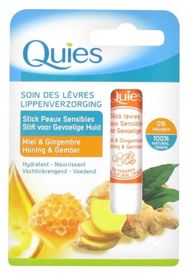
Quies Lips Care Sensitive Skins Stick Honey & Ginger 4
Works for
0 of 1 advertised claim delivered
Anti-aging3 ingredients credited for this claimLimited evidence
“Quies Lips Care Sensitive Skins Stick Honey & Ginger 4,5g is a lipstick with an innovative formula enriched with 100% natural plant oils combining , shea butter that moisturizes and nourishes intensely for a feeling of immediate comfort, , sweet almond oil with soothing and softening properties, ideal for the most sensitive lips, , vitamin A and E, antioxidants that fight against free radicals and premature aging of the lips.”
This product does not contain ingredients that are able to reduce fine lines and wrinkles or help with skin elasticity, but it can improve the look of the skin temporarily through moisturization. Well-moisturized skin might also be able to repair the sun damage better.This ingredient - butyrospermum parkii butter - could be helpful for preventing or repairing signs of aging in theory, but there is no evidence that it actually works.
This ingredient rubus idaeus seed oil might be able to help neutralize free radicals in skin and help it fight off some of the sun damage.
Anti-oxidationNot advertised by the brand · 7 ingredients credited for this claimModerate evidence
This product contains antioxidants (rubus idaeus seed oil) that might be able to help neutralize free radicals in skin to lessen the damage it gets from the UV light (sun). There is not enough evidence to confirm their effectiveness in skin though.
MoisturizingNot advertised by the brand · 12 ingredients credited for this claimGood evidence
This product can help soften the skin and reduce its moisture loss with emollients and occlusives: butyrospermum parkii butter, cera alba.
Keep in mind that this product does not contain effective ingredients to attract water to the upper layer of the skin. This is why an additional product with humectants like glycerin or hyaluronic acid can be helpful (apply it before this product for the best results).
Can it cause trouble?
Irritancy4 strong irritants: Zingiber officinale root extract, Aroma + 2 more — patch-test recommendedHigh risk
Comedogenic3 ingredients rated 2 or more on the 0–5 pore-clogging scale3 flagged
User reviews
Be the first — your take helps the next person decide.
Ingredients
Filter by role to see what each ingredient is doing.
Ricinus communis seed oil~25–37%
- Irritation risk
- Medium
A plant oil that can help soften the skin. It might be helpful in calming down inflammation, but solid research is lacking. Is often used in lip products to create the needed product consistency
More about Ricinus communis seed oilButyrospermum parkii butter~5.8–8.6%
- Irritation risk
- Low
- Comedogenicity
- 3/5
A great moisturising ingredient that softens the skin and reduces water loss from its upper layer. It also can be helpful in protecting skin from free radicals
More about Butyrospermum parkii butterC10-18 triglycerides~4.6–7%
- Irritation risk
- Low
Helps soften the skin and attract water to its upper layer. Helps create nice product texture
More about C10-18 triglyceridesCetearyl alcohol~3.2–4.8%
- Irritation risk
- Low
- Comedogenicity
- 2/5
A non-drying alcohol. Works as an emollient. Helps water and oil mix together and creates a nice product texture
More about Cetearyl alcoholCera alba~3.4–5%
- Irritation risk
- Medium
Forms a protective barrier that holds water and keeps dry skin hydrated. Keeps an emulsion from separating into its oil and liquid components, and increases the thickness of a product. Can be an allergen
More about Cera albaCopernicia cerifera cera~2.5–3.8%
- Irritation risk
- Low
Brazilian palm wax. Helps soften the upper layer of the skin
More about Copernicia cerifera ceraCandelilla cera~2–2.9%
- Irritation risk
- Low
Cocos nucifera oil~1.6–2.4%
- Irritation risk
- Low
- Comedogenicity
- 3/5
An emollient. Found to be as effective as a moisturizer for dry skin as mineral oil. Could be comedogenic
More about Cocos nucifera oilPrunus amygdalus dulcis oil~1.2–1.8%
- Irritation risk
- Low
An emollient that softens the skin
More about Prunus amygdalus dulcis oilPersea gratissima oil~1.1–1.6%
- Irritation risk
- Medium
An emollient that helps soften the skin and could be helpful in repairing its barrier function
More about Persea gratissima oilTocopheryl acetate~0.8–1.2%
- Irritation risk
- Medium
A more stable but less bio-available form of vitamin E compared to Tocopherol. Might help moisturize and protect the skin from free radicals, but mostly used in low concentrations to stabilize other ingredients.
More about Tocopheryl acetateZingiber officinale root extract~0.55–1.25%
- Irritation risk
- High
A plant extract that can contain an irritating essential oil. Might have some anti-oxidant effect, but evidence is lacking
More about Zingiber officinale root extractAroma~0.45–1.05%
Honey~0.35–0.8%
- Irritation risk
- Low
Helps attract water to the skin and might have some anti-bacterial properties. Can be an allergen
More about HoneyRetinyl palmitate~0.3–0.7%
- Irritation risk
- High
Three steps removed from the active form of vitamin A - retinoic acid. To have an effect in the skin, it first needs to be converted twice to become the retinoic acid. This means it is less potent than retinol, but could also be less irritating. Once converted to the retinoic acid in the skin, it helps against all signs of aging, improves skin cell turnover and helps fight blemishes and clogged pores. However, in many cosmetic formulations, it is used in a concentration that is too low to have the full effect
More about Retinyl palmitateRubus idaeus seed oil~0.35–0.8%
- Irritation risk
- Medium
A plant oil that might be able to help neutralize free radicals in skin
More about Rubus idaeus seed oilHelianthus annuus seed oil~0.2–0.75%
- Irritation risk
- Low
A great emollient due to its high linoleic acid content. One of the most effective plant oils in helping skin hydration and repairing skin barrier function
More about Helianthus annuus seed oilRosmarinus officinalis leaf extract~0.1–0.4%
- Irritation risk
- High
Can be helpful in reducing inflammation in skin, including inflamed acne. It can be irritating
More about Rosmarinus officinalis leaf extractCorylus avellana seed oil~0.1–0.3%
- Irritation risk
- Low
Mel extract~0.05–0.25%
- Irritation risk
- Low
Propolis extract~0.1–0.35%
- Irritation risk
- High
A complex substance produced by honey bees. Can have anti-bacterial and some anti-oxidant effect. Is an allergen and can be irritating
More about Propolis extractIngredient list view
Ricinus communis seed oil, Butyrospermum parkii butter, C10-18 triglycerides, Cetearyl alcohol, Cera alba, Copernicia cerifera cera, Candelilla cera, Cocos nucifera oil, Prunus amygdalus dulcis oil, Persea gratissima oil, Tocopheryl acetate, Zingiber officinale root extract, Aroma, Honey, Retinyl palmitate, Rubus idaeus seed oil, Helianthus annuus seed oil, Rosmarinus officinalis leaf extract, Corylus avellana seed oil, Mel extract, Propolis extract
Compare prices
Retailers ranked by price — lowest first.

Affiliate links · prices updated regularly
Sources cited in this review
Every concentration estimate and effectiveness label is anchored to one of these 14 studies and safety reviews.
- 1
- 2
- 3
- 4
- 5
- 6

Affiliate links · As an Amazon Associate, WIMJ earns from qualifying purchases.