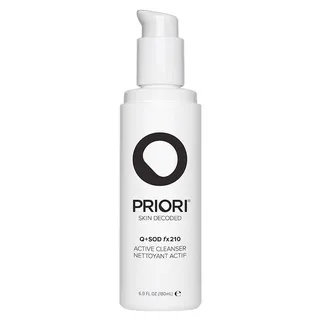
PRIORI Skincare Active Cleanser Q+SOD fx210
Works for
CleansingSodium c14-16 olefin sulfonate, Cocamidopropylamine oxide + 12 moreCleanses gently
“Gentle and mild exfoliating cleanser with AHA, Lactic Acid and BHA, Salicylic Acid to renew, hydrate and refine skin.”
This product works by removing dirt and oil from the surface of the skin. It uses a combination of mild cleansing agents (ceteareth-33, cetearyl alcohol, cocamidopropylamine oxide, coco-glucoside, coconut alcohol, di-ppg-2 myreth-10 adipate, glycol palmitate, palmitic acid, peg-120 methyl glucose dioleate, peg-6 caprylic/capric glycerides, sodium c14-16 olefin sulfonate, sodium lauroyl oat amino acids, xanthan gum) and should be able to cleanse the skin gently. Still keep in mind that any cleansing can disrupt the skin barrier, and most people do not need to cleanse their skin more than once per day.
Even though this formulation is mild, the following cleansing agents could trigger an irritation or allergy for some people: coco-glucoside, sodium c14-16 olefin sulfonate
ExfoliationSalicylic acid, Lactic acidWorks well
“Gentle and mild exfoliating cleanser with AHA, Lactic Acid and BHA, Salicylic Acid to renew, hydrate and refine skin.”
This product can help exfoliate the skin. In other words, it helps break down the bonds between dead cells on the surface of the skin and speed up the skin turnover. Skin often appears softer and brighter after exfoliation, but overdoing it can result in disrupted skin barrier. The following ingredient is doing the exfoliating job in this product: salicylic acid.
Anti-blemishSide benefit the brand mentions · Salicylic acidWorks well
“Acne & Blemishes Anti-Ageing Blackheads & Pores Combination Skin Damaged Skin Barrier Dark Circles Dry Skin Dull Skin Oily Skin Pigmentation Redness Sensitive Skin”
This product can help reduce breakouts and clogged pores because it contains the following ingredient: salicylic acid. This ingredient is used for treating acne and can have a noticeable effect.
Can it cause trouble?
Irritancy12 flagged ingredientsLow risk
Comedogenic1 ingredient rated 2 or more on the 0–5 pore-clogging scale1 flagged
User reviews
Be the first — your take helps the next person decide.
Ingredients
Filter by role to see what each ingredient is doing.
Water~45–55%
Sodium lactate~6.8–8.3%
- Irritation risk
- Medium
Helps attract water to the upper layer of the skin. Is often used to adjust the pH level of the product
More about Sodium lactateSodium c14-16 olefin sulfonate~5.8–7.1%
- Irritation risk
- High
Helps oil and water mix together and used as a cleansing agent. Can be irritating and is better avoided for sensitive skin
More about Sodium c14-16 olefin sulfonateCocamidopropylamine oxide~3.9–4.7%
Di-ppg-2 myreth-10 adipate~2.4–2.9%
Peg-6 caprylic/capric glycerides~1.9–2.3%
- Irritation risk
- Low
Helps dissolve other ingredients
More about Peg-6 caprylic/capric glyceridesSodium lauroyl oat amino acids~1.6–2%
Glycerin~1.5–1.8%
- Irritation risk
- Low
One of the best moisturizing ingredients. Naturally present in skin. It attracts water to the upper layer of the skin working as a humectant
More about GlycerinCaprylic/capric triglyceride~1.3–1.5%
- Irritation risk
- Medium
A good mix of fatty acids that forms a protective layer on the skin. Improves the shelf life of products. Derived from coconut and glycerin
More about Caprylic/capric triglycerideCetearyl alcohol~1.1–1.3%
- Irritation risk
- Low
- Comedogenicity
- 2/5
A non-drying alcohol. Works as an emollient. Helps water and oil mix together and creates a nice product texture
More about Cetearyl alcoholLactic acid~0.7–1.05%
- Irritation risk
- Medium
An exfoliating and moisturizing alpha-hydroxy acid (AHA). Typically causes less irritation than other AHAs, for example, glycolic acid. At high concentrations (about 15%), lactic acid can help reduce lines and wrinkles. Recent studies show that lactic acid can support the "good" bacteria living on skin's surface (healthy skin microbiome)
More about Lactic acidTitanium dioxide~0.95–1.15%
- Irritation risk
- Low
Works as a UV filter when used in high concentrations. It is photostable and is effective mostly against the UVB light, with some protection in the UVA range. In small concentrations, used for its ability to improve the color of cosmetic products. Is usually well tolerated by the skin
More about Titanium dioxideGlycol palmitate~0.65–0.95%
Ubiquinone~0.55–0.8%
- Irritation risk
- Low
Coenzyme Q10. It helps neutralize free radicals in skin, improves skin hydration and might be helpful agains fine lines and wrinkles. It can be an allergen
More about UbiquinoneSuperoxide dismutase~0.5–0.75%
- Irritation risk
- Low
An antioxidant enzyme that is naturally present in skin. It can help support skin barrier function and reduce inflammation in skin. It is used in topical medications for inflammatory skin conditions including atopic dermatitis (eczema) and psoriasis. There are three types of natural Superoxide Dismutase in human skin. The compound used in topical treatments and cosmetics are mimics of typically one of these natural variants
More about Superoxide dismutaseSalicylic acid~0.5–0.75%
- Irritation risk
- High
Used for skin exfoliation. It has an anti-inflammatory and anti-bacterial effect, helps to unclog pores, prevent blemishes and speed up healing of the existing ones. Sometimes referred to as a BHA (beta-hydroxy acid)
More about Salicylic acidPalmitic acid~0.55–0.8%
- Irritation risk
- Low
An emollient that is naturally present in skin and helps soften it
More about Palmitic acidCucumis sativus fruit extract~0.45–0.7%
- Irritation risk
- Medium
Might be somewhat helpful in reducing hyperpigmentation and neutralizing free radicals but its typical concentration in a product is too low for having an effect
More about Cucumis sativus fruit extractCoco-glucoside~0.5–0.7%
- Irritation risk
- High
Used as a cleansing agent (surfactant) in cleansers. Helps water and oil mix together in lotions. Can be irritating
More about Coco-glucosidePeg-120 methyl glucose dioleate~0.4–0.6%
Ceteareth-33~0.45–0.65%
Coconut alcohol~0.35–0.65%
Xanthan gum~0.3–0.5%
- Irritation risk
- Low
Used to create a thicker product consistency
More about Xanthan gumHydroxyethylcellulose~0.25–0.5%
- Irritation risk
- Low
Used to thicken product formulations and create gel-like textures
More about HydroxyethylcellulosePhenoxyethanol~0.25–0.45%
- Irritation risk
- Low
A preservative. It helps prevent bacterial growth in cosmetic products
More about PhenoxyethanolAluminum hydroxide~0.25–0.5%
- Irritation risk
- Low
Is used to add opaque (non-transparent) appearance to formulations. Can be used to coat other ingredients for even dispersion. This is a different ingredient compared to the ones used in antipersperants (aluminium chloride and aluminium chlorohydrate)
More about Aluminum hydroxideStearic acid~0.3–0.55%
- Irritation risk
- Low
Helps oil and water mix together and works as an emollient
More about Stearic acidCitric acid~0.15–0.25%
- Irritation risk
- Medium
Can work as an exfoliant but is typically used to adjust the product pH
More about Citric acidEthylhexylglycerin~0.15–0.25%
Disodium edta~0.1–0.2%
Sodium chloride~0.1–0.2%
- Irritation risk
- Low
Used to stabilize mixtures of oil and water, and create thicker, gel-like product textures
More about Sodium chlorideGlycol~0.05–0.15%
- Irritation risk
- Low
Benzoic acid~0.1–0.15%
Ingredient list view
Water, Sodium lactate, Sodium c14-16 olefin sulfonate, Cocamidopropylamine oxide, Di-ppg-2 myreth-10 adipate, Peg-6 caprylic/capric glycerides, Sodium lauroyl oat amino acids, Glycerin, Caprylic/capric triglyceride, Cetearyl alcohol, Lactic acid, Titanium dioxide, Glycol palmitate, Ubiquinone, Superoxide dismutase, Salicylic acid, Palmitic acid, Cucumis sativus fruit extract, Coco-glucoside, Peg-120 methyl glucose dioleate, Ceteareth-33, Coconut alcohol, Xanthan gum, Hydroxyethylcellulose, Phenoxyethanol, Aluminum hydroxide, Stearic acid, Citric acid, Ethylhexylglycerin, Disodium edta, Sodium chloride, Glycol, Benzoic acid
Compare prices
Retailers ranked by price — lowest first.
Worth comparing, line by line.
Match % combines shared ingredients, the first five ingredients, shared actives and hero ingredients, irritancy (lower counts in the alternative's favour), texture and body area. Only products in the same routine step are compared.
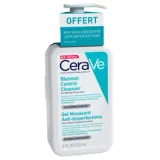
| PRIORI SkincareActive Cleanser Q+SOD fx210YOUR PRODUCT | CeraVeGel Moussant Anti-Imperfections | OleHenriksenDaily D-Clog Pore-Clearing Salicylic Acid Cleanser | Face factsCeramide Blemish Foaming Cleanser | |
|---|---|---|---|---|
| Match | — | 72% | 64% | 63% |
| Price | — | — | $33.77 | $7.82 |
| Shared key ingredients | — | 5 of 22 | 3 of 22 | 4 of 22 |
| Key difference | — | Niacinamide | Betaine Salicylate | Niacinamide |
| Irritancy | Low | Low | Medium | Low |
| Drying alcohol | — | — | — | — |
| View product | Shop | Shop | Shop |

More alternatives: The INKEY List CA Salicylic Acid Acne + Blackhead CleanserDCL Active Mattifying Cleanser
Sources cited in this review
Every concentration estimate and effectiveness label is anchored to one of these 18 studies and safety reviews.
- 1Final Report On the Safety Assessment of Sodium Alpha-Olefin Sulfonatesjournals.sagepub.com
- 2
- 3Epidermal and dermal effects of topical lactic acidncbi.nlm.nih.gov
- 4Dual Effects of Alpha-Hydroxy Acids on the Skinpdfs.semanticscholar.org
- 5
- 6

Affiliate links · As an Amazon Associate, WIMJ earns from qualifying purchases.