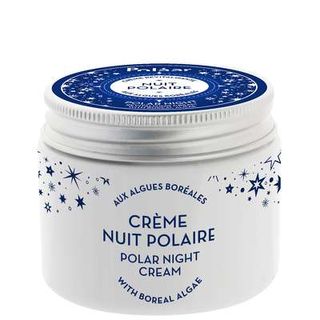
Polaar Night Revitalizing Cream with Boreal Algae
Works for
1 of 1 advertised claim delivered
Moisturizing9 ingredients credited for this claimGood support
“Rich in beta-endorphins and essential nutritional elements, this Boreal Algae revitalises stressed and dehydrated skin, the skin is radiant with youth.”
This product can help improve hydration of the skin with the two types of ingredients.
The first type is called “humectants”:
these ingredients help attract water.
When humectants are on the surface of the skin, they “pull in” the moisture from the outside environment, or from
within deeper layers of the skin. The following ingredients in this product do the job:
betaine, glycerin.
This product also contains ingredients called “occlusives”. They help reduce the speed with which our skin loses moisture to the outside environment. These ingredients also help soften the upper layer of the skin, so it feels less tight and nicer to the touch. The following ingredients in this product do the job: caprylic/capric triglyceride, glycine soja oil.
Can it cause trouble?
Irritancy7 strong irritants: Parfum, Benzyl salicylate + 5 more — patch-test recommendedHigh risk
Comedogenic2 ingredients rated 2 or more on the 0–5 pore-clogging scale2 flagged
User reviews
Be the first — your take helps the next person decide.
Ingredients
Filter by role to see what each ingredient is doing.
Water~40–60%
Glycerin~3.9–5.8%
- Irritation risk
- Low
One of the best moisturizing ingredients. Naturally present in skin. It attracts water to the upper layer of the skin working as a humectant
More about GlycerinCaprylic/capric triglyceride~3.8–5.6%
- Irritation risk
- Medium
A good mix of fatty acids that forms a protective layer on the skin. Improves the shelf life of products. Derived from coconut and glycerin
More about Caprylic/capric triglyceridePropanediol~2.7–4%
- Irritation risk
- Low
Acts as a solvent for other ingredients. Speeds up the absorption of other ingredients into the skin
More about PropanediolCoco-caprylate/caprate~2.1–3.1%
- Irritation risk
- Low
Helps to soften the upper layer of the skin without creating a greasy texture
More about Coco-caprylate/caprateDipentaerythrityl hexacaprylate/hexacaprate~1.7–2.5%
- Irritation risk
- Low
Glyceryl hydroxystearate~1.4–2.2%
- Irritation risk
- Low
Helps oil and water mix together. It is used to stabilize the product formulation and create a thicker product consistency
More about Glyceryl hydroxystearateGlyceryl stearate~1.3–1.9%
- Irritation risk
- Low
An emollient that softens the skin and forms a protective layer on its surface. Helps water and oil mix together
More about Glyceryl stearatePeg-100 stearate~1.1–1.6%
- Irritation risk
- Low
Helps oil and water mix togehter and creates a nice product texture
More about Peg-100 stearateBetaine~0.8–1.2%
- Irritation risk
- Low
Helps attract water to the upper layer of the skin and improves the product texture
More about BetaineNylon-6/12~0.6–1.35%
- Irritation risk
- Low
Ethylhexylglycerin~0.4–0.95%
Glycine soja oil~0.4–0.9%
- Irritation risk
- Medium
- Comedogenicity
- 2/5
A good emollient that helps soften the skin and helps repair its barrier function. It can clog pores if used in high concentrations.
More about Glycine soja oilHelichrysum italicum extract~0.3–0.75%
- Irritation risk
- High
A plant extract used to conceal the smell of other ingredients in a product. Has anti-microbial properties. Can be irritating
More about Helichrysum italicum extractTocopherol~0.3–0.75%
- Irritation risk
- Low
Pure form of vitamin E. Can help moisturise and protect the skin from free radicals. Often used to help stabilise other ingredients or the formula itself
More about TocopherolPalmaria palmata extract~0.3–0.75%
- Irritation risk
- Low
- Comedogenicity
- 3/5
Red algae extract that helps attract water to the upper layer of the skin
More about Palmaria palmata extractSodium polyacrylate starch~0.3–0.7%
- Irritation risk
- Low
Used to create a thicker product consistency
More about Sodium polyacrylate starchParfum~0.15–0.65%
- Irritation risk
- High
An aromatic blend of unspecified and possibly irritating ingredients
More about ParfumAcrylates/c10-30 alkyl acrylate crosspolymer~0.15–0.65%
- Irritation risk
- Medium
Maintains the texture of skincare products. Allows the product to spread evenly. Helps oil and water mix together
More about Acrylates/c10-30 alkyl acrylate crosspolymerXanthan gum~0.15–0.55%
- Irritation risk
- Low
Used to create a thicker product consistency
More about Xanthan gumCitric acid~0.1–0.5%
- Irritation risk
- Medium
Can work as an exfoliant but is typically used to adjust the product pH
More about Citric acidSodium hydroxide~0.1–0.45%
Phenoxyethanol~0.1–0.4%
- Irritation risk
- Low
A preservative. It helps prevent bacterial growth in cosmetic products
More about PhenoxyethanolBenzyl salicylate~0.1–0.3%
Alpha-isomethyl ionone~0.05–0.3%
- Irritation risk
- High
A fragrance. Potential allergen and can be irritating
More about Alpha-isomethyl iononeButylphenyl methylpropional~0.05–0.25%
- Irritation risk
- High
A fragrance. Can trigger allergic reactions and be irritating
More about Butylphenyl methylpropionalLinalool~0.05–0.2%
Limonene~0.05–0.15%
- Irritation risk
- High
A common frangrance that can easily irritate skin, especially if exposed to air, light or heat
More about LimoneneGeraniol~0.05–0.1%
Ingredient list view
Water, Glycerin, Caprylic/capric triglyceride, Propanediol, Coco-caprylate/caprate, Dipentaerythrityl hexacaprylate/hexacaprate, Glyceryl hydroxystearate, Glyceryl stearate, Peg-100 stearate, Betaine, Nylon-6/12, Ethylhexylglycerin, Glycine soja oil, Helichrysum italicum extract, Tocopherol, Palmaria palmata extract, Sodium polyacrylate starch, Parfum, Acrylates/c10-30 alkyl acrylate crosspolymer, Xanthan gum, Citric acid, Sodium hydroxide, Phenoxyethanol, Benzyl salicylate, Alpha-isomethyl ionone, Butylphenyl methylpropional, Linalool, Limonene, Geraniol
Compare prices
Retailers ranked by price — lowest first.
Affiliate links · prices updated regularly · As an Amazon Associate, WIMJ earns from qualifying purchases.
Sources cited in this review
Every concentration estimate and effectiveness label is anchored to one of these 6 studies and safety reviews.
- 1
- 2Safety Assessment of Alkyl Esters as Used in Cosmeticscir-safety.org
- 3
- 4Vitamin E in dermatologyncbi.nlm.nih.gov
- 5Vitamin E and Skin Healthlpi.oregonstate.edu
- 6

Affiliate links · As an Amazon Associate, WIMJ earns from qualifying purchases.