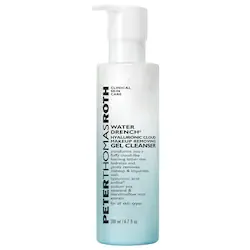
Peter Thomas Roth Water Drench Hyaluronic Cloud Makeup Removing Gel Cleanser
Works for
CleansingPolysorbate 20, Cocamidopropyl betaine + 6 moreCleanses gently
“Water Drench Hyaluronic Cloud Makeup Removing Gel Cleanser”
This product works by removing dirt and oil from the surface of the skin. It uses a combination of mild cleansing agents (cocamidopropyl betaine, cocamidopropyl dimethylamine, coco-glucoside, glyceryl oleate, polysorbate 20, potassium cocoate, potassium cocoyl glycinate) and should be able to cleanse the skin gently. Still keep in mind that any cleansing can disrupt the skin barrier, and most people do not need to cleanse their skin more than once per day.
Even though this formulation is mild, the following cleansing agents could trigger an irritation or allergy for some people: cocamidopropyl betaine, cocamidopropyl dimethylamine, coco-glucoside, glyceryl oleate
Can it cause trouble?
Irritancy1 strong irritant: ParfumMedium risk
ComedogenicClean of flagged comedogenic ingredientsNone flagged
User reviews
Be the first — your take helps the next person decide.
Ingredients
Filter by role to see what each ingredient is doing.
Water~45–55%
Glycerin~4.7–5.8%
- Irritation risk
- Low
One of the best moisturizing ingredients. Naturally present in skin. It attracts water to the upper layer of the skin working as a humectant
More about GlycerinAcrylates copolymer~4.3–5.3%
- Irritation risk
- Medium
Used to stabilize product formulation, help create an even product layer over skin (for example, in sunscreen) and create a thicker product consistency
More about Acrylates copolymerButylene glycol~3–3.7%
- Irritation risk
- Low
Used to create a nice product texture and help delivery of other ingredients. Might be somewhat helpful in attracting water to the upper layer of the skin
More about Butylene glycolPolysorbate 20~2.3–2.8%
Potassium cocoyl glycinate~1.9–2.4%
Cocamidopropyl betaine~2.1–2.6%
- Irritation risk
- High
Helps water and oil mix together. Used as a cleansing ingredient. Could be an allergen
More about Cocamidopropyl betaineSodium chloride~1.5–1.9%
- Irritation risk
- Low
Used to stabilize mixtures of oil and water, and create thicker, gel-like product textures
More about Sodium chloridePotassium cocoate~1.2–1.5%
- Irritation risk
- Medium
Helps oil and water mix together and works as a cleansing agent
More about Potassium cocoateSodium pca~0.95–1.2%
- Irritation risk
- Low
Naturally present in skin and helps to attract water to its upper layer
More about Sodium pcaSqualane~0.75–1.15%
- Irritation risk
- Low
An oil naturally present in skin. Works as an emollient to soften the skin and form a protective layer on its surface without a greasy feeling.
More about SqualaneCoco-glucoside~0.7–1.05%
- Irritation risk
- High
Used as a cleansing agent (surfactant) in cleansers. Helps water and oil mix together in lotions. Can be irritating
More about Coco-glucosideGlyceryl oleate~0.55–0.85%
- Irritation risk
- High
Helps oil and water mix together. Can be irritating
More about Glyceryl oleateSodium hydroxide~0.5–0.75%
Althaea officinalis root extract~0.45–0.65%
- Irritation risk
- High
A plant extract that can help attract water to the upper layer of the skin and might help to reduce inflammation
More about Althaea officinalis root extractCitric acid~0.45–0.65%
- Irritation risk
- Medium
Can work as an exfoliant but is typically used to adjust the product pH
More about Citric acidSodium phytate~0.4–0.65%
Sodium glycolate~0.35–0.65%
- Irritation risk
- Low
Cocamidopropyl dimethylamine~0.3–0.6%
- Irritation risk
- High
Helps oil and water mix together. Can work as a cleansing agent. Can be irritating
More about Cocamidopropyl dimethylamineSodium hyaluronate~0.3–0.55%
- Irritation risk
- Low
One of the best moisturizing ingredients. Attracts water into the upper layer of the skin
More about Sodium hyaluronateSodium benzoate~0.25–0.5%
Potassium sorbate~0.25–0.45%
Propylene glycol~0.2–0.4%
- Irritation risk
- High
Helps oil and water mix together and can enhance the penetration of other ingredients into the skin. It can be irritating
More about Propylene glycolHydrolyzed silk~0.2–0.35%
- Irritation risk
- Medium
Can help attract water to the upper layer of the skin
More about Hydrolyzed silkEthylhexylglycerin~0.2–0.35%
Tocopherol~0.15–0.3%
- Irritation risk
- Low
Pure form of vitamin E. Can help moisturise and protect the skin from free radicals. Often used to help stabilise other ingredients or the formula itself
More about TocopherolHydrogenated palm glycerides citrate~0.2–0.35%
- Irritation risk
- Low
Helps soften the upper layer of the skin
More about Hydrogenated palm glycerides citrateLecithin~0.15–0.3%
- Irritation risk
- Low
Used mostly for creating emulsions - helping oil and water mix together. Helps soften the upper layer of the skin
More about LecithinAscorbyl palmitate~0.1–0.15%
- Irritation risk
- Medium
Being a lipid soluble form of vitamin C, it is more stable and can penetrate the skin better than L-Ascorbic acid. It is effective in protecting the skin from free radicals, as well as evening the skin tone, but is less effective in stimulating collagen production compared to L-Ascorbic acid.
More about Ascorbyl palmitatePhenoxyethanol~0.1–0.2%
- Irritation risk
- Low
A preservative. It helps prevent bacterial growth in cosmetic products
More about PhenoxyethanolParfum~0.05–0.1%
- Irritation risk
- High
An aromatic blend of unspecified and possibly irritating ingredients
More about ParfumIngredient list view
Water, Glycerin, Acrylates copolymer, Butylene glycol, Polysorbate 20, Potassium cocoyl glycinate, Cocamidopropyl betaine, Sodium chloride, Potassium cocoate, Sodium pca, Squalane, Coco-glucoside, Glyceryl oleate, Sodium hydroxide, Althaea officinalis root extract, Citric acid, Sodium phytate, Sodium glycolate, Cocamidopropyl dimethylamine, Sodium hyaluronate, Sodium benzoate, Potassium sorbate, Propylene glycol, Hydrolyzed silk, Ethylhexylglycerin, Tocopherol, Hydrogenated palm glycerides citrate, Lecithin, Ascorbyl palmitate, Phenoxyethanol, Parfum
Compare prices
Retailers ranked by price — lowest first.


Worth comparing, line by line.
Match % combines shared ingredients, the first five ingredients, shared actives and hero ingredients, irritancy (lower counts in the alternative's favour), texture and body area. Only products in the same routine step are compared.
| Peter Thomas RothWater Drench Hyaluronic Cloud Makeup Removing Gel CleanserYOUR PRODUCT | AlphanovaBaby Organic Nourishing Foaming Gel | Be MinimalistOat Extract 06% Gentle Cleanser | NaturiumThe Calmer Ceramide Body Wash | |
|---|---|---|---|---|
| Match | — | 36% | 36% | 35% |
| Price | $32.00 | — | $7.99−$24.01 | $14.03−$17.97 |
| Shared key ingredients | — | 4 of 13 | 4 of 13 | 6 of 13 |
| Key difference | — | Butyrospermum Parkii Butter | Oatmeal Extract | Ceramide Eop |
| Irritancy | Medium | Low | Low | Low |
| Drying alcohol | — | — | — | — |
| View product | Shop | Shop | Shop |


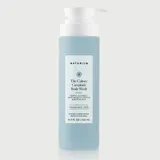
More alternatives: The INKEY List CA Glycerin Gentle Purifying CleanserUriage Xemose Gentle Cleansing Syndet Gel
Sources cited in this review
Every concentration estimate and effectiveness label is anchored to one of these 15 studies and safety reviews.
- 1
- 2
- 3
- 4
- 5Allergen of the Year—Alkyl Glucosidepracticeupdate.com
- 6

Affiliate links · As an Amazon Associate, WIMJ earns from qualifying purchases.