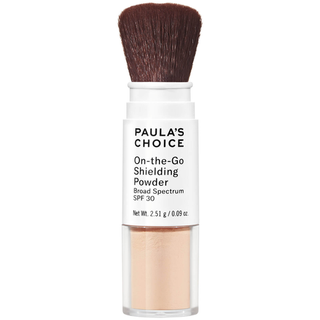
Paula's choice On-the-Go Shielding Powder Broad Spectrum SPF30
Works for
1 of 1 advertised claim delivered
Sun protectionSPF 30 · 1 UV filterBroad spectrum
This product offers a good level of protection against both UVB and UVA rays.
It is a mineral sunscreen. In other words, it contains non-organic UV filters. It will probably not sting your eyes but might leave a white cast.
This product can be considered "reef safe" because it does not contain the UV filters (oxybenzone and octinoxate) that can be harmful to coral reefs when present in the water in high concentrations.
Evens skin toneNot advertised by the brand · 1 ingredient credited for this claimStrong support
This product offers broad spectrum sun protection. It means that it can prevent hyperpigmentation and help keep the skin tone even (sun damage is the main factor causing age spots, darkening of post-acne marks and other discolorations).
Can it cause trouble?
Irritancy1 strong irritant: Retinyl palmitateMedium risk
ComedogenicClean of flagged comedogenic ingredientsNone flagged


User reviews
Be the first — your take helps the next person decide.
Ingredients
Filter by role to see what each ingredient is doing.
Zinc oxide19.24%
- Irritation risk
- Low
A broad spectrum sunblock (protects from both UVA and UVB rays). Is suitable for most sensitive skins. In small concentrations, can be used as a colorant
More about Zinc oxideSynthetic fluorphlogopite~26–39%
- Irritation risk
- Low
A mineral that is used as an optical filter (makes the skin looks nicer through light reflection) and to improve the texture of cosmetic products
More about Synthetic fluorphlogopiteBoron nitride~7.5–11.3%
- Irritation risk
- Low
Helps to absord oil and evenly disperse other ingredients (for example, pigment) in product formulation
More about Boron nitrideVinyl dimethicone/methicone silsesquioxane crosspolymer~4–6%
- Irritation risk
- Low
A type of silicone that create a smooth product finish and can create an optical soft-focus effect on the skin. Helps to thicken the product consistency
More about Vinyl dimethicone/methicone silsesquioxane crosspolymerSilica~3.1–4.6%
Oryza sativa bran~2.5–3.7%
- Irritation risk
- Low
Butylene glycol~2–3%
- Irritation risk
- Low
Used to create a nice product texture and help delivery of other ingredients. Might be somewhat helpful in attracting water to the upper layer of the skin
More about Butylene glycolStearic acid~2–3%
- Irritation risk
- Low
Helps oil and water mix together and works as an emollient
More about Stearic acidCeramide np~1.4–2.1%
- Irritation risk
- Low
A type of lipid similar to ceramides naturally present in skin. Helps to soften the upper layer of the skin and supports the skin barrier function to keep it hydrated. Can help to prevent inflammation in skin
More about Ceramide npTocopherol~1.1–1.6%
- Irritation risk
- Low
Pure form of vitamin E. Can help moisturise and protect the skin from free radicals. Often used to help stabilise other ingredients or the formula itself
More about TocopherolOlive glycerides~0.95–1.4%
Ascorbyl palmitate~0.55–1.3%
- Irritation risk
- Medium
Being a lipid soluble form of vitamin C, it is more stable and can penetrate the skin better than L-Ascorbic acid. It is effective in protecting the skin from free radicals, as well as evening the skin tone, but is less effective in stimulating collagen production compared to L-Ascorbic acid.
More about Ascorbyl palmitateSalix nigra bark extract~0.5–1.1%
- Irritation risk
- Medium
A plant extract that might contain salicylic acid
More about Salix nigra bark extractWater~0.4–1%
Triethoxycaprylylsilane~0.35–0.85%
- Irritation risk
- Low
A type of silicone that helps oil and water mix well together. Helps to disperse other ingredients, e.g. pigments, evenly in a formulation
More about TriethoxycaprylylsilanePolymethylsilsesquioxane~0.35–0.8%
- Irritation risk
- Low
A silicone that improves product texture and helps dissolve other ingredients. Can form a non-greasy film on the skin to prevent moisture loss
More about PolymethylsilsesquioxaneNylon-6/12~0.2–0.7%
- Irritation risk
- Low
Edta~0.1–0.45%
Retinyl palmitate~0.05–0.25%
- Irritation risk
- High
Three steps removed from the active form of vitamin A - retinoic acid. To have an effect in the skin, it first needs to be converted twice to become the retinoic acid. This means it is less potent than retinol, but could also be less irritating. Once converted to the retinoic acid in the skin, it helps against all signs of aging, improves skin cell turnover and helps fight blemishes and clogged pores. However, in many cosmetic formulations, it is used in a concentration that is too low to have the full effect
More about Retinyl palmitatePotassium sorbate~0.05–0.25%
Chlorphenesin~0.05–0.3%
Iron oxides~0.1–0.35%
- Irritation risk
- Low
An umbrella term for the following three colorants: CI 77491, CI 77492, CI 77499. They might be able to offer some protection against visible light, but the degree of the protection is not clear
More about Iron oxidesIngredient list view
Zinc oxide, Synthetic fluorphlogopite, Boron nitride, Vinyl dimethicone/methicone silsesquioxane crosspolymer, Silica, Oryza sativa bran, Unknown, Butylene glycol, Stearic acid, Ceramide np, Tocopherol, Olive glycerides, Ascorbyl palmitate, Salix nigra bark extract, Water, Triethoxycaprylylsilane, Polymethylsilsesquioxane, Nylon-6/12, Edta, Retinyl palmitate, Potassium sorbate, Chlorphenesin, Iron oxides
Compare prices
Retailers ranked by price — lowest first.
Worth comparing, line by line.
Match % combines shared ingredients, the first five ingredients, shared actives and hero ingredients, irritancy (lower counts in the alternative's favour), texture and body area. Only products in the same routine step are compared.
| Paula's choiceOn-the-Go Shielding Powder Broad Spectrum SPF30YOUR PRODUCT | innisfreeDaily UV Defense Mineral Sunscreen SPF 50 Protection Solaire Minérale | PigeonUV Baby Milk Waterproof SPF 50+ PA++++ | moodysensisoothe mineral sunscreen SPF 50 | |
|---|---|---|---|---|
| Match | — | 57% | 56% | 54% |
| Price | $23.20 | $24.00+$0.80 | $15.50−$7.70 | $56.83+$33.63 |
| Shared key ingredients | — | 4 of 4 | 3 of 4 | 3 of 4 |
| Key difference | — | Madecassoside | Cyclopentasiloxane | Niacinamide |
| Irritancy | Medium | Low | Low | Low |
| SPF | SPF 30 | SPF 50 | SPF 50 | SPF 50 |
| Drying alcohol | — | — | — | — |
| View product | Shop | Shop | Shop |

Product summary
We believe that "Paula's choice - On-the-Go Shielding Powder Broad Spectrum SPF30" can provide reliable sun protection based on the ingredients listed. It can protect from both UVA and UVB rays. This is great news because not all sunscreens with SPF ratings give UVA protection. (UVA rays do not cause sunburn, but still damage our skin and lead to early aging).
Sunscreen filters
This product is a mineral sunscreen. It uses zinc oxide for sun protection. Zinc oxide almost never irritates the skin or stings eyes, but it can leave a white cast.
Irritation risk
There are actives in this product that can be irritating. We assess the overall irritancy of it to be medium. For a detailed overview of all potential irritants: click here
You can see the detailed formula review with the breakdown of all actives in the product and the full ingredient list with estimated concentrations in the tables below.
Sources cited in this review
Every concentration estimate and effectiveness label is anchored to one of these 10 studies and safety reviews.
- 1A review of inorganic UV filters zinc oxide and titanium dioxideonlinelibrary.wiley.com
- 2
- 3
- 4
- 5
- 6Safety Assessment of Boron Nitride as Used in Cosmetics cir-safety.org

Affiliate links · As an Amazon Associate, WIMJ earns from qualifying purchases.