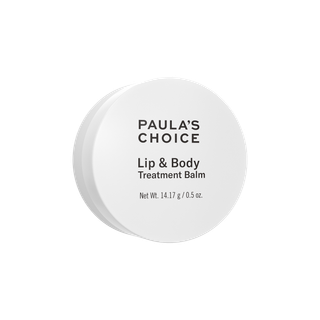
Paula's choice Lip & Body Treatment Balm
Works for
1 of 1 advertised claim delivered
Moisturizing13 ingredients credited for this claimStrong support
“On-the-spot relief for dry skin. This ultra-rich balm offers immediate and long-lasting relief for dry, flaky lips, cuticles, heels, and elbows.”
This product can help soften the skin and reduce its moisture loss with emollients and occlusives: beeswax, cera alba.
Keep in mind that this product does not contain effective ingredients to attract water to the upper layer of the skin. This is why an additional product with humectants like glycerin or hyaluronic acid can be helpful (apply it before this product for the best results).
The following ingredients in this product are especially good for supporting the skin barrier and helping with the hydration level: lanolin, petrolatum
Can it cause trouble?
Irritancy5 flagged ingredientsLow risk
Comedogenic3 ingredients rated 2 or more on the 0–5 pore-clogging scale3 flagged
User reviews
Ingredients
Filter by role to see what each ingredient is doing.
Ricinus communis seed oil~25–38%
- Irritation risk
- Medium
A plant oil that can help soften the skin. It might be helpful in calming down inflammation, but solid research is lacking. Is often used in lip products to create the needed product consistency
More about Ricinus communis seed oilPetrolatum~5.5–8.3%
- Irritation risk
- Low
One of the most effective and the most studied occlusive ingredients that creates a protective layer on top of the skin preventing moisture loss
More about PetrolatumEuphorbia cerifera wax~5.2–7.9%
- Irritation risk
- Low
Candelilla cera~4–6.1%
- Irritation risk
- Low
Lanolin~3.1–4.6%
- Irritation risk
- Low
Sebum of wool-bearing animals (most commonly sheep). Helps soften the upper layer of the skin and reduce the skin water loss. In rare cases could be an allergen. Not suitable for vegans
More about LanolinC10-30 cholesterol/lanosterol esters~2.2–3.3%
Cera alba~2.2–3.2%
- Irritation risk
- Medium
Forms a protective barrier that holds water and keeps dry skin hydrated. Keeps an emulsion from separating into its oil and liquid components, and increases the thickness of a product. Can be an allergen
More about Cera albaBeeswax~1.6–2.4%
- Irritation risk
- Low
Forms a protective barrier that holds water and keeps dry skin hydrated. Keeps an emulsion from separating into its oil and liquid components, and increases the thickness of a product. Can be an allergen
More about BeeswaxOzokerite~1.3–1.9%
Ethylhexyl palmitate~1.1–1.6%
- Irritation risk
- Low
- Comedogenicity
- 3/5
An emollient that helps soften the skin and create a nice product texture
More about Ethylhexyl palmitateCopernicia cerifera wax~0.95–1.45%
- Irritation risk
- Low
Helps to soften the upper layer of the skin and create a nice product consistency
More about Copernicia cerifera waxButyrospermum parkii butter~0.85–1.25%
- Irritation risk
- Low
- Comedogenicity
- 3/5
A great moisturising ingredient that softens the skin and reduces water loss from its upper layer. It also can be helpful in protecting skin from free radicals
More about Butyrospermum parkii butterJojoba esters~0.55–1.25%
- Irritation risk
- Medium
An emollient made of jojoba oil. Helps soften the skin and support its barrier function
More about Jojoba estersTriticum vulgare germ oil~0.5–1.15%
- Irritation risk
- Low
- Comedogenicity
- 3/5
A good emoillient. Contains vitamin E which can help neutralise free radicals, however the oil is unstable. Avoid if you have gluten or wheat sensitivity (including food allergies).
More about Triticum vulgare germ oilBisabolol~0.4–0.95%
- Irritation risk
- Low
An active component of chamomile plant that historically has been used to calm down irritated skin. A recent study shows that bisabolol indeed can have some anti-inflammatory effect on skin, even though conclusive data is lacking. Bisabolol has a sweet floral scent and can be added to products for its aromatic properties
More about BisabololTetrahexyldecyl ascorbate~0.3–0.7%
- Irritation risk
- Medium
Being a lipid soluble form of vitamin C, it is more stable than ascorbic acid, but still degrades quickly and needs to be stabilized in a formulation with another ingredient. It is claimed to penetrate skin better than pure vitamin C and have the the similar benefits, but solid studies of its effectiveness are lacking. Is likely to require a higher concentration in a product than pure vitamin C to be effective. It might be able to help reduce pore clogging.
More about Tetrahexyldecyl ascorbateTocopheryl acetate~0.15–0.65%
- Irritation risk
- Medium
A more stable but less bio-available form of vitamin E compared to Tocopherol. Might help moisturize and protect the skin from free radicals, but mostly used in low concentrations to stabilize other ingredients.
More about Tocopheryl acetateTocopherol~0.1–0.5%
- Irritation risk
- Low
Pure form of vitamin E. Can help moisturise and protect the skin from free radicals. Often used to help stabilise other ingredients or the formula itself
More about TocopherolTrihydroxystearin~0.1–0.4%
- Irritation risk
- Low
Helps soften the upper layer of the skin and improve the product texture
More about TrihydroxystearinHydrogenated polyisobutene~0.1–0.4%
- Irritation risk
- Low
Used to improve the product consistency and soften the upper layer of the skin
More about Hydrogenated polyisobuteneIngredient list view
Ricinus communis seed oil, Petrolatum, Euphorbia cerifera wax, Candelilla cera, Lanolin, C10-30 cholesterol/lanosterol esters, Cera alba, Beeswax, Ozokerite, Ethylhexyl palmitate, Copernicia cerifera wax, Butyrospermum parkii butter, Jojoba esters, Triticum vulgare germ oil, Bisabolol, Tetrahexyldecyl ascorbate, Tocopheryl acetate, Tocopherol, Trihydroxystearin, Hydrogenated polyisobutene
Compare prices
Retailers ranked by price — lowest first.
Affiliate links · prices updated regularly · As an Amazon Associate, WIMJ earns from qualifying purchases.
Product summary
Judging from the ingredient list, "Paula's choice - Lip & Body Treatment Balm" works well for improving skin hydration
This product contains ingredients that could be beneficial, but their concentrations are too low in this formulation: vitamin e and tetrahexyldecyl ascorbateIrritation risk
This product does not contain known common irritants and is suitable for sensitive skin. We assess the overall irritancy of this moisturizer to be low. For a detailed overview of all potential irritants: click here
You can see the detailed formula review with the breakdown of all actives in the product and the full ingredient list with estimated concentrations in the tables below.
What our users say
Based on 1 review 100% recommend this product- When it comes to comedogenicity, the reviewer believes that it clogs pores.
Price
The product retails for 15.00$ in the United States, from 14.00£ up to 24.99£ in the United Kingdom and for 21.00A$ in Australia.
For a detailed price comparison: click here.
Sources cited in this review
Every concentration estimate and effectiveness label is anchored to one of these 11 studies and safety reviews.
- 1
- 2
- 3
- 4
- 5
- 6

Affiliate links · As an Amazon Associate, WIMJ earns from qualifying purchases.