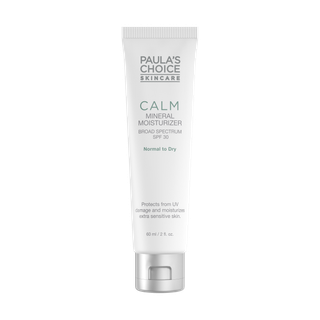
Paula's choice Redness Relief SPF 30 Mineral Moisturizer for Normal to Dry Skin

Paula's choice Redness Relief SPF 30 Mineral Moisturizer for Normal to Dry Skin

SPF 30Efficacy90/100IrritancyMedium·2 UV filters
Edit

Works for

3 of 3 advertised claims delivered

Sun protection
SPF 30 · 2 UV filters
Broad spectrum
SPF 30Broad spectrumMineral filtersNano filters

This product offers a good level of protection against both UVB and UVA rays.

It is a mineral sunscreen. In other words, it contains non-organic UV filters. It will probably not sting your eyes but might leave a white cast.

This product can be considered "reef safe" because it does not contain the UV filters (oxybenzone and octinoxate) that can be harmful to coral reefs when present in the water in high concentrations.

UV spectrum
UVB290–320 nmUVA II320–340 nmUVA I340–400 nm
Titanium Dioxide
Zinc Oxide
FilterCoverageWhat it doesEst. amount
Titanium Dioxide Mineral UVBUVA2 Photo-stable Works as a UV filter when used in high concentrations. It is photostable and is effective mostly against the UVB light, with some protection in the UVA range. In small concentrations, used for its ability to improve the color of cosmetic products. Is usually well tolerated by the skin85%
Zinc Oxide Mineral UVBUVA Photo-stable A broad spectrum sunblock (protects from both UVA and UVB rays). Is suitable for most sensitive skins. In small concentrations, can be used as a colorant12%
Reef-safe
No oxybenzone or octinoxate — the two filters banned in Hawaii, Florida Keys and Aruba.
Moisturizing
24 ingredients credited for this claim
Strong support
What the product description says
“Redness Relief SPF 30 Mineral Moisturizer for Normal to Dry Skin”
From product name

This product can help improve hydration of the skin with the two types of ingredients.

The first type is called “humectants”:
these ingredients help attract water. When humectants are on the surface of the skin, they “pull in” the moisture from the outside environment, or from within deeper layers of the skin. The following ingredients in this product do the job: glycerin, butylene glycol.

This product also contains ingredients called “occlusives”. They help reduce the speed with which our skin loses moisture to the outside environment. These ingredients also help soften the upper layer of the skin, so it feels less tight and nicer to the touch. The following ingredients in this product do the job: dimethicone, methicone.

The following ingredients in this product are especially good for supporting the skin barrier and helping with the hydration level: ceramide ng, palmitoyl hexapeptide-12

DimethiconeKey active· Emollient, OcclusiveEffect: HighA silicone that helps to reduce water loss from the surface of the skin. Can temporarily "fill in" lines and wrinkles, absorb oil, and create a nice product finish~0.7–1.05%
Ceramide ngHero· EmollientEffect: HighA type of lipid similar to ceramides naturally present in skin. Helps to soften the upper layer of the skin and supports the skin barrier function to keep it hydrated. Can help to prevent inflammation in skin~0.3–0.55%
Prunus armeniaca kernel oilKey active· EmollientEffect: HighAn emollient that helps soften the skin~3.4–4.1%
Peg-10 dimethiconeKey active· Emollient, OcclusiveEffect: HighA silicone that works to soften the upper layer of the skin and reduce its water loss~0.3–0.55%
UbiquinoneKey activeEffect: HighCoenzyme Q10. It helps neutralize free radicals in skin, improves skin hydration and might be helpful agains fine lines and wrinkles. It can be an allergen~0.3–0.55%
Palmitoyl hexapeptide-12HeroEffect: HighA type of peptide. Peptides are excellent moisturizers and might be able support collagen production reducing fine lines and wrinkles~0.25–0.5%
MethiconeKey active· Emollient, OcclusiveEffect: HighA type of silicone that helps soften the upper layer of the skin and reduces the water loss from the skin surface~0.25–0.5%
Glycine soja sterolsKey active· EmollientEffect: HighAn emollient that helps soften the skin~0.55–0.8%
Superoxide dismutaseKey activeEffect: HighAn antioxidant enzyme that is naturally present in skin. It can help support skin barrier function and reduce inflammation in skin. It is used in topical medications for inflammatory skin conditions including atopic dermatitis (eczema) and psoriasis. There are three types of natural Superoxide Dismutase in human skin. The compound used in topical treatments and cosmetics are mimics of typically one of these natural variants~0.3–0.5%
GlycerinKey active· HumectantEffect: HighOne of the best moisturizing ingredients. Naturally present in skin. It attracts water to the upper layer of the skin working as a humectant~0.45–0.7%
Cetearyl alcoholKey active· EmollientEffect: MediumA non-drying alcohol. Works as an emollient. Helps water and oil mix together and creates a nice product texture~1–1.2%
C12-15 alkyl benzoateKey active· EmollientEffect: MediumEnhances the product texture and makes it more spreadable. Helps reduce water loss from the outer layer of skin. Extands the shelf life by preventing bacteria growth~5.4–6.7%
CyclopentasiloxaneKey active· EmollientEffect: MediumA silicone that helps improve the product texture and spreadability. Can absorb oil creating a short-term mattifying effect on the skin~1.8–2.1%
Tribehenin· EmollientEffect: LowUsed to create a thicker product consistency and soften the upper layer of the skin~0.3–0.55%
Caprylyl glycol· Humectant, EmollientEffect: LowHelps preserve products and creates a nice product texture~0.3–0.5%
Butylene glycol· HumectantEffect: LowUsed to create a nice product texture and help delivery of other ingredients. Might be somewhat helpful in attracting water to the upper layer of the skin~1.4–1.7%
Isononyl isononanoate· Emollient, OcclusiveEffect: LowForms a protective film on the surface of the skin to prevent moisture loss. Gives a velvety feel to products while reducing tackiness~4.6–5.6%
Pentylene glycol· EmollientEffect: LowUsed to preserve products, dissolve other ingredients and create a nice product texture~1.2–1.5%
Glyceryl stearate· EmollientEffect: LowAn emollient that softens the skin and forms a protective layer on its surface. Helps water and oil mix together~2.5–3.1%
Caprylic/capric triglycerideUnder-dosedEffect: HighA good mix of fatty acids that forms a protective layer on the skin. Improves the shelf life of products. Derived from coconut and glycerin~0.3–0.6%
AllantoinUnder-dosedEffect: HighHelps calm down inflammation in skin and can help reduce itching. Helps to repair the skin barrier and keep skin hydrated~0.35–0.65%
Avena sativa kernel extractUnder-dosedEffect: HighAn effective moisturizing and skin barrier repair ingredient. Helps calm down inflammation and has some anti-oxidant properties~0.45–0.7%
Cucumis sativus fruit extractEffect: Low, below effective doseMight be somewhat helpful in reducing hyperpigmentation and neutralizing free radicals but its typical concentration in a product is too low for having an effect~0.25–0.5%
TocopherolEffect: Low, below effective dosePure form of vitamin E. Can help moisturise and protect the skin from free radicals. Often used to help stabilise other ingredients or the formula itself~0.35–0.6%
Evens skin tone
1 ingredient credited for this claim
Strong support

This product offers broad spectrum sun protection. It means that it can prevent hyperpigmentation and help keep the skin tone even (sun damage is the main factor causing age spots, darkening of post-acne marks and other discolorations).

Tetrahexyldecyl ascorbateUnder-dosedEffect: HighBeing a lipid soluble form of vitamin C, it is more stable than ascorbic acid, but still degrades quickly and needs to be stabilized in a formulation with another ingredient. It is claimed to penetrate skin better than pure vitamin C and have the the similar benefits, but solid studies of its effectiveness are lacking. Is likely to require a higher concentration in a product than pure vitamin C to be effective. It might be able to help reduce pore clogging.~0.3–0.55%
Anti-oxidation
Not advertised by the brand · 8 ingredients credited for this claim
Strong support

This product contains antioxidants (superoxide dismutase, ubiquinone) that can help neutralize free radicals in skin. By doing so, they can lessen the damage the skin gets from the UV light (sun).

Superoxide dismutaseKey activeEffect: HighAn antioxidant enzyme that is naturally present in skin. It can help support skin barrier function and reduce inflammation in skin. It is used in topical medications for inflammatory skin conditions including atopic dermatitis (eczema) and psoriasis. There are three types of natural Superoxide Dismutase in human skin. The compound used in topical treatments and cosmetics are mimics of typically one of these natural variants~0.3–0.5%
UbiquinoneKey activeEffect: HighCoenzyme Q10. It helps neutralize free radicals in skin, improves skin hydration and might be helpful agains fine lines and wrinkles. It can be an allergen~0.3–0.55%
Prunus armeniaca kernel oilEffect: LowAn emollient that helps soften the skin~3.4–4.1%
Tetrahexyldecyl ascorbateUnder-dosedEffect: HighBeing a lipid soluble form of vitamin C, it is more stable than ascorbic acid, but still degrades quickly and needs to be stabilized in a formulation with another ingredient. It is claimed to penetrate skin better than pure vitamin C and have the the similar benefits, but solid studies of its effectiveness are lacking. Is likely to require a higher concentration in a product than pure vitamin C to be effective. It might be able to help reduce pore clogging.~0.3–0.55%
TocopherolUnder-dosedEffect: HighPure form of vitamin E. Can help moisturise and protect the skin from free radicals. Often used to help stabilise other ingredients or the formula itself~0.35–0.6%
Cucumis sativus fruit extractEffect: Low, below effective doseMight be somewhat helpful in reducing hyperpigmentation and neutralizing free radicals but its typical concentration in a product is too low for having an effect~0.25–0.5%
Tocopheryl acetateEffect: Low, below effective doseA more stable but less bio-available form of vitamin E compared to Tocopherol. Might help moisturize and protect the skin from free radicals, but mostly used in low concentrations to stabilize other ingredients.~0.4–0.6%
Avena sativa kernel extractEffect: Low, below effective doseAn effective moisturizing and skin barrier repair ingredient. Helps calm down inflammation and has some anti-oxidant properties~0.45–0.7%

Can it cause trouble?

Irritancy
14 flagged ingredients
Medium risk
We flagged 14 ingredients with irritancy potential. Severity depends on your sensitivity threshold; the table lists the worst offenders first.
IngredientFunctionIrritationEst. amount
Prunus armeniaca kernel oilAn emollient that helps soften the skinMedium~3.4–4.1%est.
Pentylene glycolUsed to preserve products, dissolve other ingredients and create a nice product textureMedium~1.2–1.5%est.
Vp/eicosene copolymerUsed to improve the product adherence to the skin, for example, to pro-long the protective effect of sunscreens. Can be irritating to very sensitive skinMedium~0.6–0.9%est.
Tocopheryl acetateA more stable but less bio-available form of vitamin E compared to Tocopherol. Might help moisturize and protect the skin from free radicals, but mostly used in low concentrations to stabilize other ingredients.Medium~0.4–0.6%est.
Tetrahexyldecyl ascorbateBeing a lipid soluble form of vitamin C, it is more stable than ascorbic acid, but still degrades quickly and needs to be stabilized in a formulation with another ingredient. It is claimed to penetrate skin better than pure vitamin C and have the the similar benefits, but solid studies of its effectiveness are lacking. Is likely to require a higher concentration in a product than pure vitamin C to be effective. It might be able to help reduce pore clogging.Medium~0.3–0.55%est.
Cucumis sativus fruit extractMight be somewhat helpful in reducing hyperpigmentation and neutralizing free radicals but its typical concentration in a product is too low for having an effectMedium~0.25–0.5%est.
Caprylic/capric triglycerideA good mix of fatty acids that forms a protective layer on the skin. Improves the shelf life of products. Derived from coconut and glycerinMedium~0.3–0.6%est.
Peg-10 phytosterolHelps oil and water mix togetherMedium~0.3–0.55%est.
Polyhydroxystearic acidUsed to create a thicker product consistency and stabilize the formulationMedium~0.3–0.55%est.
Aluminum stearateUsed to help evenly disperse other ingredients (for example, pigment) in a formulationMedium~0.25–0.5%est.
Caprylyl glycolHelps preserve products and creates a nice product textureMedium~0.3–0.5%est.
Disodium edtaStabilizes the product formulationMedium~0.25–0.4%est.
EthylhexylglycerinA preservativeMedium~0.2–0.35%est.
ChlorphenesinA preservativeMedium~0.15–0.25%est.
Comedogenic
1 ingredient rated 2 or more on the 0–5 pore-clogging scale
1 flagged
These ingredients have a comedogenic rating of 2 or more on a 0–5 scale; the table shows each one's rating. In leave-on products they can clog pores in acne-prone skin.
IngredientFunctionRatingEst. amount
Cetearyl alcoholA non-drying alcohol. Works as an emollient. Helps water and oil mix together and creates a nice product texture2/5~1–1.2%est.
Edit
Cheaper Alternatives
Similar formulations, better price
No cheaper similar product found.

User reviews

Would you recommend?
No community reviews yet.

Be the first — your take helps the next person decide.

Write a review · ~30s

Ingredients

Filter by role to see what each ingredient is doing.

Water~45–55%
Formula
Irritation risk
Low

Plain old water

More about Water
C12-15 alkyl benzoate~5.4–6.7%
Key active
Irritation risk
Low
Works for
Moisturizing

Enhances the product texture and makes it more spreadable. Helps reduce water loss from the outer layer of skin. Extands the shelf life by preventing bacteria growth

More about C12-15 alkyl benzoate
Isononyl isononanoate~4.6–5.6%
Formula
Irritation risk
Low
Works for
Moisturizing

Forms a protective film on the surface of the skin to prevent moisture loss. Gives a velvety feel to products while reducing tackiness

More about Isononyl isononanoate
Titanium dioxide85%
UV filterKey active
Irritation risk
Low
Works for
Sun protection

Works as a UV filter when used in high concentrations. It is photostable and is effective mostly against the UVB light, with some protection in the UVA range. In small concentrations, used for its ability to improve the color of cosmetic products. Is usually well tolerated by the skin

More about Titanium dioxide
Prunus armeniaca kernel oil~3.4–4.1%
Key activeIrritant · medium
Irritation risk
Medium
Works for
MoisturizingAnti-oxidation

An emollient that helps soften the skin

More about Prunus armeniaca kernel oil
Zinc oxide12%
UV filterKey active
Irritation risk
Low
Works for
Sun protection

A broad spectrum sunblock (protects from both UVA and UVB rays). Is suitable for most sensitive skins. In small concentrations, can be used as a colorant

More about Zinc oxide
Glyceryl stearate~2.5–3.1%
Formula
Irritation risk
Low
Works for
CleansingMoisturizing

An emollient that softens the skin and forms a protective layer on its surface. Helps water and oil mix together

More about Glyceryl stearate
Peg-100 stearate~2.2–2.7%
Formula
Irritation risk
Low
Works for
Cleansing

Helps oil and water mix togehter and creates a nice product texture

More about Peg-100 stearate
Cyclopentasiloxane~1.8–2.1%
Key active
Irritation risk
Low
Works for
MattifyingMoisturizing

A silicone that helps improve the product texture and spreadability. Can absorb oil creating a short-term mattifying effect on the skin

More about Cyclopentasiloxane
Butylene glycol~1.4–1.7%
Formula
Irritation risk
Low
Works for
Moisturizing

Used to create a nice product texture and help delivery of other ingredients. Might be somewhat helpful in attracting water to the upper layer of the skin

More about Butylene glycol
Pentylene glycol~1.2–1.5%
Irritant · medium
Irritation risk
Medium
Works for
Moisturizing

Used to preserve products, dissolve other ingredients and create a nice product texture

More about Pentylene glycol
Cetearyl alcohol~1–1.2%
Key activeComedogenic 2/5
Irritation risk
Low
Comedogenicity
2/5
Works for
CleansingMoisturizing

A non-drying alcohol. Works as an emollient. Helps water and oil mix together and creates a nice product texture

More about Cetearyl alcohol
Dimethicone~0.7–1.05%
Key active
Irritation risk
Low
Works for
MoisturizingMattifying

A silicone that helps to reduce water loss from the surface of the skin. Can temporarily "fill in" lines and wrinkles, absorb oil, and create a nice product finish

More about Dimethicone
Vp/eicosene copolymer~0.6–0.9%
Irritant · medium
Irritation risk
Medium
Works for
Sun protection

Used to improve the product adherence to the skin, for example, to pro-long the protective effect of sunscreens. Can be irritating to very sensitive skin

More about Vp/eicosene copolymer
Glycine soja sterols~0.55–0.8%
Key active
Irritation risk
Low
Works for
Moisturizing

An emollient that helps soften the skin

More about Glycine soja sterols
Avena sativa kernel extract~0.45–0.7%
Under-dosed
Irritation risk
Low
Works for
Anti-inflammatoryReduces irritationMoisturizingReduces rednessAnti-oxidation

An effective moisturizing and skin barrier repair ingredient. Helps calm down inflammation and has some anti-oxidant properties

More about Avena sativa kernel extract
Glycerin~0.45–0.7%
Key active
Irritation risk
Low
Works for
Moisturizing

One of the best moisturizing ingredients. Naturally present in skin. It attracts water to the upper layer of the skin working as a humectant

More about Glycerin
(hydration/skin replenishing), etanorulayh muidos…
Not recognized
Allantoin~0.35–0.65%
Under-dosed
Irritation risk
Low
Works for
MoisturizingAnti-inflammatoryReduces irritationReduces rednessAnti-blemishExfoliation

Helps calm down inflammation in skin and can help reduce itching. Helps to repair the skin barrier and keep skin hydrated

More about Allantoin
Tocopheryl acetate~0.4–0.6%
Irritant · medium
Irritation risk
Medium
Works for
Anti-oxidation

A more stable but less bio-available form of vitamin E compared to Tocopherol. Might help moisturize and protect the skin from free radicals, but mostly used in low concentrations to stabilize other ingredients.

More about Tocopheryl acetate
Tocopherol~0.35–0.6%
Under-dosed
Irritation risk
Low
Works for
Anti-oxidationMoisturizingAnti-inflammatoryAnti-aging

Pure form of vitamin E. Can help moisturise and protect the skin from free radicals. Often used to help stabilise other ingredients or the formula itself

More about Tocopherol
Hydrogenated lecithin~0.3–0.6%
Formula
Irritation risk
Low
Works for
Cleansing

Helps to retain moisture by creating a protective barrier on the skin. Rich in fatty acids. Improves product texture and helps with the penetration of other ingredients.

More about Hydrogenated lecithin
Tetrahexyldecyl ascorbate~0.3–0.55%
Under-dosedIrritant · medium
Irritation risk
Medium
Works for
Evens skin toneAnti-agingAnti-oxidation

Being a lipid soluble form of vitamin C, it is more stable than ascorbic acid, but still degrades quickly and needs to be stabilized in a formulation with another ingredient. It is claimed to penetrate skin better than pure vitamin C and have the the similar benefits, but solid studies of its effectiveness are lacking. Is likely to require a higher concentration in a product than pure vitamin C to be effective. It might be able to help reduce pore clogging.

More about Tetrahexyldecyl ascorbate
Superoxide dismutase~0.3–0.5%
Key active
Irritation risk
Low
Works for
Anti-oxidationMoisturizingAnti-inflammatory

An antioxidant enzyme that is naturally present in skin. It can help support skin barrier function and reduce inflammation in skin. It is used in topical medications for inflammatory skin conditions including atopic dermatitis (eczema) and psoriasis. There are three types of natural Superoxide Dismutase in human skin. The compound used in topical treatments and cosmetics are mimics of typically one of these natural variants

More about Superoxide dismutase
Ubiquinone~0.3–0.55%
Key active
Irritation risk
Low
Works for
MoisturizingAnti-oxidationAnti-aging

Coenzyme Q10. It helps neutralize free radicals in skin, improves skin hydration and might be helpful agains fine lines and wrinkles. It can be an allergen

More about Ubiquinone
Ceramide ng~0.3–0.55%
Hero · Moisturizing
Irritation risk
Low
Works for
MoisturizingAnti-inflammatory

A type of lipid similar to ceramides naturally present in skin. Helps to soften the upper layer of the skin and supports the skin barrier function to keep it hydrated. Can help to prevent inflammation in skin

More about Ceramide ng
Methicone~0.25–0.5%
Key active
Irritation risk
Low
Works for
Moisturizing

A type of silicone that helps soften the upper layer of the skin and reduces the water loss from the skin surface

More about Methicone
Palmitoyl hexapeptide-12~0.25–0.5%
Hero · Moisturizing
Irritation risk
Low
Works for
Anti-agingMoisturizing

A type of peptide. Peptides are excellent moisturizers and might be able support collagen production reducing fine lines and wrinkles

More about Palmitoyl hexapeptide-12
Peg-10 dimethicone~0.3–0.55%
Key active
Irritation risk
Low
Works for
Moisturizing

A silicone that works to soften the upper layer of the skin and reduce its water loss

More about Peg-10 dimethicone
Cucumis sativus fruit extract~0.25–0.5%
Irritant · medium
Irritation risk
Medium
Works for
MoisturizingAnti-oxidation

Might be somewhat helpful in reducing hyperpigmentation and neutralizing free radicals but its typical concentration in a product is too low for having an effect

More about Cucumis sativus fruit extract
Caprylic/capric triglyceride~0.3–0.6%
Under-dosedIrritant · medium
Irritation risk
Medium
Works for
Moisturizing

A good mix of fatty acids that forms a protective layer on the skin. Improves the shelf life of products. Derived from coconut and glycerin

More about Caprylic/capric triglyceride
Tribehenin~0.3–0.55%
Formula
Irritation risk
Low
Works for
Moisturizing

Used to create a thicker product consistency and soften the upper layer of the skin

More about Tribehenin
Peg-10 phytosterol~0.3–0.55%
Irritant · medium
Irritation risk
Medium
Works for
Cleansing

Helps oil and water mix together

More about Peg-10 phytosterol
Sorbitan stearate~0.3–0.5%
Formula
Irritation risk
Low
Works for
Cleansing

Helps water and oil mix together

More about Sorbitan stearate
Polyhydroxystearic acid~0.3–0.55%
Irritant · medium
Irritation risk
Medium
Works for
Cleansing

Used to create a thicker product consistency and stabilize the formulation

More about Polyhydroxystearic acid
Alumina~0.4–0.65%
Formula
Irritation risk
Low

The same compound that is used safely in dental implants and bone cements. In cosmetics, it is used to improve the consistency of products

More about Alumina
Polysorbate 20~0.3–0.55%
Formula
Irritation risk
Low
Works for
Cleansing

Helps oil and water mix together

More about Polysorbate 20
Aluminum stearate~0.25–0.5%
Irritant · medium
Irritation risk
Medium

Used to help evenly disperse other ingredients (for example, pigment) in a formulation

More about Aluminum stearate
Xanthan gum~0.25–0.5%
Formula
Irritation risk
Low
Works for
Cleansing

Used to create a thicker product consistency

More about Xanthan gum
Caprylyl glycol~0.3–0.5%
Irritant · medium
Irritation risk
Medium
Works for
Moisturizing

Helps preserve products and creates a nice product texture

More about Caprylyl glycol
Disodium edta~0.25–0.4%
Irritant · medium
Irritation risk
Medium

Stabilizes the product formulation

More about Disodium edta
Ethylhexylglycerin~0.2–0.35%
Irritant · medium
Irritation risk
Medium

A preservative

More about Ethylhexylglycerin
Phenoxyethanol~0.2–0.35%
Formula
Irritation risk
Low

A preservative. It helps prevent bacterial growth in cosmetic products

More about Phenoxyethanol
Chlorphenesin~0.15–0.25%
Irritant · medium
Irritation risk
Medium

A preservative

More about Chlorphenesin
Ingredient list view

Water, C12-15 alkyl benzoate, Isononyl isononanoate, Titanium dioxide, Prunus armeniaca kernel oil, Zinc oxide, Glyceryl stearate, Peg-100 stearate, Cyclopentasiloxane, Butylene glycol, Pentylene glycol, Cetearyl alcohol, Dimethicone, Vp/eicosene copolymer, Glycine soja sterols, Avena sativa kernel extract, Glycerin, Unknown, Allantoin, Tocopheryl acetate, Tocopherol, Hydrogenated lecithin, Tetrahexyldecyl ascorbate, Superoxide dismutase, Ubiquinone, Ceramide ng, Methicone, Palmitoyl hexapeptide-12, Peg-10 dimethicone, Cucumis sativus fruit extract, Caprylic/capric triglyceride, Tribehenin, Peg-10 phytosterol, Sorbitan stearate, Polyhydroxystearic acid, Alumina, Polysorbate 20, Aluminum stearate, Xanthan gum, Caprylyl glycol, Disodium edta, Ethylhexylglycerin, Phenoxyethanol, Chlorphenesin

Compare prices

Retailers ranked by price — lowest first.

Paula's Choice US
$39.00
Buy
Amazon US
Price unavailable
Check
Amazon US
Price unavailable
Check

Affiliate links · prices updated regularly · As an Amazon Associate, WIMJ earns from qualifying purchases.

Cheaper alternatives? See how this stacks up against similar formulas.
We compare ingredient profiles across our catalog — pick the closest match for your budget.
Open dupe finder

Product summary

Based on the ingredients included, we believe that "Paula's choice - Redness Relief SPF 30 Mineral Moisturizer for Normal to Dry Skin" can offer reliable sun protection. It can protect from both UVA and UVB rays. This is great news because not all sunscreens with SPF ratings give UVA protection. (UVA rays do not cause sunburn, but still damage our skin and lead to early aging).

It contains good moisturizing ingredients and can double as a hydrating day cream.

Sunscreen filters

This moisturizer is a mineral sunscreen. It uses titanium dioxide and zinc oxide for sun protection. Both titanium dioxide and zinc oxide almost never irritate even the most sensitive skin and eyes, but can leave a white cast.

Irritation risk

This product does not contain known common irritants and is suitable for sensitive skin. We assess the overall irritancy of this moisturizer to be medium. For a detailed overview of all potential irritants: click here

You can see the detailed formula review with the breakdown of all actives in the product and the full ingredient list with estimated concentrations in the tables below.

Price

The product retails for 39.00$ in the United States and for 39.00£ in the United Kingdom.

For a detailed price comparison: click here.

Sources cited in this review

Every concentration estimate and effectiveness label is anchored to one of these 24 studies and safety reviews.

  1. 1
  2. 2
  3. 3
  4. 4
  5. 5
  6. 6
Paula's choice Redness Relief SPF 30 Mineral Moisturizer for Normal to Dry Skin
Paula's choiceRedness Relief SPF 30 Mineral Moisturizer for Normal to Dry Skin

Affiliate links · As an Amazon Associate, WIMJ earns from qualifying purchases.

As an Amazon Associate, WIMJ earns from qualifying purchases.