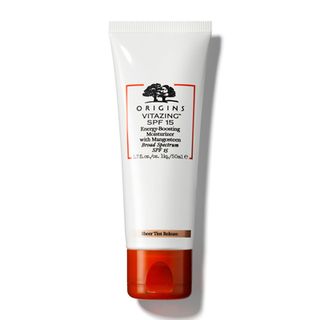
Origins VitaZing Energy-Boosting Moisturizer with Mangosteen SPF15
Works for
1 of 2 advertised claims delivered
Sun protectionSPF 15 · 5 UV filters · Broad spectrumWeak protectionSPF under 30
This product offers broad spectrum sun protection, but it is weak. We recommend to use a broad spectrum sunscreen with at least SPF 30.
This product can be considered "reef safe" because it does not contain the UV filters (oxybenzone and octinoxate) that can be harmful to coral reefs when present in the water in high concentrations.
Moisturizing20 ingredients credited for this claimGood support
“Vita Zing Energy-Boosting Moisturizer with Mangosteen SPF15”
This product can help improve hydration of the skin with the two types of ingredients.
The first type is called “humectants”:
these ingredients help attract water.
When humectants are on the surface of the skin, they “pull in” the moisture from the outside environment, or from
within deeper layers of the skin. The following ingredients in this product do the job:
glycerin, glyceryl acrylate/acrylic acid copolymer.
This product also contains ingredients called “occlusives”. They help reduce the speed with which our skin loses moisture to the outside environment. These ingredients also help soften the upper layer of the skin, so it feels less tight and nicer to the touch. The following ingredients in this product do the job: squalane, isopropyl myristate.
Anti-oxidationNot advertised by the brand · 7 ingredients credited for this claimModerate support
This product contains antioxidants (castanea sativa seed extract) that might be able to help neutralize free radicals in skin to lessen the damage it gets from the UV light (sun). There is not enough evidence to confirm their effectiveness in skin though.
Can it cause trouble?
Irritancy6 strong irritants: Citrus paradisi peel oil, Eucalyptus globulus leaf oil + 4 more — patch-test recommendedHigh risk
Comedogenic4 ingredients rated 2 or more on the 0–5 pore-clogging scale4 flagged

User reviews
Ingredients
Filter by role to see what each ingredient is doing.
Butyl methoxydibenzoylmethane3%
- Irritation risk
- Medium
Avobenzone. An organic, or so-called "chemical" UV filter. Protects against both UVA and UVB rays. Needs to be combined with other filters in a formulation to be stable.
More about Butyl methoxydibenzoylmethaneEthylhexyl salicylate3%
- Irritation risk
- Low
Octisalate. A UV filter. It offers some protection against the sun rays that cause sunburn (UVB), but does not protect against the most aging sun rays (UVA). It loses its effectiveness quickly when exposed to sunlight. It is an organic, or so called "chemical" sunscreen
More about Ethylhexyl salicylateOctocrylene2.7%
- Irritation risk
- Medium
A weak sunscreen that protects against the sun rays that cause sunburn (UVB) and is somewhat effective against the UVA rays. It is quite stable and can help stabilize other, more vulnerable, sunscreen ingredients like Avobenzone. It is an organic, or so called "chemical" sunscreen
More about OctocryleneWater~45–55%
Ethyl macadamiate~4.4–5.4%
Butylene glycol~4.6–5.6%
- Irritation risk
- Low
Used to create a nice product texture and help delivery of other ingredients. Might be somewhat helpful in attracting water to the upper layer of the skin
More about Butylene glycolMethyl trimethicone~3.8–4.7%
- Irritation risk
- Low
A type of silicone that helps create a silky product finish and dissolve other ingredients
More about Methyl trimethiconeHdi/trimethylol hexyllactone crosspolymer~2.6–3.2%
- Irritation risk
- Low
Used to create a silky product texture and add volume to products
More about Hdi/trimethylol hexyllactone crosspolymerLauryl peg-9 polydimethylsiloxyethyl dimethicone~1.9–2.3%
- Irritation risk
- Low
A type of silicone that helps to soften upper layer of the skin and create a nice product texture
More about Lauryl peg-9 polydimethylsiloxyethyl dimethiconePeg-100 stearate~1.4–1.8%
- Irritation risk
- Low
Helps oil and water mix togehter and creates a nice product texture
More about Peg-100 stearateButyloctyl salicylate~1.2–1.4%
- Irritation risk
- Medium
A synthetic ester of salicylic acid that is used to help disperse pigments and boost effectiveness of sunscreen ingredients. It is able to absorb UV light (working as an organic, or chemical filter), but is not approved as a sunscreen ingredient on its own
More about Butyloctyl salicylateJojoba esters~1–1.2%
- Irritation risk
- Medium
An emollient made of jojoba oil. Helps soften the skin and support its barrier function
More about Jojoba estersGlyceryl stearate~0.7–1.05%
- Irritation risk
- Low
An emollient that softens the skin and forms a protective layer on its surface. Helps water and oil mix together
More about Glyceryl stearateBarosma betulina leaf oil~0.55–0.85%
- Irritation risk
- Low
Citrus paradisi peel oil~0.45–0.7%
Eucalyptus globulus leaf oil~0.4–0.6%
- Irritation risk
- High
An essential oil that can be very irritating. Has some anti-bacterial properties
More about Eucalyptus globulus leaf oilAbies sibirica oil~0.3–0.55%
- Irritation risk
- Low
Prunus amygdalus amara kernel oil~0.3–0.55%
- Irritation risk
- Low
Mentha arvensis leaf oil~0.3–0.55%
Rosa damascena flower oil~0.3–0.55%
- Irritation risk
- High
Used as a fragrance. Can be irritating
More about Rosa damascena flower oilLimonene~0.25–0.5%
- Irritation risk
- High
A common frangrance that can easily irritate skin, especially if exposed to air, light or heat
More about LimonenePanax ginseng root extract~0.3–0.6%
- Irritation risk
- High
A plant extract that might have some anti-inflammatory properties, but solid evidence is lacking. It can be irritating
More about Panax ginseng root extractCordyceps sinensis extract~0.3–0.55%
- Irritation risk
- Low
Garcinia mangostana peel extract~0.25–0.4%
- Irritation risk
- Low
Castanea sativa seed extract~0.2–0.4%
- Irritation risk
- Medium
A plant extract that helps attract water to the upper layer of the skin and can help neutralize free radicals
More about Castanea sativa seed extractHordeum vulgare extract~0.25–0.5%
- Irritation risk
- Medium
A plant extract that might have some anti-oxidant properties. Avoid if you are sensitive to gluten
More about Hordeum vulgare extractTriticum vulgare germ extract~0.25–0.5%
- Irritation risk
- Medium
- Comedogenicity
- 3/5
Plant extract that might have moisturizing properties. Avoid if you suffer from wheat or gluten intolerance
More about Triticum vulgare germ extractLaminaria saccharina extract~0.2–0.4%
- Irritation risk
- Low
- Comedogenicity
- 3/5
A seaweed extract that contains sugars and can be helpful in attracting water to the upper layers of the skin if used in high enough concentrations
More about Laminaria saccharina extractMangifera indica seed butter~0.2–0.4%
- Irritation risk
- Low
Helps to soften the upper layer of the skin and might have some anti-oxidant effect
More about Mangifera indica seed butterButyrospermum parkii butter~0.3–0.55%
- Irritation risk
- Low
- Comedogenicity
- 3/5
A great moisturising ingredient that softens the skin and reduces water loss from its upper layer. It also can be helpful in protecting skin from free radicals
More about Butyrospermum parkii butterCaffeine~0.2–0.4%
- Irritation risk
- Medium
Might be helpful in neutralizing free radicals. Can have a dehydration effect that might somewhat decrease the look of puffy eyes
More about CaffeineCitrus aurantium amara flower water~0.2–0.35%
- Irritation risk
- High
A citrus plant essential oil (in a less concentrated format). Used as a fragrance and can be irritating
More about Citrus aurantium amara flower waterAnthemis nobilis flower extract~0.2–0.35%
- Irritation risk
- High
A plant extract that one one hand, can contain compounds that can help calm down skin irritation, but, on the other hand, its other compounds (especially fragrant ones) can themselves be irritating
More about Anthemis nobilis flower extractPotassium cetyl phosphate~0.25–0.45%
- Irritation risk
- Medium
Helps oil and water mix together
More about Potassium cetyl phosphateGlycerin~0.25–0.45%
- Irritation risk
- Low
One of the best moisturizing ingredients. Naturally present in skin. It attracts water to the upper layer of the skin working as a humectant
More about GlycerinCetyl alcohol~0.3–0.6%
- Irritation risk
- Low
A non-drying alcohol that works to soften the skin and stabilize product formulations helping oil and water mix together
More about Cetyl alcoholIsopropyl myristate~0.25–0.5%
- Irritation risk
- Low
- Comedogenicity
- 3/5
An emollient that helps soften the skin. Could be comedogenic
More about Isopropyl myristateTrehalose~0.2–0.35%
- Irritation risk
- Low
A sugar that attracts water to the upper layer of the skin
More about TrehaloseEthylhexylglycerin~0.2–0.4%
Linoleic acid~0.35–0.6%
- Irritation risk
- Low
An excellent emollient. Helps soften the skin, restore its barrier function, and can help to calm down inflammation. It can be helpful to prevent blemishes and clogged pores
More about Linoleic acidSqualane~0.3–0.55%
- Irritation risk
- Low
An oil naturally present in skin. Works as an emollient to soften the skin and form a protective layer on its surface without a greasy feeling.
More about SqualanePolymethyl methacrylate~0.3–0.55%
- Irritation risk
- Low
Is used to enhance product texture and can help to optically mask skin imperfections
More about Polymethyl methacrylateDehydroxanthan gum~0.3–0.55%
- Irritation risk
- Low
Helps create thicker product formulations and stabilize emulsions
More about Dehydroxanthan gumAscorbyl tocopheryl maleate~0.25–0.5%
- Irritation risk
- Low
Glyceryl acrylate/acrylic acid copolymer~0.2–0.4%
- Irritation risk
- Medium
Helps attract water to the upper layer of the skin and provide a longer-lasting hydration. Can create a thicker product consistency
More about Glyceryl acrylate/acrylic acid copolymerSodium hyaluronate~0.2–0.35%
- Irritation risk
- Low
One of the best moisturizing ingredients. Attracts water into the upper layer of the skin
More about Sodium hyaluronateCaprylyl glycol~0.25–0.45%
- Irritation risk
- Medium
Helps preserve products and creates a nice product texture
More about Caprylyl glycolAmmonium acryloyldimethyltaurate/vp copolymer~0.2–0.4%
- Irritation risk
- Low
Increases thickness of a product. Texture enhancer for oil-in-water emulsions
More about Ammonium acryloyldimethyltaurate/vp copolymerCitric acid~0.2–0.4%
- Irritation risk
- Medium
Can work as an exfoliant but is typically used to adjust the product pH
More about Citric acidStearic acid~0.4–0.6%
- Irritation risk
- Low
Helps oil and water mix together and works as an emollient
More about Stearic acidSilica~0.4–0.65%
Sodium dehydroacetate~0.2–0.35%
Phenoxyethanol~0.15–0.3%
- Irritation risk
- Low
A preservative. It helps prevent bacterial growth in cosmetic products
More about PhenoxyethanolMica~0.2–0.4%
- Irritation risk
- Low
Creates an illusion of smoother and more radiant skin tone. Adds shimmer to the skin by reflecting light
More about MicaIron oxides~0.15–0.25%
- Irritation risk
- Low
An umbrella term for the following three colorants: CI 77491, CI 77492, CI 77499. They might be able to offer some protection against visible light, but the degree of the protection is not clear
More about Iron oxidesTitanium dioxide~0.15–0.3%
- Irritation risk
- Low
Works as a UV filter when used in high concentrations. It is photostable and is effective mostly against the UVB light, with some protection in the UVA range. In small concentrations, used for its ability to improve the color of cosmetic products. Is usually well tolerated by the skin
More about Titanium dioxideCi 77891~0.1–0.2%
- Irritation risk
- Low
Ingredient list view
Butyl methoxydibenzoylmethane, Ethylhexyl salicylate, Octocrylene, Water, Ethyl macadamiate, Butylene glycol, Methyl trimethicone, Hdi/trimethylol hexyllactone crosspolymer, Lauryl peg-9 polydimethylsiloxyethyl dimethicone, Peg-100 stearate, Butyloctyl salicylate, Jojoba esters, Glyceryl stearate, Barosma betulina leaf oil, Citrus paradisi peel oil, Eucalyptus globulus leaf oil, Abies sibirica oil, Prunus amygdalus amara kernel oil, Mentha arvensis leaf oil, Rosa damascena flower oil, Limonene, Panax ginseng root extract, Cordyceps sinensis extract, Garcinia mangostana peel extract, Castanea sativa seed extract, Hordeum vulgare extract, Triticum vulgare germ extract, Laminaria saccharina extract, Mangifera indica seed butter, Butyrospermum parkii butter, Caffeine, Citrus aurantium amara flower water, Anthemis nobilis flower extract, Potassium cetyl phosphate, Glycerin, Cetyl alcohol, Isopropyl myristate, Trehalose, Ethylhexylglycerin, Linoleic acid, Squalane, Polymethyl methacrylate, Dehydroxanthan gum, Ascorbyl tocopheryl maleate, Glyceryl acrylate/acrylic acid copolymer, Sodium hyaluronate, Caprylyl glycol, Ammonium acryloyldimethyltaurate/vp copolymer, Citric acid, Stearic acid, Silica, Sodium dehydroacetate, Phenoxyethanol, Mica, Iron oxides, Titanium dioxide, Ci 77891
Compare prices
Retailers ranked by price — lowest first.
Affiliate links · prices updated regularly
Worth comparing, line by line.
Match % combines shared ingredients, the first five ingredients, shared actives and hero ingredients, irritancy (lower counts in the alternative's favour), texture and body area. Only products in the same routine step are compared.
| OriginsVitaZing Energy-Boosting Moisturizer with Mangosteen SPF15YOUR PRODUCT | CliniqueEven Better Moisturizer SPF 20 | M-61Hydraboost Moisturizer SPF 30 | Specific BeautyActive Brightening Day Moisture Broad Spectrum SPF 30 | |
|---|---|---|---|---|
| Match | — | 58% | 58% | 52% |
| Price | $50.24 | $56.00+$5.76 | $78.00+$27.76 | — |
| Shared key ingredients | — | 8 of 16 | 7 of 16 | 5 of 16 |
| Key difference | — | Ascorbyl Glucoside | Urea | Niacinamide |
| Irritancy | High | Medium | Medium | Medium |
| SPF | SPF 15 | SPF 20 | SPF 30 | SPF 30 |
| Drying alcohol | — | — | — | — |
| View product | Shop | Shop | Shop |


Product summary
"Origins - VitaZing Energy-Boosting Moisturizer with Mangosteen SPF15" "is a broad spectrum sunscreen meaning that it protects both from UVB rays (" burning "- they cause sunburn) and UVA rays (" aging "- they don't cause sunburn but lead to premature aging and pigmentation issues). However, this moisturizer does not offer enough sun protection. We recommend to use a sunscreen with at least SPF 30 daily.
It contains good moisturizing ingredients and can double as a hydrating day cream.
Sunscreen filters
This sunscreen uses so-called" chemical ", or organic UV filters (organic simply means that their molecules contain atoms of carbon). These filters typically give good sun protection and rarely leave a white cast, but they can be irritating for sensitive skin. Here are the exact UV filters in this sunscreen: avobenzone 3.00% (declared), butyloctyl salicylate 1.20% - 1.40%, octisalate 3.00% (declared) and octocrylene 2.70% (declared).
Irritation risk
This moisturizer contains a bunch of common irritants, including ingredients that do not provide any known benefit for the skin. It might not be the best choice if your skin is sensitive. We assess the overall irritancy of this moisturizer to be high. For a detailed overview of all potential irritants: click here
You can see the detailed formula review with the breakdown of all actives in the product and the full ingredient list with estimated concentrations in the tables below.
What our users say
Based on 1 review 100% recommend this product- When it comes to comedogenicity, the reviewer found that it does not clog pores.
- As for the white cast, it did not leave a noticeable white residue for the reviewer.
- When it comes to using this sunscreen under makeup, the user found that it pills under a foundation.
- As for using this sunscreen in the eye area, the reviewer reported that it does not sting eyes.
Price
The product retails for 38.00£ in the United Kingdom.
For a detailed price comparison: click here.
Sources cited in this review
Every concentration estimate and effectiveness label is anchored to one of these 20 studies and safety reviews.
- 1
- 2
- 3
- 4Ginseng in Dermatology: A Reviewncbi.nlm.nih.gov
- 5
- 6Chestnut extractmdedge.com

Affiliate links · As an Amazon Associate, WIMJ earns from qualifying purchases.