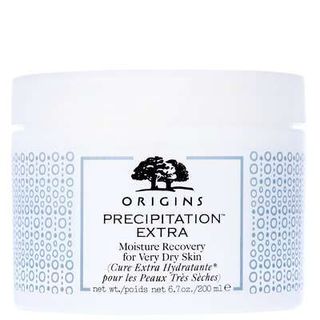
Origins Precipitation Moisture Recovery For Very Dry Skin
Works for
1 of 1 advertised claim delivered
Moisturizing21 ingredients credited for this claimStrong support
“Precipitation Moisture Recovery For Very Dry Skin”
This product can help improve hydration of the skin with the two types of ingredients.
The first type is called “humectants”:
these ingredients help attract water.
When humectants are on the surface of the skin, they “pull in” the moisture from the outside environment, or from
within deeper layers of the skin. The following ingredients in this product do the job:
glycerin, butylene glycol.
This product also contains ingredients called “occlusives”. They help reduce the speed with which our skin loses moisture to the outside environment. These ingredients also help soften the upper layer of the skin, so it feels less tight and nicer to the touch. The following ingredients in this product do the job: ethylhexyl hydroxystearate, helianthus annuus seed oil.
The following ingredients in this product are especially good for supporting the skin barrier and helping with the hydration level: phytosphingosine
Can it cause trouble?
Irritancy17 strong irritants: Citrus aurantium amara flower water, Citrus grandis peel oil + 15 more — patch-test recommendedHigh risk
Comedogenic4 ingredients rated 2 or more on the 0–5 pore-clogging scale4 flagged


User reviews
Be the first — your take helps the next person decide.
Ingredients
Filter by role to see what each ingredient is doing.
Water~45–55%
Anthemis nobilis flower extract~4.9–6%
- Irritation risk
- High
A plant extract that one one hand, can contain compounds that can help calm down skin irritation, but, on the other hand, its other compounds (especially fragrant ones) can themselves be irritating
More about Anthemis nobilis flower extractCitrus aurantium amara flower water~4.1–5%
- Irritation risk
- High
A citrus plant essential oil (in a less concentrated format). Used as a fragrance and can be irritating
More about Citrus aurantium amara flower waterCyclopentasiloxane~3–3.7%
- Irritation risk
- Low
A silicone that helps improve the product texture and spreadability. Can absorb oil creating a short-term mattifying effect on the skin
More about CyclopentasiloxaneGlycine soja oil~2.1–2.6%
- Irritation risk
- Medium
- Comedogenicity
- 2/5
A good emollient that helps soften the skin and helps repair its barrier function. It can clog pores if used in high concentrations.
More about Glycine soja oilAloe barbadensis leaf juice~1.8–2.2%
- Irritation risk
- Medium
Traditionally used to treat sunburns, dermatitis and inflammation, but evidence for its effectiveness is lacking. The extract can contain humectants that help attract water into the skin
More about Aloe barbadensis leaf juiceCetyl ethylhexanoate~1.5–1.8%
- Irritation risk
- Medium
An emollient that helps soften the skin and creates a thicker product texture
More about Cetyl ethylhexanoateCetyl alcohol~1.3–1.6%
- Irritation risk
- Low
A non-drying alcohol that works to soften the skin and stabilize product formulations helping oil and water mix together
More about Cetyl alcoholGlyceryl stearate~1–1.2%
- Irritation risk
- Low
An emollient that softens the skin and forms a protective layer on its surface. Helps water and oil mix together
More about Glyceryl stearateButylene glycol~0.65–1%
- Irritation risk
- Low
Used to create a nice product texture and help delivery of other ingredients. Might be somewhat helpful in attracting water to the upper layer of the skin
More about Butylene glycolOctyldodecanol~0.5–0.75%
- Irritation risk
- Low
An emollient that helps to soften the skin and create a pleasant product texture and stabilize the formulation
More about OctyldodecanolEthylhexyl hydroxystearate~0.45–0.7%
- Irritation risk
- Low
Helps soften the upper layer of the skin and reduce water loss from it
More about Ethylhexyl hydroxystearatePeg-100 stearate~0.5–0.75%
- Irritation risk
- Low
Helps oil and water mix togehter and creates a nice product texture
More about Peg-100 stearateGlyceryl polymethacrylate~0.35–0.6%
- Irritation risk
- Low
Used to create a nice product texture
More about Glyceryl polymethacrylateFerula galbaniflua resin oil~0.25–0.45%
- Irritation risk
- Low
Citrus grandis peel oil~0.25–0.45%
- Irritation risk
- High
A plant oil with high content of volatile compounds that, especially when exposed to air, can cause allergic reactions and irritate the skin
More about Citrus grandis peel oilCymbopogon martini oil~0.25–0.45%
- Irritation risk
- High
Aromatic plant oil used in cosmetics as a fragrance. A likely irritant
More about Cymbopogon martini oilCitrus aurantium dulcis peel oil~0.25–0.4%
- Irritation risk
- High
An essentil oil from orange peel. Potential allergen and can be irritating
More about Citrus aurantium dulcis peel oilCitrus limon peel oil~0.2–0.35%
Lavandula hybrida oil~0.2–0.4%
- Irritation risk
- High
Plant extract that can be irritating and is a known allergen
More about Lavandula hybrida oilAbies sibirica oil~0.15–0.3%
- Irritation risk
- Low
Citrus nobilis peel oil~0.15–0.3%
- Irritation risk
- High
A plant oil with high content of volatile compounds that, especially when exposed to air, can cause allergic reactions and irritate the skin
More about Citrus nobilis peel oilCitrus reticulata leaf oil~0.15–0.25%
- Irritation risk
- High
Eugenia caryophyllus leaf oil~0.1–0.2%
- Irritation risk
- High
An essential oil. Used as a fragrance. Can be irritating and sensitizing
More about Eugenia caryophyllus leaf oilCitrus aurantium bergamia fruit oil~0.15–0.25%
- Irritation risk
- High
A plant oil with a high content of volatile compounds that can irritate the skin and lead to allergic reactions. Can lead to photosensitivity
More about Citrus aurantium bergamia fruit oilGossypium herbaceum seed oil~0.15–0.3%
- Irritation risk
- Low
- Comedogenicity
- 3/5
Cottonseed oil. It is used as an emollient and occlusive in products. It is rich palmitic, oleic acid, and linoleic fatty acids.
More about Gossypium herbaceum seed oilCitrus aurantifolia peel extract~0.15–0.3%
- Irritation risk
- High
Citrus aurantium amara peel extract~0.15–0.3%
- Irritation risk
- High
Styrax benzoin gum~0.2–0.4%
- Irritation risk
- Low
Geraniol~0.15–0.3%
Linalool~0.15–0.3%
Eugenol~0.15–0.25%
Limonene~0.15–0.3%
- Irritation risk
- High
A common frangrance that can easily irritate skin, especially if exposed to air, light or heat
More about LimoneneCoffea arabica seed extract~0.2–0.35%
- Irritation risk
- Low
Might be helpful in neutralizing free radicals in skin
More about Coffea arabica seed extractPanthenol~0.2–0.4%
- Irritation risk
- Low
Helps attract water to the upper layer of the skin and can help improve skin barrier function
More about PanthenolPanax ginseng root extract~0.25–0.4%
- Irritation risk
- High
A plant extract that might have some anti-inflammatory properties, but solid evidence is lacking. It can be irritating
More about Panax ginseng root extractBisabolol~0.2–0.35%
- Irritation risk
- Low
An active component of chamomile plant that historically has been used to calm down irritated skin. A recent study shows that bisabolol indeed can have some anti-inflammatory effect on skin, even though conclusive data is lacking. Bisabolol has a sweet floral scent and can be added to products for its aromatic properties
More about BisabololPhellodendron amurense bark extract~0.2–0.35%
- Irritation risk
- Medium
A plant extract that might have an anti-inflammatory effect
More about Phellodendron amurense bark extractSalvia sclarea extract~0.2–0.35%
- Irritation risk
- High
Used as a fragrance. Can be irritating
More about Salvia sclarea extractTocopheryl acetate~0.25–0.4%
- Irritation risk
- Medium
A more stable but less bio-available form of vitamin E compared to Tocopherol. Might help moisturize and protect the skin from free radicals, but mostly used in low concentrations to stabilize other ingredients.
More about Tocopheryl acetateAstrocaryum murumuru seed butter~0.25–0.45%
- Irritation risk
- Medium
Helps soften the upper layer of the skin. Could be comedogenic due to the myrisic acid content
More about Astrocaryum murumuru seed butterGentiana lutea root extract~0.2–0.4%
- Irritation risk
- Medium
A plant extract that can help strengthen the skin barrier function and improve skin moisture levels
More about Gentiana lutea root extractHordeum distichon extract~0.2–0.4%
- Irritation risk
- Low
Hordeum vulgare extract~0.25–0.45%
- Irritation risk
- Medium
A plant extract that might have some anti-oxidant properties. Avoid if you are sensitive to gluten
More about Hordeum vulgare extractHelianthus annuus seed oil~0.25–0.45%
- Irritation risk
- Low
A great emollient due to its high linoleic acid content. One of the most effective plant oils in helping skin hydration and repairing skin barrier function
More about Helianthus annuus seed oilXanthan gum~0.2–0.4%
- Irritation risk
- Low
Used to create a thicker product consistency
More about Xanthan gumGlycine soja sterols~0.25–0.45%
- Irritation risk
- Low
An emollient that helps soften the skin
More about Glycine soja sterolsGlycerin~0.25–0.45%
- Irritation risk
- Low
One of the best moisturizing ingredients. Naturally present in skin. It attracts water to the upper layer of the skin working as a humectant
More about GlycerinPotassium hydroxide~0.25–0.4%
Chondrus crispus~0.2–0.35%
- Irritation risk
- Low
- Comedogenicity
- 3/5
Red algae extract that helps attract water to the upper layer of the skin and create a nicer product consistency
More about Chondrus crispusCarrageenan~0.25–0.4%
- Irritation risk
- Medium
- Comedogenicity
- 3/5
Helps thicken the product formula and create a nice product formulation
More about CarrageenanPropylene glycol dicaprate~0.25–0.5%
- Irritation risk
- Low
An emollient that helps soften the upper layer of the skin
More about Propylene glycol dicapratePhytosphingosine~0.25–0.5%
- Irritation risk
- Low
A type of lipid that is naturally present in skin. It might help in repairing skin barrier function and has anti-bacterial effect
More about PhytosphingosineSorbitan palmitate~0.25–0.45%
- Irritation risk
- Medium
Helps water and oil mix together and stabilize the product formulation
More about Sorbitan palmitatePhenyl trimethicone~0.25–0.45%
- Irritation risk
- Low
A type of silicone that can decrease loss of moisture from the skin surface. It helps create a nice product texture
More about Phenyl trimethiconePolysorbate 60~0.2–0.4%
Carbomer~0.15–0.3%
- Irritation risk
- Low
Helps create a thicker or gel-like product texture. It is not a surfactant but can be used in gentle cleansing formulations
More about CarbomerStearic acid~0.25–0.5%
- Irritation risk
- Low
Helps oil and water mix together and works as an emollient
More about Stearic acidDisodium edta~0.15–0.3%
Sorbic acid~0.15–0.3%
Chlorphenesin~0.15–0.25%
Phenoxyethanol~0.15–0.25%
- Irritation risk
- Low
A preservative. It helps prevent bacterial growth in cosmetic products
More about PhenoxyethanolIngredient list view
Water, Anthemis nobilis flower extract, Citrus aurantium amara flower water, Cyclopentasiloxane, Glycine soja oil, Aloe barbadensis leaf juice, Cetyl ethylhexanoate, Cetyl alcohol, Glyceryl stearate, Butylene glycol, Octyldodecanol, Ethylhexyl hydroxystearate, Peg-100 stearate, Glyceryl polymethacrylate, Ferula galbaniflua resin oil, Citrus grandis peel oil, Cymbopogon martini oil, Citrus aurantium dulcis peel oil, Citrus limon peel oil, Lavandula hybrida oil, Abies sibirica oil, Citrus nobilis peel oil, Citrus reticulata leaf oil, Eugenia caryophyllus leaf oil, Citrus aurantium bergamia fruit oil, Gossypium herbaceum seed oil, Citrus aurantifolia peel extract, Citrus aurantium amara peel extract, Styrax benzoin gum, Geraniol, Linalool, Eugenol, Limonene, Coffea arabica seed extract, Panthenol, Panax ginseng root extract, Bisabolol, Phellodendron amurense bark extract, Salvia sclarea extract, Tocopheryl acetate, Astrocaryum murumuru seed butter, Gentiana lutea root extract, Hordeum distichon extract, Hordeum vulgare extract, Helianthus annuus seed oil, Xanthan gum, Glycine soja sterols, Glycerin, Potassium hydroxide, Chondrus crispus, Carrageenan, Propylene glycol dicaprate, Phytosphingosine, Sorbitan palmitate, Phenyl trimethicone, Polysorbate 60, Carbomer, Stearic acid, Disodium edta, Sorbic acid, Chlorphenesin, Phenoxyethanol
Compare prices
Retailers ranked by price — lowest first.
Affiliate links · prices updated regularly · As an Amazon Associate, WIMJ earns from qualifying purchases.
Worth comparing, line by line.
Match % combines shared ingredients, the first five ingredients, shared actives and hero ingredients, irritancy (lower counts in the alternative's favour), texture and body area. Only products in the same routine step are compared.
| OriginsPrecipitation Moisture Recovery For Very Dry SkinYOUR PRODUCT | TOSOWOONGCeramide Cream | AcadermaBetter With Age - Rejuvenating Rich Cream | mixsoonMaster Repair Cream Deep Soothing | |
|---|---|---|---|---|
| Match | — | 55% | 55% | 54% |
| Price | $39.87 | $16.40−$23.47 | $80.00+$40.13 | $42.00+$2.13 |
| Shared key ingredients | — | 4 of 12 | 4 of 12 | 4 of 12 |
| Key difference | — | Madecassoside | Acetyl Tetrapeptide-9 | Madecassoside |
| Irritancy | High | Medium | Medium | Medium |
| Drying alcohol | — | Contains drying alcohol | — | — |
| View product | Shop | Shop | Shop |


Product summary
Based on the ingredient list, "Origins - Precipitation Moisture Recovery For Very Dry Skin" can work well for skin moisturization. As we expect from a proper moisturizer, the formula includes a combo of effective humectants and emollients. These are the two different types of ingredients that are essential for improving the skin hydration and supporting a healthy skin barrier. Glycerin, butylene glycol and glyceryl polymethacrylate in this product (humectants) attract water molecules to the upper layer of the skin (the water comes from the outside air or from the deeper layers of the skin if the air is dry). Phytosphingosine, astrocaryum murumuru seed butter, glycine soja oil, glycine soja sterols and ethylhexyl hydroxystearate in this product help decrease the water evoporation from the skin, so that it stays hydrated for longer. These ingredients also soften the skin and take away the feeling of tightness and dryness.
Ingredient callouts
- As a plus, this moisturizer also contains Ceramides (phytosphingosine 0.25% - 0.50%). Ceramides are a type of lipids that our skin produces itself. They are a building block of the skin's barrier. Ceramides used in skincare are synthetic or extracted from plants. They work well for softening the skin surface and "patch holes" in the skin's barrier.
Irritation risk
There are quite a few common irritants in this product, including ingredients without particular skin benefits. We would not recommend it for sensitive skin. We assess the overall irritancy of this moisturizer to be high. For a detailed overview of all potential irritants: click here
You can see the detailed formula review with the breakdown of all actives in the product and the full ingredient list with estimated concentrations in the tables below.
Price
The product retails from 29.90£ up to 328.00£ in the United Kingdom, for 115.94A$ in Australia and for 41.98$ in the United States.
For a detailed price comparison: click here.
Sources cited in this review
Every concentration estimate and effectiveness label is anchored to one of these 24 studies and safety reviews.
- 1
- 2
- 3
- 4Air oxidation increases skin irritation from fragrance terpenesonlinelibrary.wiley.com
- 5
- 6

Affiliate links · As an Amazon Associate, WIMJ earns from qualifying purchases.