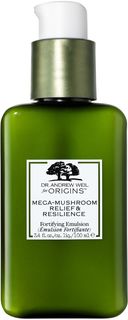
Origins Dr. Andrew Weil for Origins Mega-Mushroom Relief & Resilience Weightless Moisturizer
Works for
1 of 1 advertised claim delivered
Moisturizing21 ingredients credited for this claimGood support
“Dr. Andrew Weil for Origins Mega-Mushroom Relief & Resilience Weightless Moisturizer”
This product can help improve hydration of the skin with the two types of ingredients.
The first type is called “humectants”:
these ingredients help attract water.
When humectants are on the surface of the skin, they “pull in” the moisture from the outside environment, or from
within deeper layers of the skin. The following ingredients in this product do the job:
algae extract, glycerin.
This product also contains ingredients called “occlusives”. They help reduce the speed with which our skin loses moisture to the outside environment. These ingredients also help soften the upper layer of the skin, so it feels less tight and nicer to the touch. The following ingredients in this product do the job: helianthus annuus seed oil, simmondsia chinensis seed oil.
Can it cause trouble?
Irritancy11 strong irritants: Lavandula angustifolia oil, Citrus nobilis peel oil + 9 more — patch-test recommendedHigh risk
Comedogenic1 ingredient rated 2 or more on the 0–5 pore-clogging scale1 flagged
User reviews
Be the first — your take helps the next person decide.
Ingredients
Filter by role to see what each ingredient is doing.
Water~45–55%
Squalane~4.7–5.8%
- Irritation risk
- Low
An oil naturally present in skin. Works as an emollient to soften the skin and form a protective layer on its surface without a greasy feeling.
More about SqualaneSimmondsia chinensis seed oil~4.4–5.4%
- Irritation risk
- Medium
Softens the upper layer of skin and helps restore the healthy skin barrier. Has shown to help calm down inflammation in skin. It is a stable oil, meaning that it retains its properties even when exposed to air.
More about Simmondsia chinensis seed oilButylene glycol~3.1–3.8%
- Irritation risk
- Low
Used to create a nice product texture and help delivery of other ingredients. Might be somewhat helpful in attracting water to the upper layer of the skin
More about Butylene glycolGlycerin~2.4–3%
- Irritation risk
- Low
One of the best moisturizing ingredients. Naturally present in skin. It attracts water to the upper layer of the skin working as a humectant
More about GlycerinPolyglyceryl-3 methylglucose distearate~2–2.4%
- Irritation risk
- Medium
Helps water and oil mix together
More about Polyglyceryl-3 methylglucose distearateLavandula angustifolia oil~1.6–2%
- Irritation risk
- High
An essential oil. Potential allergen and can be irritating. It has some anti-bacterial properties
More about Lavandula angustifolia oilCitrus nobilis peel oil~1.4–1.7%
- Irritation risk
- High
A plant oil with high content of volatile compounds that, especially when exposed to air, can cause allergic reactions and irritate the skin
More about Citrus nobilis peel oilPogostemon cablin oil~1.3–1.5%
- Irritation risk
- Low
Boswellia carterii oil~1–1.2%
Citrus aurantium dulcis oil~0.75–1.15%
- Irritation risk
- High
Used as a fragrance. It can be irritating and cause photosensitivity
More about Citrus aurantium dulcis oilPelargonium graveolens flower oil~0.7–1%
- Irritation risk
- High
An essential oil. Can be irritating. Can become an allergen with oxidation
More about Pelargonium graveolens flower oilLinalool~0.6–0.9%
Citronellol~0.55–0.85%
Limonene~0.5–0.8%
- Irritation risk
- High
A common frangrance that can easily irritate skin, especially if exposed to air, light or heat
More about LimoneneGeraniol~0.5–0.8%
Ganoderma lucidum extract~0.55–0.8%
- Irritation risk
- Medium
Helps attract water to the upper layer of the skin
More about Ganoderma lucidum extractAlgae extract~0.55–0.85%
- Irritation risk
- Low
- Comedogenicity
- 3/5
Plant extract that helps the skin to attract water and make it more smooth for touch. Also shows promise of anti-aging properties, but research is not extensive yet
More about Algae extractLens esculenta fruit extract~0.45–0.7%
- Irritation risk
- Medium
A plant extract containing sugars that might help attract water to the upper layer of the skin. Is claimed by the manufacturer to help reduce pore size but evidence is lacking
More about Lens esculenta fruit extractPyrus malus fruit extract~0.45–0.65%
- Irritation risk
- Medium
Can have some moisturizing properties due to its sugar content
More about Pyrus malus fruit extractFuscoporia obliqua sclerotium extract~0.4–0.65%
- Irritation risk
- Low
Cordyceps sinensis extract~0.45–0.65%
- Irritation risk
- Low
Zingiber officinale root extract~0.3–0.55%
- Irritation risk
- High
A plant extract that can contain an irritating essential oil. Might have some anti-oxidant effect, but evidence is lacking
More about Zingiber officinale root extractCurcuma longa root extract~0.35–0.6%
- Irritation risk
- High
A plant extract that can contain an active compound curcumin, that may have some anti-inflammatory properties when applied to the skin, but solid research is lacking and the typical concentration used in skincare products is too low. Can be an irritant
More about Curcuma longa root extractOcimum sanctum leaf extract~0.35–0.65%
- Irritation risk
- High
A plant extract that is rich in a fragrance compound eugenol that is a frequent allergen and can be irritating. It might also contain anti-oxidants to help neutralize free radicals
More about Ocimum sanctum leaf extractSilybum marianum fruit extract~0.35–0.65%
- Irritation risk
- Low
Sodium hyaluronate~0.4–0.6%
- Irritation risk
- Low
One of the best moisturizing ingredients. Attracts water into the upper layer of the skin
More about Sodium hyaluronateHelianthus annuus seed oil~0.45–0.65%
- Irritation risk
- Low
A great emollient due to its high linoleic acid content. One of the most effective plant oils in helping skin hydration and repairing skin barrier function
More about Helianthus annuus seed oilLactobacillus ferment~0.35–0.65%
- Irritation risk
- Low
A fermentation product created by bacteria Lactobacillus. The fermented product has anti-bacterial properties and might be helpful in calming down inflammation, but studies are lacking. Helps attract water to the upper layer of the skin. Can be used as a preservative
More about Lactobacillus fermentTocopheryl acetate~0.4–0.65%
- Irritation risk
- Medium
A more stable but less bio-available form of vitamin E compared to Tocopherol. Might help moisturize and protect the skin from free radicals, but mostly used in low concentrations to stabilize other ingredients.
More about Tocopheryl acetateCitrullus lanatus fruit extract~0.35–0.65%
- Irritation risk
- Medium
A plant extract that can contain an antioxidant compound
More about Citrullus lanatus fruit extractCamelina sativa seed oil~0.35–0.65%
- Irritation risk
- Low
Helps soften the upper layer of the skin
More about Camelina sativa seed oilSorbitol~0.4–0.6%
- Irritation risk
- Low
Helps attract water to the upper layer of the skin and improves the product texture
More about SorbitolSaccharomyces ferment filtrate~0.4–0.6%
- Irritation risk
- Low
A product of yeast fermentation. Helps attract water to the upper layer of the skin
More about Saccharomyces ferment filtrateSodium stearoyl glutamate~0.45–0.7%
- Irritation risk
- Medium
Helps oil and water mix together
More about Sodium stearoyl glutamateHippophae rhamnoides extract~0.35–0.65%
- Irritation risk
- Low
Caffeine~0.4–0.6%
- Irritation risk
- Medium
Might be helpful in neutralizing free radicals. Can have a dehydration effect that might somewhat decrease the look of puffy eyes
More about CaffeineCoco-caprylate/caprate~0.45–0.65%
- Irritation risk
- Low
Helps to soften the upper layer of the skin without creating a greasy texture
More about Coco-caprylate/caprateSucrose~0.35–0.6%
- Irritation risk
- Low
Can help attract water to the upper layer of the skin. In crystal form, it can work as a gentle exfoliant, gentler than the salt scrub. Helps stabilize the emulsion
More about SucrosePolysorbate 20~0.45–0.65%
Sodium hydroxide~0.4–0.6%
Sodium lactate~0.4–0.6%
- Irritation risk
- Medium
Helps attract water to the upper layer of the skin. Is often used to adjust the pH level of the product
More about Sodium lactateErgothioneine~0.35–0.65%
- Irritation risk
- Low
Can help neutralize free radicals in skin. Preliminary studies show that it can be more effective than coenzyme Q10 but studies on effective concentration for topical applications are lacking
More about ErgothioneineMaltodextrin~0.4–0.6%
- Irritation risk
- Low
Used to stabilize the product formulation and can help absorb oil
More about MaltodextrinBehenyl alcohol~0.45–0.7%
- Irritation risk
- Low
Non-drying alcohol that helps water and oil mix together. Also serves as an emollient
More about Behenyl alcoholPolyacrylate crosspolymer-6~0.4–0.6%
- Irritation risk
- Low
Sodium pca~0.35–0.6%
- Irritation risk
- Low
Naturally present in skin and helps to attract water to its upper layer
More about Sodium pcaAmmonium acryloyldimethyltaurate/vp copolymer~0.3–0.6%
- Irritation risk
- Low
Increases thickness of a product. Texture enhancer for oil-in-water emulsions
More about Ammonium acryloyldimethyltaurate/vp copolymerHydrogenated lecithin~0.35–0.6%
- Irritation risk
- Low
Helps to retain moisture by creating a protective barrier on the skin. Rich in fatty acids. Improves product texture and helps with the penetration of other ingredients.
More about Hydrogenated lecithinAcrylates/c10-30 alkyl acrylate crosspolymer~0.3–0.55%
- Irritation risk
- Medium
Maintains the texture of skincare products. Allows the product to spread evenly. Helps oil and water mix together
More about Acrylates/c10-30 alkyl acrylate crosspolymerPalmitic acid~0.3–0.6%
- Irritation risk
- Low
An emollient that is naturally present in skin and helps soften it
More about Palmitic acidCaprylyl glycol~0.3–0.55%
- Irritation risk
- Medium
Helps preserve products and creates a nice product texture
More about Caprylyl glycolHexylene glycol~0.2–0.4%
- Irritation risk
- Medium
Helps create a more spreadable product texture
More about Hexylene glycolT-butyl alcohol~0.15–0.3%
- Irritation risk
- Medium
Used to dissolve other ingredients and to improve smell of products. It could be irritating
More about T-butyl alcoholSodium benzoate~0.1–0.25%
Phenoxyethanol~0.15–0.3%
- Irritation risk
- Low
A preservative. It helps prevent bacterial growth in cosmetic products
More about PhenoxyethanolPotassium sorbate~0.15–0.3%
Sucrose~0.1–0.2%
- Irritation risk
- Low
Can help attract water to the upper layer of the skin. In crystal form, it can work as a gentle exfoliant, gentler than the salt scrub. Helps stabilize the emulsion
More about SucroseIngredient list view
Water, Squalane, Simmondsia chinensis seed oil, Butylene glycol, Glycerin, Polyglyceryl-3 methylglucose distearate, Lavandula angustifolia oil, Citrus nobilis peel oil, Pogostemon cablin oil, Boswellia carterii oil, Citrus aurantium dulcis oil, Pelargonium graveolens flower oil, Linalool, Citronellol, Limonene, Geraniol, Ganoderma lucidum extract, Algae extract, Lens esculenta fruit extract, Pyrus malus fruit extract, Fuscoporia obliqua sclerotium extract, Cordyceps sinensis extract, Zingiber officinale root extract, Curcuma longa root extract, Ocimum sanctum leaf extract, Silybum marianum fruit extract, Sodium hyaluronate, Helianthus annuus seed oil, Lactobacillus ferment, Tocopheryl acetate, Citrullus lanatus fruit extract, Camelina sativa seed oil, Sorbitol, Saccharomyces ferment filtrate, Sodium stearoyl glutamate, Hippophae rhamnoides extract, Caffeine, Coco-caprylate/caprate, Sucrose, Polysorbate 20, Sodium hydroxide, Sodium lactate, Ergothioneine, Maltodextrin, Behenyl alcohol, Polyacrylate crosspolymer-6, Sodium pca, Ammonium acryloyldimethyltaurate/vp copolymer, Hydrogenated lecithin, Acrylates/c10-30 alkyl acrylate crosspolymer, Palmitic acid, Caprylyl glycol, Hexylene glycol, T-butyl alcohol, Sodium benzoate, Phenoxyethanol, Potassium sorbate, Sucrose, Unknown
Compare prices
Retailers ranked by price — lowest first.

Affiliate links · prices updated regularly
Sources cited in this review
Every concentration estimate and effectiveness label is anchored to one of these 23 studies and safety reviews.
- 1
- 2
- 3
- 4Air oxidation increases skin irritation from fragrance terpenesonlinelibrary.wiley.com
- 5
- 6

Affiliate links · As an Amazon Associate, WIMJ earns from qualifying purchases.