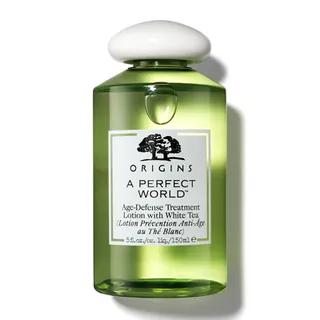
Origins A Perfect World Antioxidant Treatment Lotion White Tea
Works for
MoisturizingGlycerin, Trehalose + 6 moreWorks
“Ingredients including White Tea help to preserve skins youth, whilst dirt-grabbing minerals and gentle palm and coconut detoxify the skin and prevent dehydration.”
This product contains good ingredients to attract water to the upper layer of the skin. These ingredients are called "humectants": glycerin, sodium hyaluronate.
When humectants are on the surface of the skin, they “pull in” the moisture from the outside environment, or from within deeper layers of the skin. If the air is dry, humectants can speed up the moisture loss from the skin. This is why it is a good idea to use another product on top of this one to help "seal in" the moisture (look for ingredients like dimethicone, squalane, oils and butters).
Can it cause trouble?
Irritancy10 strong irritants: Citrus aurantium bergamia fruit oil, Citrus limon peel oil + 8 more — patch-test recommendedHigh risk
ComedogenicClean of flagged comedogenic ingredientsNone flagged
User reviews
Be the first — your take helps the next person decide.
Ingredients
Filter by role to see what each ingredient is doing.
Water~40–60%
Butylene glycol~5.5–8.2%
- Irritation risk
- Low
Used to create a nice product texture and help delivery of other ingredients. Might be somewhat helpful in attracting water to the upper layer of the skin
More about Butylene glycolCitrus aurantium bergamia fruit oil~3.8–5.7%
- Irritation risk
- High
A plant oil with a high content of volatile compounds that can irritate the skin and lead to allergic reactions. Can lead to photosensitivity
More about Citrus aurantium bergamia fruit oilCitrus limon peel oil~2.6–3.9%
Citrus aurantium dulcis oil~2–3.1%
- Irritation risk
- High
Used as a fragrance. It can be irritating and cause photosensitivity
More about Citrus aurantium dulcis oilCinnamomum camphora bark oil~1.6–2.4%
- Irritation risk
- High
Mentha viridis leaf oil~1.4–2.2%
Magnolia acuminata flower extract~1.2–1.8%
- Irritation risk
- Low
Iris pallida root extract~0.9–1.35%
- Irritation risk
- Low
Rosa damascena extract~0.6–1.4%
- Irritation risk
- High
Oil of a very fragrant pink rose used as fragrance in cosmetics. Extensive research has shown it has mixed benefits. In the pro column, inhaling this flower’s scent seems to have relaxing properties and the plant’s petals contain skin-soothing and antioxidant compounds that can benefit skin. On the flipside, the numerous chemicals that create this rose’s distinctive fragrance pose a risk of causing skin aggravation.
More about Rosa damascena extractCitral~0.45–1.1%
Linalool~0.35–0.85%
Limonene~0.35–0.8%
- Irritation risk
- High
A common frangrance that can easily irritate skin, especially if exposed to air, light or heat
More about LimoneneCamellia sinensis leaf extract~0.35–0.75%
- Irritation risk
- Low
Can contain potent anti-oxidant compounds (abbreviated ECG, GCG, EGC, and EGCG) that might help protect the skin from free radicals. Can help calm down inflammation and has some anti-bacterial properties. Unfortunately, these antioxidants are unstable and lose their effectiveness very quickly in products. The concentration of the antioxidant compounds in the extract also tends to be low to be effective in topical formulation
More about Camellia sinensis leaf extractGlycerin~0.3–0.75%
- Irritation risk
- Low
One of the best moisturizing ingredients. Naturally present in skin. It attracts water to the upper layer of the skin working as a humectant
More about GlycerinThermus thermophillus ferment~0.2–0.75%
- Irritation risk
- Medium
Might be helpful in neutralising free radicals in skin and have some hydration properties
More about Thermus thermophillus fermentTrehalose~0.2–0.75%
- Irritation risk
- Low
A sugar that attracts water to the upper layer of the skin
More about TrehaloseSorbitol~0.15–0.65%
- Irritation risk
- Low
Helps attract water to the upper layer of the skin and improves the product texture
More about SorbitolSodium hyaluronate~0.15–0.6%
- Irritation risk
- Low
One of the best moisturizing ingredients. Attracts water into the upper layer of the skin
More about Sodium hyaluronateCaprylyl glycol~0.15–0.65%
- Irritation risk
- Medium
Helps preserve products and creates a nice product texture
More about Caprylyl glycolPolysorbate 20~0.15–0.6%
Magnesium ascorbyl phosphate~0.15–0.55%
- Irritation risk
- Medium
A derivative of vitamin C that is more stable, but less bioavailable than the pure form of vitamin C. It does not penetrate the skin well, but has been shown to convert to pure vitamin C once in skin. It can be helpful in stimulating collagen production and lightening the skin tone, but the required concentration is likely to be very high
More about Magnesium ascorbyl phosphateHexylene glycol~0.1–0.5%
- Irritation risk
- Medium
Helps create a more spreadable product texture
More about Hexylene glycolTocopheryl acetate~0.15–0.5%
- Irritation risk
- Medium
A more stable but less bio-available form of vitamin E compared to Tocopherol. Might help moisturize and protect the skin from free radicals, but mostly used in low concentrations to stabilize other ingredients.
More about Tocopheryl acetateCitric acid~0.1–0.45%
- Irritation risk
- Medium
Can work as an exfoliant but is typically used to adjust the product pH
More about Citric acidSodium citrate~0.1–0.45%
- Irritation risk
- Medium
Helps to control the skin's pH level. Maintains the skin's natural film of amino-lactic acids and oils. Helps to preserve products
More about Sodium citrateSodium benzoate~0.1–0.35%
Phenoxyethanol~0.1–0.35%
- Irritation risk
- Low
A preservative. It helps prevent bacterial growth in cosmetic products
More about PhenoxyethanolLitsea cubeba fruit oil~0.05–0.3%
- Irritation risk
- High
An essential oil with a lemon-like smell that is extracted from a fruit grown in Asia. Used as a fragrance
More about Litsea cubeba fruit oilDatem~0.1–0.4%
Ingredient list view
Water, Butylene glycol, Citrus aurantium bergamia fruit oil, Citrus limon peel oil, Citrus aurantium dulcis oil, Cinnamomum camphora bark oil, Mentha viridis leaf oil, Magnolia acuminata flower extract, Iris pallida root extract, Rosa damascena extract, Citral, Linalool, Limonene, Camellia sinensis leaf extract, Glycerin, Thermus thermophillus ferment, Trehalose, Sorbitol, Sodium hyaluronate, Caprylyl glycol, Polysorbate 20, Magnesium ascorbyl phosphate, Hexylene glycol, Tocopheryl acetate, Citric acid, Sodium citrate, Sodium benzoate, Phenoxyethanol, Unknown, Litsea cubeba fruit oil, Unknown, Datem
Compare prices
Retailers ranked by price — lowest first.
Worth comparing, line by line.
Match % combines shared ingredients, the first five ingredients, shared actives and hero ingredients, irritancy (lower counts in the alternative's favour), texture and body area. Only products in the same routine step are compared.
| OriginsA Perfect World Antioxidant Treatment Lotion White TeaYOUR PRODUCT | CliniqueFor Men Maximum Hydrator 72-Hour Auto-Replenishing Hydrator | Estée LauderRe-Nutriv Ultimate Diamond Transformative Brilliance | Skin Longevity Serum | ShiseidoAqualabel Aqua Lotion Moist | |
|---|---|---|---|---|
| Match | — | 42% | 40% | 39% |
| Price | — | $36.15 | $330.00 | $16.56 |
| Shared key ingredients | — | 5 of 5 | 3 of 5 | 3 of 5 |
| Key difference | — | Palmitoyl Hexapeptide-12 | Ascorbyl Glucoside | Alanine |
| Irritancy | High | Medium | Medium | Medium |
| Drying alcohol | — | — | — | — |
| View product | Shop | Shop | Shop |




More alternatives: Cl de Peau Beaut Hydro-Clarifying LotionErno Laszlo Phormula 3-10 Essence Lotion
Sources cited in this review
Every concentration estimate and effectiveness label is anchored to one of these 10 studies and safety reviews.
- 1
- 2
- 3Air oxidation increases skin irritation from fragrance terpenesonlinelibrary.wiley.com
- 4
- 5
- 6Hyaluronic acid: A key molecule in skin agingncbi.nlm.nih.gov

Affiliate links · As an Amazon Associate, WIMJ earns from qualifying purchases.