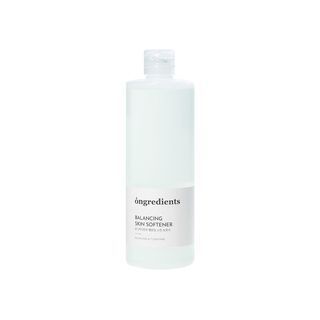
Ongredients Balancing Skin Softener
Works for
1 of 1 advertised claim delivered
Moisturizing20 ingredients credited for this claimStrong support
“Balancing Skin Softener”
This product contains good ingredients to attract water to the upper layer of the skin. These ingredients are called "humectants": hydrolyzed hyaluronic acid, sodium acetylated hyaluronate.
When humectants are on the surface of the skin, they “pull in” the moisture from the outside environment, or from within deeper layers of the skin. If the air is dry, humectants can speed up the moisture loss from the skin. This is why it is a good idea to use another product on top of this one to help "seal in" the moisture (look for ingredients like dimethicone, squalane, oils and butters).
The following ingredients in this product are especially good for supporting the skin barrier and helping with the hydration level: madecassoside, panthenol
Anti-oxidationNot advertised by the brand · 10 ingredients credited for this claimStrong support
This product contains antioxidants (asiaticoside, madecassoside) that can help neutralize free radicals in skin. By doing so, they can lessen the damage the skin gets from the UV light (sun).
Anti-agingNot advertised by the brand · 5 ingredients credited for this claimModerate support
This product contains asiaticoside, madecassoside. These ingredients might be able to help reduce and prevent fine lines and wrinkles, improve skin elasticity and firmness, but there is not enough evidence that it actually works.
Can it cause trouble?
Irritancy2 strong irritants: Rosmarinus officinalis leaf oil, Rosmarinus officinalis leaf extractMedium risk
Comedogenic1 ingredient rated 2 or more on the 0–5 pore-clogging scale1 flagged


User reviews
Be the first — your take helps the next person decide.
Ingredients
Filter by role to see what each ingredient is doing.
Houttuynia cordata extract~22–33%
- Irritation risk
- Low
Butylene glycol~5.3–7.9%
- Irritation risk
- Low
Used to create a nice product texture and help delivery of other ingredients. Might be somewhat helpful in attracting water to the upper layer of the skin
More about Butylene glycol1,2-hexanediol~1.8–2.8%
Water~3.5–5.3%
Methylpropanediol~2.5–3.8%
Diethoxyethyl succinate~1.9–2.8%
- Irritation risk
- Low
Helps dissolve other ingredients in the formulation
More about Diethoxyethyl succinateGlycereth-25 pca isostearate~1.5–2.2%
Dipropylene glycol~1.1–1.6%
- Irritation risk
- Low
Helps to dissolve other ingredients in a formulation. Slows down the rate of product drying
More about Dipropylene glycolSodium citrate~0.85–1.25%
- Irritation risk
- Medium
Helps to control the skin's pH level. Maintains the skin's natural film of amino-lactic acids and oils. Helps to preserve products
More about Sodium citrateNelumbo nucifera seed extract~0.55–1.3%
- Irritation risk
- Low
Schizonepeta tenuifolia extract~0.45–1.1%
- Irritation risk
- Low
Portulaca oleracea extract~0.4–1%
- Irritation risk
- Medium
A plant extract that has some anti-oxidant activity, but solid research is lacking. Can help attract water to the upper layer of the skin
More about Portulaca oleracea extractScrophularia buergeriana root extract~0.45–1%
- Irritation risk
- Low
Tocopherol~0.35–0.8%
- Irritation risk
- Low
Pure form of vitamin E. Can help moisturise and protect the skin from free radicals. Often used to help stabilise other ingredients or the formula itself
More about TocopherolEthylhexylglycerin~0.35–0.75%
Citric acid~0.35–0.75%
- Irritation risk
- Medium
Can work as an exfoliant but is typically used to adjust the product pH
More about Citric acidPanthenol~0.3–0.75%
- Irritation risk
- Low
Helps attract water to the upper layer of the skin and can help improve skin barrier function
More about PanthenolPolyglyceryl-10 dimyristate~0.35–0.75%
Rosmarinus officinalis leaf oil~0.2–0.75%
- Irritation risk
- High
A plant oil with high content of volatile compounds that can irritate the skin. Can be used as a fragrance. Has anti-bacterial properties and might help neutralize free radicals on the surface of the skin
More about Rosmarinus officinalis leaf oilCetyl ethylhexanoate~0.35–0.75%
- Irritation risk
- Medium
An emollient that helps soften the skin and creates a thicker product texture
More about Cetyl ethylhexanoateCentella asiatica extract~0.3–0.7%
- Irritation risk
- Medium
A plant extract that has been shown to be able to reduce inflammation in skin, support restoration of skin barrier function, as well as support collagen production. Contains active compounds called centelloids: asiaticoside, madecasosside, asiatic acid and madecassic acid. Might be helpful in preventing stretch marks. It can be itself be irritating though.
More about Centella asiatica extractCaprylic/capric/stearic triglyceride~0.15–0.7%
- Irritation risk
- Low
Helps soften the upper layer of the skin and create a nice product texture
More about Caprylic/capric/stearic triglycerideEthylhexyl palmitate~0.3–0.7%
- Irritation risk
- Low
- Comedogenicity
- 3/5
An emollient that helps soften the skin and create a nice product texture
More about Ethylhexyl palmitatePolygonum cuspidatum root extract~0.15–0.65%
- Irritation risk
- Medium
A plant extract that can contain resveratrol, an antioxidant that can help neutralize free radicals in skin. The effectiveness depends on the extract quality and concentration in the product
More about Polygonum cuspidatum root extractScutellaria baicalensis root extract~0.15–0.5%
- Irritation risk
- High
A plant extract that might contain a compound baicalin that could be helpful in neutralizing free radicals and reducing inflammation in skin. The baicalin concentration in skincare products is often too low for an effective action. Can be used for its fragrant properties
More about Scutellaria baicalensis root extractSodium hyaluronate~0.15–0.65%
- Irritation risk
- Low
One of the best moisturizing ingredients. Attracts water into the upper layer of the skin
More about Sodium hyaluronateCamellia sinensis leaf extract~0.15–0.65%
- Irritation risk
- Low
Can contain potent anti-oxidant compounds (abbreviated ECG, GCG, EGC, and EGCG) that might help protect the skin from free radicals. Can help calm down inflammation and has some anti-bacterial properties. Unfortunately, these antioxidants are unstable and lose their effectiveness very quickly in products. The concentration of the antioxidant compounds in the extract also tends to be low to be effective in topical formulation
More about Camellia sinensis leaf extractChamomilla recutita flower extract~0.15–0.65%
- Irritation risk
- High
Plant extract that can have healing and anti-inflammatory properties. It is a potential allergen and can be irritating
More about Chamomilla recutita flower extractRosmarinus officinalis leaf extract~0.15–0.6%
- Irritation risk
- High
Can be helpful in reducing inflammation in skin, including inflamed acne. It can be irritating
More about Rosmarinus officinalis leaf extractDipotassium glycyrrhizate~0.2–0.75%
- Irritation risk
- Low
A salt derived from licorice. Works as an emollient to soften the upper layer of the skin and can help calm down inflammation. Might be helpful for skin lightening
More about Dipotassium glycyrrhizateHydrolyzed hyaluronic acid~0.2–0.75%
- Irritation risk
- Low
One of the best moisturizing ingredients. Attracts water into the upper layer of the skin. A version of it is naturally present in skin
More about Hydrolyzed hyaluronic acidHydroxypropyltrimonium hyaluronate~0.35–0.75%
- Irritation risk
- Low
Pentylene glycol~0.2–0.8%
- Irritation risk
- Medium
Used to preserve products, dissolve other ingredients and create a nice product texture
More about Pentylene glycolSodium hyaluronate crosspolymer~0.15–0.55%
- Irritation risk
- Medium
Attracts water into the upper layer of the skin
More about Sodium hyaluronate crosspolymerSodium acetylated hyaluronate~0.1–0.45%
- Irritation risk
- Low
A type of hyaluronic acid that works as an excellent moisturizer by attracting water into the upper layer of the skin. Is typically feels less sticky on the skin compared to the usual hyaluronic acid
More about Sodium acetylated hyaluronateAsiaticoside~0.1–0.35%
- Irritation risk
- Medium
An active compound of Centella Asiatica plant extract. In combination with other active compounds of Centella Asiatica extract (madecasosside, asiatic acid and madecassic acid), asiaticoside has been shown to be helpful in wound-healing, restoring skin barrier function and supporting collagen production in skin. It can, however, itself be irritating
More about AsiaticosideAsiatic acid~0.1–0.4%
- Irritation risk
- Medium
An active compound of Centella Asiatica plant extract. In combination with other active compounds of Centella Asiatica extract (asiaticoside, madecasosside and madecassic acid) asiatic acid has been shown to be helpful in wound-healing, restoring skin barrier function and supporting collagen production in skin. It can, however, itself be irritating
More about Asiatic acidMadecassoside~0.1–0.35%
- Irritation risk
- Medium
An antioxidant that is typically derived from plant Centella Asiatica. It can help neutralize free radicals in skin and support skin barrier function. It could, however, itself be irritating. It is often unstable in formulations
More about MadecassosideMadecassic acid~0.05–0.3%
- Irritation risk
- Medium
An active compound of Centella Asiatica plant extract. In combination with other active compounds of Centella Asiatica extract (asiaticoside, madecasosside and asiatic acid), madecassic acid has been shown to be helpful in wound-healing, restoring skin barrier function and supporting collagen production in skin. It can, however, itself be irritating
More about Madecassic acidDisodium edta~0.05–0.15%
Ingredient list view
Houttuynia cordata extract, Butylene glycol, 1,2-hexanediol, Water, Methylpropanediol, Diethoxyethyl succinate, Glycereth-25 pca isostearate, Dipropylene glycol, Sodium citrate, Nelumbo nucifera seed extract, Schizonepeta tenuifolia extract, Portulaca oleracea extract, Scrophularia buergeriana root extract, Tocopherol, Ethylhexylglycerin, Citric acid, Panthenol, Polyglyceryl-10 dimyristate, Rosmarinus officinalis leaf oil, Cetyl ethylhexanoate, Centella asiatica extract, Caprylic/capric/stearic triglyceride, Ethylhexyl palmitate, Polygonum cuspidatum root extract, Scutellaria baicalensis root extract, Sodium hyaluronate, Camellia sinensis leaf extract, Chamomilla recutita flower extract, Rosmarinus officinalis leaf extract, Dipotassium glycyrrhizate, Hydrolyzed hyaluronic acid, Hydroxypropyltrimonium hyaluronate, Pentylene glycol, Sodium hyaluronate crosspolymer, Sodium acetylated hyaluronate, Asiaticoside, Asiatic acid, Madecassoside, Madecassic acid, Disodium edta
Compare prices
Retailers ranked by price — lowest first.

Worth comparing, line by line.
Match % combines shared ingredients, the first five ingredients, shared actives and hero ingredients, irritancy (lower counts in the alternative's favour), texture and body area. Only products in the same routine step are compared.
| OngredientsBalancing Skin SoftenerYOUR PRODUCT | BeplainCicaterol Moisturizer | PURITOB5 Panthenol Re-Barrier Cream | Dr.wantRed Soothing Gel | |
|---|---|---|---|---|
| Match | — | 55% | 55% | 54% |
| Price | $17.99 | $25.60+$7.61 | $5.38−$12.61 | $18.20 |
| Shared key ingredients | — | 7 of 14 | 8 of 14 | 11 of 14 |
| Key difference | — | Niacinamide | Niacinamide | Salicylic Acid |
| Irritancy | Medium | Low | Low | Medium |
| Drying alcohol | — | — | — | Contains drying alcohol |
| View product | Shop | Shop | Shop |


Product summary
Judging from the ingredient list, "Ongredients - Balancing Skin Softener" works well for improving skin hydration As we expect from a proper moisturizer, the formula includes a combo of effective humectants and emollients. These are the two different types of ingredients that are essential for improving the skin hydration and supporting a healthy skin barrier. Humectants in this product (panthenol, hydrolyzed hyaluronic acid, sodium acetylated hyaluronate, sodium hyaluronate and sodium hyaluronate crosspolymer) help to increase the water content in the upper layer of the skin. (These ingredients do so by "capturing" water molecules from the outside air or from within the deeper layers of the skin). Ethylhexyl palmitate, cetyl ethylhexanoate and pentylene glycol in this product help decrease the water evoporation from the skin, so that it stays hydrated for longer. These ingredients also soften the skin and take away the feeling of tightness and dryness.
Ingredient callouts
- Actives derived from an extract of the Centella Asiatica plant (also known as Gotu Kola) - madecassic acid 0.05% - 0.30%, madecassoside 0.10% - 0.35%, asiatic acid 0.10% - 0.40% and asiaticoside 0.10% - 0.35% The Centella Asiatica Actives, even in low concentration, can help reduce inflammation in skin, strengthen the skin barrier and reduce photodamage. They can also help to decrease scarring.
Irritation risk
There are actives in this product that can be irritating. We assess the overall irritancy of this moisturizer to be medium. For a detailed overview of all potential irritants: click here
You can see the detailed formula review with the breakdown of all actives in the product and the full ingredient list with estimated concentrations in the tables below.
Price
The product retails for 27.50$ in the United States.
For a detailed price comparison: click here.
Sources cited in this review
Every concentration estimate and effectiveness label is anchored to one of these 43 studies and safety reviews.
- 1
- 2Portulaca oleracea (purslane)mdedge.com
- 3Vitamin E in dermatologyncbi.nlm.nih.gov
- 4Vitamin E and Skin Healthlpi.oregonstate.edu
- 5Skin moisturizing effects of panthenol-based formulationspdfs.semanticscholar.org
- 6

Affiliate links · As an Amazon Associate, WIMJ earns from qualifying purchases.