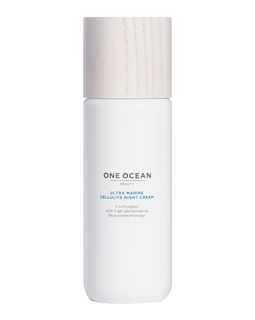
One Ocean Beauty Ultra Marine Cellulite Night Cream
Works for
1 of 2 advertised claims delivered
Moisturizing16 ingredients credited for this claimGood support
“Meanwhile, a second marine active promotes muscle fibres and metabolism to firm and tone and murumuru seed and shea butters further moisturise and condition the skin.”
This product can help improve hydration of the skin with the two types of ingredients.
The first type is called “humectants”:
these ingredients help attract water.
When humectants are on the surface of the skin, they “pull in” the moisture from the outside environment, or from
within deeper layers of the skin. The following ingredients in this product do the job:
alanine, glycerin.
This product also contains ingredients called “occlusives”. They help reduce the speed with which our skin loses moisture to the outside environment. These ingredients also help soften the upper layer of the skin, so it feels less tight and nicer to the touch. The following ingredients in this product do the job: butyrospermum parkii butter, caprylic/capric triglyceride.
Evens skin tone1 ingredient credited for this claimLimited support
“Meanwhile, a second marine active promotes muscle fibres and metabolism to firm and tone and murumuru seed and shea butters further moisturise and condition the skin.”
This product contains ingredients (alanine) that could help reduce hyperpigmentation (for example, post-acne marks or age spots) in theory, but there is not enough evidence that they actually work.
Anti-agingNot advertised by the brand · 3 ingredients credited for this claimModerate support
This product contains serine. This ingredient might be able to help reduce and prevent fine lines and wrinkles, improve skin elasticity and firmness, but there is not enough evidence that it actually works.
Can it cause trouble?
Irritancy12 flagged ingredientsMedium risk
Comedogenic2 ingredients rated 2 or more on the 0–5 pore-clogging scale2 flagged
User reviews
Be the first — your take helps the next person decide.
Ingredients
Filter by role to see what each ingredient is doing.
Water~45–55%
Glycerin~4.5–5.5%
- Irritation risk
- Low
One of the best moisturizing ingredients. Naturally present in skin. It attracts water to the upper layer of the skin working as a humectant
More about GlycerinButyrospermum parkii butter~4.2–5.1%
- Irritation risk
- Low
- Comedogenicity
- 3/5
A great moisturising ingredient that softens the skin and reduces water loss from its upper layer. It also can be helpful in protecting skin from free radicals
More about Butyrospermum parkii butterGlyceryl stearate~2.8–3.4%
- Irritation risk
- Low
An emollient that softens the skin and forms a protective layer on its surface. Helps water and oil mix together
More about Glyceryl stearateCocoglycerides~2.3–2.8%
- Irritation risk
- High
Help soften the upper layer of the skin and make it easier for oil and water mix together. Recently, a rising number of allergic reactions to cocoglycerides and other coconut-derived surfactants has been reported. As there is a significant overlap between frequent irritants and allergens, we flag this ingredient for attention of those with very sensitive, reactive skin
More about CocoglyceridesCetearyl alcohol~2–2.4%
- Irritation risk
- Low
- Comedogenicity
- 2/5
A non-drying alcohol. Works as an emollient. Helps water and oil mix together and creates a nice product texture
More about Cetearyl alcoholCaprylic/capric triglyceride~1.7–2.1%
- Irritation risk
- Medium
A good mix of fatty acids that forms a protective layer on the skin. Improves the shelf life of products. Derived from coconut and glycerin
More about Caprylic/capric triglycerideSimmondsia chinensis seed oil~1.5–1.9%
- Irritation risk
- Medium
Softens the upper layer of skin and helps restore the healthy skin barrier. Has shown to help calm down inflammation in skin. It is a stable oil, meaning that it retains its properties even when exposed to air.
More about Simmondsia chinensis seed oilAstrocaryum murumuru seed butter~1.2–1.5%
- Irritation risk
- Medium
Helps soften the upper layer of the skin. Could be comedogenic due to the myrisic acid content
More about Astrocaryum murumuru seed butterIsostearyl hydroxystearate~1–1.2%
- Irritation risk
- Low
Sodium stearoyl lactylate~0.7–1.05%
- Irritation risk
- Medium
Helps oil and water mix together
More about Sodium stearoyl lactylateTocopheryl acetate~0.6–0.85%
- Irritation risk
- Medium
A more stable but less bio-available form of vitamin E compared to Tocopherol. Might help moisturize and protect the skin from free radicals, but mostly used in low concentrations to stabilize other ingredients.
More about Tocopheryl acetatePseudoalteromonas ferment extract~0.5–0.75%
- Irritation risk
- Low
Saccharide isomerate~0.45–0.7%
- Irritation risk
- Low
Helps attract water to the upper layer of the skin
More about Saccharide isomerateBacillus/soybean ferment extract~0.45–0.65%
- Irritation risk
- Low
Proline~0.45–0.65%
Alanine~0.4–0.6%
- Irritation risk
- Low
An amino-acid that helps to attract water to the upper layer of the skin and might help to lighten the skin, but solid evidence is lacking
More about AlanineSerine~0.3–0.6%
- Irritation risk
- Low
An amino-acid that helps to attract water to the upper layer of the skin. In combination with other amino-acids, might help to reduce fine lines and wrinkles
More about SerineCarbomer~0.3–0.55%
- Irritation risk
- Low
Helps create a thicker or gel-like product texture. It is not a surfactant but can be used in gentle cleansing formulations
More about CarbomerXanthan gum~0.3–0.55%
- Irritation risk
- Low
Used to create a thicker product consistency
More about Xanthan gumSodium citrate~0.25–0.5%
- Irritation risk
- Medium
Helps to control the skin's pH level. Maintains the skin's natural film of amino-lactic acids and oils. Helps to preserve products
More about Sodium citrateSodium hydroxide~0.25–0.45%
Disodium phosphate~0.25–0.45%
- Irritation risk
- Low
Helps adjust the product pH and stabilize the formulation
More about Disodium phosphateSodium phosphate~0.25–0.45%
Cetearyl glucoside~0.25–0.45%
- Irritation risk
- Medium
Helps water and oil in the product mix well together and improves product texture
More about Cetearyl glucosideIsostearyl alcohol~0.25–0.5%
- Irritation risk
- Low
Helps soften the upper layer of the skin
More about Isostearyl alcoholTetrasodium glutamate diacetate~0.2–0.4%
- Irritation risk
- Low
Helps stabilize the product formulation
More about Tetrasodium glutamate diacetateTocopherol~0.2–0.4%
- Irritation risk
- Low
Pure form of vitamin E. Can help moisturise and protect the skin from free radicals. Often used to help stabilise other ingredients or the formula itself
More about TocopherolPropanediol~0.2–0.35%
- Irritation risk
- Low
Acts as a solvent for other ingredients. Speeds up the absorption of other ingredients into the skin
More about PropanediolCaprylyl glycol~0.2–0.35%
- Irritation risk
- Medium
Helps preserve products and creates a nice product texture
More about Caprylyl glycolDehydroacetic acid~0.1–0.2%
Ethylhexylglycerin~0.1–0.2%
Glyceryl caprylate~0.15–0.25%
- Irritation risk
- Low
An emollient that can also help water and oil mix together, as well as prevent bacteria growth in products
More about Glyceryl caprylateBenzyl alcohol~0.05–0.15%
- Irritation risk
- High
A preservative. Can be used to mask unpleasant smell. Can be irritating
More about Benzyl alcoholIngredient list view
Water, Glycerin, Butyrospermum parkii butter, Glyceryl stearate, Cocoglycerides, Cetearyl alcohol, Caprylic/capric triglyceride, Simmondsia chinensis seed oil, Astrocaryum murumuru seed butter, Isostearyl hydroxystearate, Sodium stearoyl lactylate, Tocopheryl acetate, Pseudoalteromonas ferment extract, Saccharide isomerate, Bacillus/soybean ferment extract, Proline, Alanine, Serine, Carbomer, Xanthan gum, Sodium citrate, Sodium hydroxide, Disodium phosphate, Sodium phosphate, Cetearyl glucoside, Isostearyl alcohol, Tetrasodium glutamate diacetate, Tocopherol, Propanediol, Caprylyl glycol, Dehydroacetic acid, Ethylhexylglycerin, Glyceryl caprylate, Benzyl alcohol
Compare prices
Retailers ranked by price — lowest first.
Affiliate links · prices updated regularly · As an Amazon Associate, WIMJ earns from qualifying purchases.
Sources cited in this review
Every concentration estimate and effectiveness label is anchored to one of these 7 studies and safety reviews.
- 1
- 2
- 3
- 4Topical palmitoyl pentapeptide provides improvement in photoaged human facial skinonlinelibrary.wiley.com
- 5Vitamin E in dermatologyncbi.nlm.nih.gov
- 6Vitamin E and Skin Healthlpi.oregonstate.edu

Affiliate links · As an Amazon Associate, WIMJ earns from qualifying purchases.