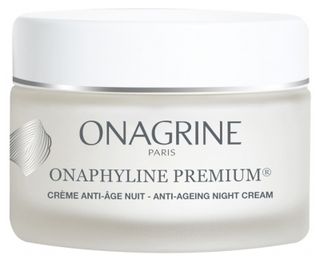
Onagrine Onaphyline Premium Anti-Aging Night Cream
Works for
1 of 2 advertised claims delivered
Moisturizing23 ingredients credited for this claimStrong support
“Onaphyline Premium Anti-Aging Night Cream”
This product can help improve hydration of the skin with the two types of ingredients.
The first type is called “humectants”:
these ingredients help attract water.
When humectants are on the surface of the skin, they “pull in” the moisture from the outside environment, or from
within deeper layers of the skin. The following ingredients in this product do the job:
glycerin, sodium hyaluronate.
This product also contains ingredients called “occlusives”. They help reduce the speed with which our skin loses moisture to the outside environment. These ingredients also help soften the upper layer of the skin, so it feels less tight and nicer to the touch. The following ingredients in this product do the job: caprylic/capric triglyceride, myristyl myristate.
The following ingredients in this product are especially good for supporting the skin barrier and helping with the hydration level: ceramide np, phytosphingosine
Anti-aging3 ingredients credited for this claimLimited support
“Onaphyline Premium Anti-Aging Night Cream”
This product does not contain ingredients that are able to reduce fine lines and wrinkles or help with skin elasticity, but it can improve the look of the skin temporarily through moisturization. Well-moisturized skin might also be able to repair the sun damage better.
Can it cause trouble?
Irritancy9 strong irritants: Commiphora mukul resin extract, Parfum + 7 more — patch-test recommendedHigh risk
Comedogenic4 ingredients rated 2 or more on the 0–5 pore-clogging scale4 flagged


User reviews
Be the first — your take helps the next person decide.
Ingredients
Filter by role to see what each ingredient is doing.
Water~45–55%
Caprylic/capric triglyceride~5.9–7.2%
- Irritation risk
- Medium
A good mix of fatty acids that forms a protective layer on the skin. Improves the shelf life of products. Derived from coconut and glycerin
More about Caprylic/capric triglycerideGlycerin~4.2–5.1%
- Irritation risk
- Low
One of the best moisturizing ingredients. Naturally present in skin. It attracts water to the upper layer of the skin working as a humectant
More about GlycerinCetyl alcohol~2.6–3.1%
- Irritation risk
- Low
A non-drying alcohol that works to soften the skin and stabilize product formulations helping oil and water mix together
More about Cetyl alcoholGlycerin~2.4–3%
- Irritation risk
- Low
One of the best moisturizing ingredients. Naturally present in skin. It attracts water to the upper layer of the skin working as a humectant
More about GlycerinOenothera biennis oil~2–2.4%
- Irritation risk
- Medium
Helps soften the upper layer of the skin and can support skin barrier function
More about Oenothera biennis oilJojoba esters~1.7–2.1%
- Irritation risk
- Medium
An emollient made of jojoba oil. Helps soften the skin and support its barrier function
More about Jojoba estersMyristyl myristate~1.6–1.9%
- Irritation risk
- Medium
- Comedogenicity
- 3/5
An emollient. Is not recommended for acne-prone skin as it can be comedogenic
More about Myristyl myristatePeg-75 stearate~1.2–1.5%
Cyperus esculentus root oil~0.95–1.15%
- Irritation risk
- Low
Moringa oleifera seed oil~0.7–1.05%
- Irritation risk
- Medium
A plant oil that helps soften the upper layer of the skin. Is unlikely to be helpful in restoring skin barrier function due to the low content of linoleic acid
More about Moringa oleifera seed oilPersea gratissima oil~0.6–0.95%
- Irritation risk
- Medium
An emollient that helps soften the skin and could be helpful in repairing its barrier function
More about Persea gratissima oilSafflower oil/palm oil aminopropanediol esters~0.5–0.75%
- Irritation risk
- Low
Sodium hyaluronate~0.45–0.7%
- Irritation risk
- Low
One of the best moisturizing ingredients. Attracts water into the upper layer of the skin
More about Sodium hyaluronateCommiphora mukul resin extract~0.45–0.65%
- Irritation risk
- High
A plant extract might be helpful in neutralizing free radicals and reducing inflammation in skin
More about Commiphora mukul resin extractCeramide np~0.5–0.7%
- Irritation risk
- Low
A type of lipid similar to ceramides naturally present in skin. Helps to soften the upper layer of the skin and supports the skin barrier function to keep it hydrated. Can help to prevent inflammation in skin
More about Ceramide npPapain~0.4–0.6%
- Irritation risk
- High
An enzyme extracted from papaya fruit. Can have an exfoliating effect on the skin. Can be irritating
More about PapainPhytosphingosine~0.45–0.65%
- Irritation risk
- Low
A type of lipid that is naturally present in skin. It might help in repairing skin barrier function and has anti-bacterial effect
More about PhytosphingosineOleic acid~0.4–0.65%
- Irritation risk
- Medium
Helps soften the upper layer of the skin. At the same time, it can weaken the skin's barrier enhancing penetration of other ingredients and increasing the risk of skin dryness
More about Oleic acidOlus oil~0.35–0.65%
- Irritation risk
- Low
An oil from a mixture of different vegetables. Helps soften the upper layer of the skin
More about Olus oilVegetable oil~0.3–0.6%
- Irritation risk
- Low
An oil from a mixture of different vegetables. Helps soften the upper layer of the skin
More about Vegetable oilVitex agnus castus extract~0.3–0.5%
- Irritation risk
- Low
Ascorbyl tetraisopalmitate~0.3–0.5%
- Irritation risk
- Medium
A vitamin C derivative. Studies show that is might be effective in reducing hyperpigmentation, but there are no studies confirming that it is effectively converted into the bioavailable form of Vitamin C in skin. It is not clear how this derivative compares in effectiveness to the topical application of bioavailable form of vitamin C (L-ascorbic acid)
More about Ascorbyl tetraisopalmitateMagnolia officinalis bark extract~0.25–0.45%
- Irritation risk
- Low
Algin~0.25–0.5%
- Irritation risk
- Low
- Comedogenicity
- 3/5
Used to thicken product formulation. Can help attract water to the upper layer of the skin
More about AlginHydrogenated olive oil decyl esters~0.3–0.5%
- Irritation risk
- Medium
Helps stabilize the product formulation
More about Hydrogenated olive oil decyl estersParfum~0.25–0.45%
- Irritation risk
- High
An aromatic blend of unspecified and possibly irritating ingredients
More about ParfumPolyacrylate crosspolymer-6~0.25–0.5%
- Irritation risk
- Low
Ceteth-20~0.45–0.65%
Steareth-20~0.35–0.65%
Xanthan gum~0.25–0.5%
- Irritation risk
- Low
Used to create a thicker product consistency
More about Xanthan gumSodium acrylates copolymer~0.25–0.45%
- Irritation risk
- Medium
Used to create a thicker product consistency
More about Sodium acrylates copolymerMaltodextrin~0.25–0.5%
- Irritation risk
- Low
Used to stabilize the product formulation and can help absorb oil
More about MaltodextrinCaprylyl glycol~0.3–0.55%
- Irritation risk
- Medium
Helps preserve products and creates a nice product texture
More about Caprylyl glycol1,2-hexanediol~0.25–0.5%
Lecithin~0.3–0.55%
- Irritation risk
- Low
Used mostly for creating emulsions - helping oil and water mix together. Helps soften the upper layer of the skin
More about LecithinEthylhexylglycerin~0.25–0.5%
Hexyl cinnamal~0.25–0.45%
Alcohol~0.25–0.5%
- Irritation risk
- High
Can be drying and contribute to skin irritation. Used in formulars to dissolve other ingredients, create a thinner product consistency or for its antibacterial properties
More about AlcoholSodium acrylate/sodium acryloyldimethyl taurate copolymer~0.25–0.45%
- Irritation risk
- Low
Used to create a thicker product consistency
More about Sodium acrylate/sodium acryloyldimethyl taurate copolymerPolyisobutene~0.3–0.55%
Cholesterol~0.3–0.55%
- Irritation risk
- Low
An emollient that is naturally found in skin
More about CholesterolStearic acid~0.4–0.65%
- Irritation risk
- Low
Helps oil and water mix together and works as an emollient
More about Stearic acidT-butyl alcohol~0.25–0.4%
- Irritation risk
- Medium
Used to dissolve other ingredients and to improve smell of products. It could be irritating
More about T-butyl alcoholTocopherol~0.25–0.5%
- Irritation risk
- Low
Pure form of vitamin E. Can help moisturise and protect the skin from free radicals. Often used to help stabilise other ingredients or the formula itself
More about TocopherolAlpha-isomethyl ionone~0.2–0.4%
- Irritation risk
- High
A fragrance. Potential allergen and can be irritating
More about Alpha-isomethyl iononeCaprylyl/capryl glucoside~0.3–0.6%
- Irritation risk
- Medium
Helps oil and water mix together. Can be used as a cleansing agent
More about Caprylyl/capryl glucosideSorbitan oleate~0.25–0.45%
- Irritation risk
- Medium
- Comedogenicity
- 2/5
Helps oil and water mix together
More about Sorbitan oleateLinalool~0.2–0.35%
Hydrogenated lecithin~0.25–0.45%
- Irritation risk
- Low
Helps to retain moisture by creating a protective barrier on the skin. Rich in fatty acids. Improves product texture and helps with the penetration of other ingredients.
More about Hydrogenated lecithinLactic acid~0.2–0.4%
- Irritation risk
- Medium
An exfoliating and moisturizing alpha-hydroxy acid (AHA). Typically causes less irritation than other AHAs, for example, glycolic acid. At high concentrations (about 15%), lactic acid can help reduce lines and wrinkles. Recent studies show that lactic acid can support the "good" bacteria living on skin's surface (healthy skin microbiome)
More about Lactic acidEugenol~0.15–0.3%
Carbomer~0.15–0.3%
- Irritation risk
- Low
Helps create a thicker or gel-like product texture. It is not a surfactant but can be used in gentle cleansing formulations
More about CarbomerGlycine soja oil~0.15–0.3%
- Irritation risk
- Medium
- Comedogenicity
- 2/5
A good emollient that helps soften the skin and helps repair its barrier function. It can clog pores if used in high concentrations.
More about Glycine soja oilCoumarin~0.15–0.3%
Limonene~0.15–0.25%
- Irritation risk
- High
A common frangrance that can easily irritate skin, especially if exposed to air, light or heat
More about LimoneneCyclodextrin~0.05–0.15%
- Irritation risk
- Low
A type of sugar that is used to support delivery of active ingredients and can enhance their penetration into the skin without disrupting the skin's barrier
More about CyclodextrinCaprylhydroxamic acid~0.05–0.15%
Ingredient list view
Water, Caprylic/capric triglyceride, Glycerin, Cetyl alcohol, Glycerin, Unknown, Oenothera biennis oil, Jojoba esters, Myristyl myristate, Peg-75 stearate, Cyperus esculentus root oil, Moringa oleifera seed oil, Persea gratissima oil, Safflower oil/palm oil aminopropanediol esters, Sodium hyaluronate, Commiphora mukul resin extract, Ceramide np, Papain, Phytosphingosine, Oleic acid, Olus oil, Vegetable oil, Vitex agnus castus extract, Ascorbyl tetraisopalmitate, Magnolia officinalis bark extract, Algin, Hydrogenated olive oil decyl esters, Parfum, Polyacrylate crosspolymer-6, Ceteth-20, Steareth-20, Xanthan gum, Sodium acrylates copolymer, Maltodextrin, Caprylyl glycol, 1,2-hexanediol, Lecithin, Ethylhexylglycerin, Hexyl cinnamal, Alcohol, Sodium acrylate/sodium acryloyldimethyl taurate copolymer, Polyisobutene, Cholesterol, Stearic acid, T-butyl alcohol, Tocopherol, Alpha-isomethyl ionone, Caprylyl/capryl glucoside, Sorbitan oleate, Linalool, Hydrogenated lecithin, Lactic acid, Eugenol, Carbomer, Glycine soja oil, Coumarin, Limonene, Cyclodextrin, Caprylhydroxamic acid
Compare prices
Retailers ranked by price — lowest first.

Worth comparing, line by line.
Match % combines shared ingredients, the first five ingredients, shared actives and hero ingredients, irritancy (lower counts in the alternative's favour), texture and body area. Only products in the same routine step are compared.
| OnagrineOnaphyline Premium Anti-Aging Night CreamYOUR PRODUCT | CeraVeMoisturising Cream | NERISHSoy Ceramide Barrier Cream | Chemist ConfessionsMr. Reliable Moisturizer | |
|---|---|---|---|---|
| Match | — | 63% | 62% | 62% |
| Price | $48.25 | $13.49−$34.76 | $16.11−$32.14 | $35.00−$13.25 |
| Shared key ingredients | — | 6 of 12 | 8 of 12 | 7 of 12 |
| Key difference | — | Ceramide Eop | Niacinamide | Ceramide Ap |
| Irritancy | High | Low | Medium | Medium |
| Drying alcohol | Contains drying alcohol | — | — | — |
| View product | Shop | Shop | Shop |


Product summary
Judging from the ingredient list, "Onagrine - Onaphyline Premium Anti-Aging Night Cream" works well for improving skin hydration This moisturizer uses a good combo of humectants and emollients. These both types of ingredients are essentials for improving the skin hydration and keeping the skin barrier healthy. Glycerin, sodium hyaluronate and caprylyl glycol in this product (humectants) attract water molecules to the upper layer of the skin (the water comes from the outside air or from the deeper layers of the skin if the air is dry). Ceramide np, phytosphingosine, cholesterol, glycine soja oil and jojoba esters in this product help decrease the water evoporation from the skin, so that it stays hydrated for longer. These ingredients also soften the skin and take away the feeling of tightness and dryness.
Ingredient callouts
- As a plus, this moisturizer also contains Ceramides (phytosphingosine 0.45% - 0.65% and ceramide np 0.50% - 0.70%). Ceramides are a type of lipids that our skin produces itself. They are a building block of the skin's barrier. Ceramides used in skincare are synthetic or extracted from plants. They work well for softening the skin surface and "patch holes" in the skin's barrier.
Irritation risk
There are quite a few common irritants in this product, including ingredients without particular skin benefits. We would not recommend it for sensitive skin. We assess the overall irritancy of this moisturizer to be high. For a detailed overview of all potential irritants: click here
You can see the detailed formula review with the breakdown of all actives in the product and the full ingredient list with estimated concentrations in the tables below.
Price
The product retails from 36.50£ up to 46.36£ in the United Kingdom.
For a detailed price comparison: click here.
Sources cited in this review
Every concentration estimate and effectiveness label is anchored to one of these 24 studies and safety reviews.
- 1
- 2
- 3
- 4Hyaluronic acid: A key molecule in skin agingncbi.nlm.nih.gov
- 5
- 6

Affiliate links · As an Amazon Associate, WIMJ earns from qualifying purchases.