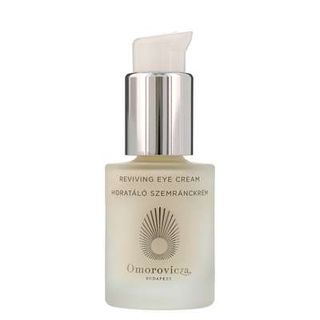
Omorovicza Eye Cream Reviving Eye Cream
Works for
1 of 2 advertised claims delivered
Moisturizing19 ingredients credited for this claimGood support
“Reviving Eye Cream is 'cult' because, like all Omorovicza products, it uses the brand's patented mineral delivery system - 'Hydro Mineral Transference' - which transports the mineral-rich thermal waters deep into your skin.”
This product can help improve hydration of the skin with the two types of ingredients.
The first type is called “humectants”:
these ingredients help attract water.
When humectants are on the surface of the skin, they “pull in” the moisture from the outside environment, or from
within deeper layers of the skin. The following ingredients in this product do the job:
glycerin, mannitol.
This product also contains ingredients called “occlusives”. They help reduce the speed with which our skin loses moisture to the outside environment. These ingredients also help soften the upper layer of the skin, so it feels less tight and nicer to the touch. The following ingredients in this product do the job: helianthus annuus seed oil, simmondsia chinensis seed oil.
Anti-aging5 ingredients credited for this claimWeak support
“Arnica helps reduce puffiness, vitamin K (lucerne oil) diminishes dark circles by mending broken capillaries, peptides (from hazelnuts) minimise the appearance of fine lines, while cooling cucumber extract combats stress and fatigue.”
Effective ingredients missing or their concentration is too low.
Can it cause trouble?
Irritancy2 strong irritants: Arnica montana flower extract, Calendula officinalis flower extractMedium risk
Comedogenic5 ingredients rated 2 or more on the 0–5 pore-clogging scale5 flagged
User reviews
Be the first — your take helps the next person decide.
Ingredients
Filter by role to see what each ingredient is doing.
Water~45–55%
Glycerin~4.8–5.9%
- Irritation risk
- Low
One of the best moisturizing ingredients. Naturally present in skin. It attracts water to the upper layer of the skin working as a humectant
More about GlycerinCucumis sativus fruit water~4–4.8%
Simmondsia chinensis seed oil~3.1–3.8%
- Irritation risk
- Medium
Softens the upper layer of skin and helps restore the healthy skin barrier. Has shown to help calm down inflammation in skin. It is a stable oil, meaning that it retains its properties even when exposed to air.
More about Simmondsia chinensis seed oilSqualane~2.4–2.9%
- Irritation risk
- Low
An oil naturally present in skin. Works as an emollient to soften the skin and form a protective layer on its surface without a greasy feeling.
More about SqualaneCetearyl ethylhexanoate~1.9–2.3%
- Irritation risk
- Low
An emollient that helps soften the skin
More about Cetearyl ethylhexanoateStearyl heptanoate~1.6–2%
Hydrolyzed hazelnut protein~1.4–1.7%
- Irritation risk
- Low
Cetearyl olivate~1.1–1.4%
Helianthus annuus seed oil~0.95–1.15%
- Irritation risk
- Low
A great emollient due to its high linoleic acid content. One of the most effective plant oils in helping skin hydration and repairing skin barrier function
More about Helianthus annuus seed oilSorbitan olivate~0.65–1%
Butyrospermum parkii butter~0.6–0.9%
- Irritation risk
- Low
- Comedogenicity
- 3/5
A great moisturising ingredient that softens the skin and reduces water loss from its upper layer. It also can be helpful in protecting skin from free radicals
More about Butyrospermum parkii butterCaprylic/capric triglyceride~0.55–0.8%
- Irritation risk
- Medium
A good mix of fatty acids that forms a protective layer on the skin. Improves the shelf life of products. Derived from coconut and glycerin
More about Caprylic/capric triglycerideCetearyl alcohol~0.55–0.8%
- Irritation risk
- Low
- Comedogenicity
- 2/5
A non-drying alcohol. Works as an emollient. Helps water and oil mix together and creates a nice product texture
More about Cetearyl alcoholPhenoxyethanol~0.4–0.6%
- Irritation risk
- Low
A preservative. It helps prevent bacterial growth in cosmetic products
More about PhenoxyethanolMannitol~0.35–0.65%
- Irritation risk
- Low
Helps to attract water to the upper layer of the skin
More about MannitolLactic acid~0.35–0.6%
- Irritation risk
- Medium
An exfoliating and moisturizing alpha-hydroxy acid (AHA). Typically causes less irritation than other AHAs, for example, glycolic acid. At high concentrations (about 15%), lactic acid can help reduce lines and wrinkles. Recent studies show that lactic acid can support the "good" bacteria living on skin's surface (healthy skin microbiome)
More about Lactic acidAscorbyl tetraisopalmitate~0.35–0.6%
- Irritation risk
- Medium
A vitamin C derivative. Studies show that is might be effective in reducing hyperpigmentation, but there are no studies confirming that it is effectively converted into the bioavailable form of Vitamin C in skin. It is not clear how this derivative compares in effectiveness to the topical application of bioavailable form of vitamin C (L-ascorbic acid)
More about Ascorbyl tetraisopalmitateBenzyl alcohol~0.25–0.5%
- Irritation risk
- High
A preservative. Can be used to mask unpleasant smell. Can be irritating
More about Benzyl alcoholArnica montana flower extract~0.25–0.45%
- Irritation risk
- High
A plant extract that can be irritating. It can have some anti-bacterial properties, but there are no evidence of a beneficial effect for skin
More about Arnica montana flower extractCalendula officinalis flower extract~0.25–0.45%
- Irritation risk
- High
A plant extract that has some anti-oxidant and anti-bacterial properties. Can be irritating
More about Calendula officinalis flower extractLaminaria digitata extract~0.25–0.5%
- Irritation risk
- Low
- Comedogenicity
- 3/5
Seaweed extract that helps the skin to attract water and make it more smooth for touch. Also shows promise of anti-aging properties, but good research is lacking at the moment
More about Laminaria digitata extractPrunus armeniaca kernel oil~0.3–0.5%
- Irritation risk
- Medium
An emollient that helps soften the skin
More about Prunus armeniaca kernel oilPrunus domestica seed extract~0.25–0.5%
- Irritation risk
- Low
Pyrus malus fruit extract~0.25–0.45%
- Irritation risk
- Medium
Can have some moisturizing properties due to its sugar content
More about Pyrus malus fruit extractXanthan gum~0.25–0.45%
- Irritation risk
- Low
Used to create a thicker product consistency
More about Xanthan gumTocopherol~0.2–0.4%
- Irritation risk
- Low
Pure form of vitamin E. Can help moisturise and protect the skin from free radicals. Often used to help stabilise other ingredients or the formula itself
More about TocopherolEthylhexylglycerin~0.2–0.4%
Disodium edta~0.2–0.35%
Phospholipids~0.2–0.4%
- Irritation risk
- Low
Emollients that are naturaly present in skin. In addition, they help water and oil mix together in the product
More about PhospholipidsYeast extract~0.15–0.3%
- Irritation risk
- Low
Helps attract water to the upper layer of the skin and might have some anti-oxidant and skin lightening properties. It can help calm down inflammation in skin
More about Yeast extractChlorella vulgaris/lupinus albus protein ferment~0.15–0.25%
- Irritation risk
- Low
- Comedogenicity
- 2/5
Pectin~0.1–0.2%
- Irritation risk
- Low
Dehydroacetic acid~0.1–0.15%
Medicago sativa extract~0.05–0.1%
- Irritation risk
- Medium
A plant extract that might help neutralize free radicals in skin
More about Medicago sativa extractPotassium sorbate~0.1–0.15%
Ingredient list view
Water, Glycerin, Cucumis sativus fruit water, Simmondsia chinensis seed oil, Squalane, Cetearyl ethylhexanoate, Stearyl heptanoate, Hydrolyzed hazelnut protein, Cetearyl olivate, Helianthus annuus seed oil, Sorbitan olivate, Butyrospermum parkii butter, Caprylic/capric triglyceride, Cetearyl alcohol, Unknown, Phenoxyethanol, Mannitol, Lactic acid, Ascorbyl tetraisopalmitate, Benzyl alcohol, Arnica montana flower extract, Calendula officinalis flower extract, Laminaria digitata extract, Prunus armeniaca kernel oil, Prunus domestica seed extract, Pyrus malus fruit extract, Xanthan gum, Tocopherol, Ethylhexylglycerin, Disodium edta, Phospholipids, Yeast extract, Chlorella vulgaris/lupinus albus protein ferment, Pectin, Dehydroacetic acid, Medicago sativa extract, Potassium sorbate
Compare prices
Retailers ranked by price — lowest first.

Sources cited in this review
Every concentration estimate and effectiveness label is anchored to one of these 25 studies and safety reviews.
- 1
- 2
- 3
- 4Effect of topically applied lipids on surfactant-irritated skinonlinelibrary.wiley.com
- 5
- 6Epidermal and dermal effects of topical lactic acidncbi.nlm.nih.gov

Affiliate links · As an Amazon Associate, WIMJ earns from qualifying purchases.