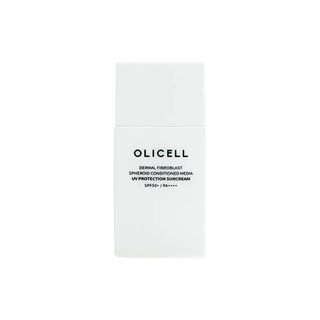
OLICELL UV Protection Sun Cream
Works for
1 of 1 advertised claim delivered
Sun protectionSPF 50 · 5 UV filtersBroad spectrum
This product offers a good level of protection against both UVB and UVA rays.
This sunscreen uses organic (so-called "chemical") sunscreen filters. Organic, or "chemical" filters usually provide reliable sun protection and rarely leave a white cast. Sunscreens with organic filters can sting eyes.
This product can be considered "reef safe" because it does not contain the UV filters (oxybenzone and octinoxate) that can be harmful to coral reefs when present in the water in high concentrations.
Anti-agingNot advertised by the brand · AdenosineStrong evidence
This product can help reduce and prevent fine lines and wrinkles, improve skin elasticity and firmness because it contains adenosine.
Keep in mind that it typically takes at least 6 weeks to notice any results because the changes that are needed to improve fine lines and elasticity happen in the deeper layers of the skin. No topical anti-aging product can “erase” wrinkles or fully reverse signs of aging.
This product can also help prevent early signs of skin aging because it offers a good level of broad spectrum sun protection. Sun damage is the main cause of premature skin aging, and protecting your skin from the sun is the best anti-aging strategy.
Evens skin toneNot advertised by the brand · No ingredient credited for this claimStrong evidence
This product offers broad spectrum sun protection. It means that it can prevent hyperpigmentation and help keep the skin tone even (sun damage is the main factor causing age spots, darkening of post-acne marks and other discolorations).
MoisturizingNot advertised by the brand · Polymethylsilsesquioxane, Glycerin + 8 moreGood evidence
This product contains good ingredients to attract water to the upper layer of the skin. These ingredients are called "humectants": glycerin.
When humectants are on the surface of the skin, they “pull in” the moisture from the outside environment, or from within deeper layers of the skin. If the air is dry, humectants can speed up the moisture loss from the skin. This is why it is a good idea to use another product on top of this one to help "seal in" the moisture (look for ingredients like dimethicone, squalane, oils and butters).
Can it cause trouble?
Irritancy11 flagged ingredientsLow risk
Comedogenic1 ingredient rated 2 or more on the 0–5 pore-clogging scale1 flagged

User reviews
Be the first — your take helps the next person decide.
Ingredients
Filter by role to see what each ingredient is doing.
Water~45–55%
Dibutyl adipate~7.2–8.8%
- Irritation risk
- Low
Helps soften the upper layer of the skin and create a nice product consistency
More about Dibutyl adipateMethylpropanediol~4.6–5.7%
Alcohol denat.~3.2–4%
- Irritation risk
- High
Produces temporary toning effect. Can help dissolve other ingredients or preserve products
More about Alcohol denat.Terephthalylidene dicamphor sulfonic acid~3.4–4.1%
- Irritation risk
- Medium
Ecamsule, Mexoryl SX. A UV filter. Is effective mostly against the UVA rays. It is legally marketed in the US with the FDA approval since 2006, even though the ingredient is not on the official FDA list of the approved sunscreen active ingredients. It is photostable
More about Terephthalylidene dicamphor sulfonic acid1,2-hexanediol~0.95–1.15%
Ethylhexyl triazone~2.2–2.7%
- Irritation risk
- Medium
Uvinul T. A UV filter. Effective against UVB rays. It is photostable. Can increase water resistance properties of the sunscreen. Unfortunately, not approved by the FDA (US) yet
More about Ethylhexyl triazoneGlycerin~1.6–2%
- Irritation risk
- Low
One of the best moisturizing ingredients. Naturally present in skin. It attracts water to the upper layer of the skin working as a humectant
More about GlycerinNiacinamide mandelate~1.2–1.5%
- Irritation risk
- Low
Polysilicone-15~1.3–1.6%
- Irritation risk
- Medium
A UV filter. Effective against UVB rays, but does not protect against the most aging UVA light
More about Polysilicone-15Tromethamine~0.7–1.05%
Polyglyceryl-3 distearate~0.6–0.95%
Caprylyl methicone~0.55–0.8%
- Irritation risk
- Low
A type of silicone that helps to soften the upper layer of the skin and create a nice product finish on the skin
More about Caprylyl methiconeCetearyl alcohol~0.6–0.85%
- Irritation risk
- Low
- Comedogenicity
- 2/5
A non-drying alcohol. Works as an emollient. Helps water and oil mix together and creates a nice product texture
More about Cetearyl alcoholDiethylamino hydroxybenzoyl hexyl benzoate~0.65–1%
- Irritation risk
- Medium
Uvinul A Plus. A new generation broad spectrum sunscreen that offers an effective protection especially in the UVA range. It is stable in formulations. Unfortunately, is not approved by the FDA (US) yet
More about Diethylamino hydroxybenzoyl hexyl benzoateDipropylene glycol~0.45–0.7%
- Irritation risk
- Low
Helps to dissolve other ingredients in a formulation. Slows down the rate of product drying
More about Dipropylene glycolPolymethylsilsesquioxane~0.5–0.75%
- Irritation risk
- Low
A silicone that improves product texture and helps dissolve other ingredients. Can form a non-greasy film on the skin to prevent moisture loss
More about PolymethylsilsesquioxanePalmitic acid~0.5–0.75%
- Irritation risk
- Low
An emollient that is naturally present in skin and helps soften it
More about Palmitic acidStearic acid~0.55–0.8%
- Irritation risk
- Low
Helps oil and water mix together and works as an emollient
More about Stearic acidBis-ethylhexyloxyphenol methoxyphenyl triazine~0.5–0.75%
- Irritation risk
- Medium
Tinosorb S. One of the most effective broad spectrum sunscreen ingredients. Protects from both UVA and UVB rays. It is photostable. Unfortunately, not approved by FDA (US) yet.
More about Bis-ethylhexyloxyphenol methoxyphenyl triazineGlyceryl stearate~0.35–0.65%
- Irritation risk
- Low
An emollient that softens the skin and forms a protective layer on its surface. Helps water and oil mix together
More about Glyceryl stearatePotassium cetyl phosphate~0.3–0.55%
- Irritation risk
- Medium
Helps oil and water mix together
More about Potassium cetyl phosphatePolyether-1~0.25–0.5%
- Irritation risk
- Low
Carbomer~0.2–0.4%
- Irritation risk
- Low
Helps create a thicker or gel-like product texture. It is not a surfactant but can be used in gentle cleansing formulations
More about CarbomerAmmonium acryloyldimethyltaurate/vp copolymer~0.2–0.4%
- Irritation risk
- Low
Increases thickness of a product. Texture enhancer for oil-in-water emulsions
More about Ammonium acryloyldimethyltaurate/vp copolymerGlyceryl stearate citrate~0.25–0.45%
- Irritation risk
- Low
Helps oil and water mix together while softening the upper layer of the skin
More about Glyceryl stearate citrateAcrylates/c10-30 alkyl acrylate crosspolymer~0.15–0.3%
- Irritation risk
- Medium
Maintains the texture of skincare products. Allows the product to spread evenly. Helps oil and water mix together
More about Acrylates/c10-30 alkyl acrylate crosspolymerEthylhexylglycerin~0.15–0.25%
Adenosine~0.1–0.2%
- Irritation risk
- Low
Might help improve cell turnover and reduce inflammation in skin. One study shows that the ingredients might be able to help reduce dynamic wrinkles (for example, in the corners of the eyes or on the forehead)
More about AdenosineIngredient list view
Unknown, Water, Dibutyl adipate, Methylpropanediol, Alcohol denat., Terephthalylidene dicamphor sulfonic acid, 1,2-hexanediol, Ethylhexyl triazone, Glycerin, Niacinamide mandelate, Polysilicone-15, Tromethamine, Polyglyceryl-3 distearate, Caprylyl methicone, Cetearyl alcohol, Diethylamino hydroxybenzoyl hexyl benzoate, Dipropylene glycol, Polymethylsilsesquioxane, Palmitic acid, Stearic acid, Bis-ethylhexyloxyphenol methoxyphenyl triazine, Glyceryl stearate, Potassium cetyl phosphate, Polyether-1, Carbomer, Ammonium acryloyldimethyltaurate/vp copolymer, Glyceryl stearate citrate, Acrylates/c10-30 alkyl acrylate crosspolymer, Ethylhexylglycerin, Adenosine
Compare prices
Retailers ranked by price — lowest first.

Affiliate links · prices updated regularly
Worth comparing, line by line.
Match % combines shared ingredients, the first five ingredients, shared actives and hero ingredients, irritancy (lower counts in the alternative's favour), texture and body area. Only products in the same routine step are compared.
| OLICELLUV Protection Sun CreamYOUR PRODUCT | P.CALMWater Barrier Sun Cream | Olive KollectionHyggee Real Sun Cream | HYGGEEReal Sun Cream | |
|---|---|---|---|---|
| Match | — | 65% | 63% | 63% |
| Price | $23.60 | $15.14−$8.46 | — | $39.50+$15.90 |
| Shared key ingredients | — | 7 of 8 | 7 of 8 | 7 of 8 |
| Key difference | — | Niacinamide | Niacinamide | Niacinamide |
| Irritancy | Low | Low | Low | Low |
| SPF | SPF 50 | SPF 50 | SPF 55 | SPF 50 |
| Drying alcohol | Contains drying alcohol | — | Contains drying alcohol | Contains drying alcohol |
| View product | Shop | Shop | Shop |


Product summary
Based on the ingredients included, we believe that "OLICELL - UV Protection Sun Cream" can offer reliable sun protection. We love that it can protect from both UVA and UVB rays (not all sunscreens with SPF ratings give UVA protection. UVA rays do not cause sunburn, but still damage our skin and lead to early aging).
It also works as a moisturizer, so you do not have to use an additional hydrating product. Like all broad-spectrum sunscreens, this product has an anti-aging benefit.
Sunscreen filters
This is a so-called "chemical" sunscreen. It means that it uses organic UV filters. They typically offer good sun protection and rarely leave a white cast, but they can be irritating for some people with sensitive skin. The UV filters in this sunscreen are: tinosorb s 0.50% - 0.75%, uvinul a plus 0.65% - 1.00%, uvinul t 2.20% - 2.70%, polysilicone-15 1.30% - 1.60% and terephthalylidene dicamphor sulfonic acid 3.40% - 4.10%.
Irritation risk
There are some common irritants in this product, including ingredients that do not have benefits for the skin. We assess the overall irritancy of this moisturizer to be low. For a detailed overview of all potential irritants: click here
You can see the detailed formula review with the breakdown of all actives in the product and the full ingredient list with estimated concentrations in the tables below.
Price
The product retails for 23.60$ in the United States.
For a detailed price comparison: click here.
Sources cited in this review
Every concentration estimate and effectiveness label is anchored to one of these 4 studies and safety reviews.
- 1
- 2
- 3Safety Assessment of Tromethamine as Used in Cosmeticscir-safety.org
- 4

Affiliate links · As an Amazon Associate, WIMJ earns from qualifying purchases.