Works for
Anti-blemishCamellia sinensis leaf extract, Kaolin + 3 moreNot delivered
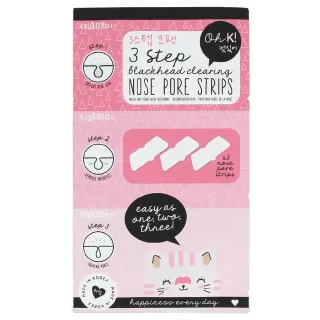
“3 Step Nose Pore Strips”
Effective ingredients missing or their concentration is too low.
MoisturizingSide benefit · Glycerin, Tartaric acid + 6 moreWorks
This product contains good ingredients to attract water to the upper layer of the skin. These ingredients are called "humectants": allantoin, glycerin.
When humectants are on the surface of the skin, they “pull in” the moisture from the outside environment, or from within deeper layers of the skin. If the air is dry, humectants can speed up the moisture loss from the skin. This is why it is a good idea to use another product on top of this one to help "seal in" the moisture (look for ingredients like dimethicone, squalane, oils and butters).
Anti-oxidationSide benefit · Camellia sinensis leaf extract, Tartaric acid + 2 moreMay help
This product contains antioxidants (camellia sinensis leaf extract, tartaric acid) that can help neutralize free radicals in skin to lessen the damage it gets from the UV light (sun). There is some human evidence for this effect in skin, though it is smaller or less consistent than the evidence for the best antioxidants.
Can it cause trouble?
Irritancy5 strong irritants: Melaleuca alternifolia leaf extract, Parfum + 3 more — patch-test recommendedHigh risk
ComedogenicClean of flagged comedogenic ingredientsNone flagged
User reviews
Be the first — your take helps the next person decide.
Ingredients
Filter by role to see what each ingredient is doing.
Water~45–55%
Dipropylene glycol~6.5–7.9%
- Irritation risk
- Low
Helps to dissolve other ingredients in a formulation. Slows down the rate of product drying
More about Dipropylene glycolPeg-7 glyceryl cocoate~3.9–4.8%
- Irritation risk
- Medium
Helps oils and water mix together and works as a cleansing agent
More about Peg-7 glyceryl cocoatePeg-60 hydrogenated castor oil~2.7–3.4%
- Irritation risk
- Medium
Helps oil and water mix together
More about Peg-60 hydrogenated castor oilPhenoxyethanol~0.5–1%
- Irritation risk
- Low
A preservative. It helps prevent bacterial growth in cosmetic products
More about PhenoxyethanolTromethamine~1.8–2.2%
Allantoin~1.4–1.7%
- Irritation risk
- Low
Helps calm down inflammation in skin and can help reduce itching. Helps to repair the skin barrier and keep skin hydrated
More about AllantoinXanthan gum~1.3–1.6%
- Irritation risk
- Low
Used to create a thicker product consistency
More about Xanthan gum1,2-hexanediol~0.6–0.95%
Butylene glycol~0.75–1.15%
- Irritation risk
- Low
Used to create a nice product texture and help delivery of other ingredients. Might be somewhat helpful in attracting water to the upper layer of the skin
More about Butylene glycolMelaleuca alternifolia leaf extract~0.6–0.85%
- Irritation risk
- High
An essential oil that can be irritating. Has some anti-bacterial properties
More about Melaleuca alternifolia leaf extractEthylhexylglycerin~0.5–0.8%
Parfum~0.45–0.65%
- Irritation risk
- High
An aromatic blend of unspecified and possibly irritating ingredients
More about ParfumMentha piperita leaf extract~0.4–0.6%
- Irritation risk
- High
Used as a fragrance and can be irritating
More about Mentha piperita leaf extractCamellia sinensis leaf extract~0.4–0.6%
- Irritation risk
- Low
Can contain potent anti-oxidant compounds (abbreviated ECG, GCG, EGC, and EGCG) that might help protect the skin from free radicals. Can help calm down inflammation and has some anti-bacterial properties. Unfortunately, these antioxidants are unstable and lose their effectiveness very quickly in products. The concentration of the antioxidant compounds in the extract also tends to be low to be effective in topical formulation
More about Camellia sinensis leaf extractPvp~0.4–0.6%
- Irritation risk
- Medium
Helps evenly disperse other ingredients in a formulation and create an even layer on the surface of the skin
More about PvpWater~0.3–0.6%
Glycerin~0.35–0.6%
- Irritation risk
- Low
One of the best moisturizing ingredients. Naturally present in skin. It attracts water to the upper layer of the skin working as a humectant
More about GlycerinVp/va copolymer~0.3–0.55%
- Irritation risk
- Low
Used to stabilize product formulation and create a nice product consistency
More about Vp/va copolymerTitanium dioxide~0.35–0.65%
- Irritation risk
- Low
Works as a UV filter when used in high concentrations. It is photostable and is effective mostly against the UVB light, with some protection in the UVA range. In small concentrations, used for its ability to improve the color of cosmetic products. Is usually well tolerated by the skin
More about Titanium dioxideDipropylene glycol~0.2–0.4%
- Irritation risk
- Low
Helps to dissolve other ingredients in a formulation. Slows down the rate of product drying
More about Dipropylene glycolBentonite~0.25–0.45%
Phenoxyethanol~0.2–0.4%
- Irritation risk
- Low
A preservative. It helps prevent bacterial growth in cosmetic products
More about Phenoxyethanol1,2-hexanediol~0.2–0.4%
Polysorbate 20~0.25–0.45%
Kaolin~0.3–0.6%
- Irritation risk
- Low
A type of clay that consists mainly of aluminum silicate. Helps absorb oil and creates a thicker product consistency. Can be used to add a white color
More about KaolinAloe barbadensis leaf extract~0.25–0.5%
- Irritation risk
- Medium
Traditionally used to treat sunburns, dermatitis and inflammation, but evidence for its effectiveness is lacking. The extract can contain humectants that help attract water into the skin
More about Aloe barbadensis leaf extractButylene glycol~0.2–0.4%
- Irritation risk
- Low
Used to create a nice product texture and help delivery of other ingredients. Might be somewhat helpful in attracting water to the upper layer of the skin
More about Butylene glycolLavandula angustifolia flower extract~0.25–0.5%
- Irritation risk
- High
Essential oil that can be irritating
More about Lavandula angustifolia flower extractRosa rugosa flower extract~0.2–0.35%
- Irritation risk
- High
Paeonia albiflora root extract~0.2–0.35%
- Irritation risk
- Low
Water~0.2–0.4%
Glycerin~0.25–0.45%
- Irritation risk
- Low
One of the best moisturizing ingredients. Naturally present in skin. It attracts water to the upper layer of the skin working as a humectant
More about GlycerinSodium polyacrylate~0.25–0.45%
- Irritation risk
- Low
Used to create a gel-like product texture, as well as to stabilize emulsions
More about Sodium polyacrylateDipropylene glycol~0.2–0.35%
- Irritation risk
- Low
Helps to dissolve other ingredients in a formulation. Slows down the rate of product drying
More about Dipropylene glycolButylene glycol~0.2–0.4%
- Irritation risk
- Low
Used to create a nice product texture and help delivery of other ingredients. Might be somewhat helpful in attracting water to the upper layer of the skin
More about Butylene glycolPaeonia suffruticosa root extract~0.2–0.4%
Centella asiatica extract~0.25–0.45%
- Irritation risk
- Medium
A plant extract that has been shown to be able to reduce inflammation in skin, support restoration of skin barrier function, as well as support collagen production. Contains active compounds called centelloids: asiaticoside, madecasosside, asiatic acid and madecassic acid. Might be helpful in preventing stretch marks. It can be itself be irritating though.
More about Centella asiatica extractChamomilla recutita flower extract~0.2–0.35%
- Irritation risk
- High
Plant extract that can have healing and anti-inflammatory properties. It is a potential allergen and can be irritating
More about Chamomilla recutita flower extract1,2-hexanediol~0.2–0.35%
Glyceryl caprylate~0.25–0.45%
- Irritation risk
- Low
An emollient that can also help water and oil mix together, as well as prevent bacteria growth in products
More about Glyceryl caprylateEthylhexylglycerin~0.2–0.35%
Cellulose gum~0.2–0.35%
- Irritation risk
- Low
Used to create thicker product consistency and stabilize emulsions
More about Cellulose gumTartaric acid~0.15–0.3%
- Irritation risk
- Medium
An AHA (alpha-hydroxy acid). It oxidizes quickly which makes it less effective in skincare formulations. It can support skin's barrier and moisture levels
More about Tartaric acidAluminum glycinate~0.15–0.3%
- Irritation risk
- Low
Allantoin~0.1–0.2%
- Irritation risk
- Low
Helps calm down inflammation in skin and can help reduce itching. Helps to repair the skin barrier and keep skin hydrated
More about AllantoinTitanium dioxide~0.2–0.35%
- Irritation risk
- Low
Works as a UV filter when used in high concentrations. It is photostable and is effective mostly against the UVB light, with some protection in the UVA range. In small concentrations, used for its ability to improve the color of cosmetic products. Is usually well tolerated by the skin
More about Titanium dioxideSciadopitys verticillata root extract~0.1–0.2%
- Irritation risk
- Low
Phenoxyethanol~0.1–0.25%
- Irritation risk
- Low
A preservative. It helps prevent bacterial growth in cosmetic products
More about PhenoxyethanolAloe barbadensis leaf extract~0.15–0.25%
- Irritation risk
- Medium
Traditionally used to treat sunburns, dermatitis and inflammation, but evidence for its effectiveness is lacking. The extract can contain humectants that help attract water into the skin
More about Aloe barbadensis leaf extractDisodium edta~0.01–0.05%
Ingredient list view
Water, Dipropylene glycol, Peg-7 glyceryl cocoate, Peg-60 hydrogenated castor oil, Phenoxyethanol, Tromethamine, Allantoin, Xanthan gum, 1,2-hexanediol, Butylene glycol, Melaleuca alternifolia leaf extract, Ethylhexylglycerin, Parfum, Mentha piperita leaf extract, Camellia sinensis leaf extract, Pvp, Water, Glycerin, Vp/va copolymer, Titanium dioxide, Dipropylene glycol, Bentonite, Phenoxyethanol, 1,2-hexanediol, Polysorbate 20, Kaolin, Aloe barbadensis leaf extract, Butylene glycol, Lavandula angustifolia flower extract, Rosa rugosa flower extract, Paeonia albiflora root extract, Water, Glycerin, Sodium polyacrylate, Dipropylene glycol, Butylene glycol, Paeonia suffruticosa root extract, Centella asiatica extract, Chamomilla recutita flower extract, 1,2-hexanediol, Glyceryl caprylate, Ethylhexylglycerin, Cellulose gum, Tartaric acid, Aluminum glycinate, Allantoin, Titanium dioxide, Sciadopitys verticillata root extract, Phenoxyethanol, Aloe barbadensis leaf extract, Disodium edta
Compare prices
Retailers ranked by price — lowest first.

Sources cited in this review
Every concentration estimate and effectiveness label is anchored to one of these 17 studies and safety reviews.
- 1Safety Assessment of Tromethamine as Used in Cosmeticscir-safety.org
- 2
- 3
- 4
- 5
- 6

Affiliate links · As an Amazon Associate, WIMJ earns from qualifying purchases.