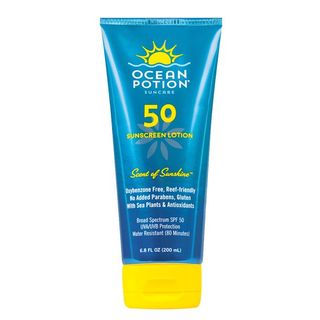
Ocean Potion Sunscreen Lotion Protect & Nourish SPF 50 Scent of Sunshine, 6.8 Fluid Ounces
Works for
2 of 2 advertised claims delivered
Sun protectionSPF 50 · 5 UV filtersBroad spectrum
This product offers a good level of protection against both UVB and UVA rays.
This sunscreen uses organic (so-called "chemical") sunscreen filters. Organic, or "chemical" filters usually provide reliable sun protection and rarely leave a white cast. Sunscreens with organic filters can sting eyes.
Anti-agingRetinyl acetate, Retinyl palmitate + 3 moreStrong evidence
“If used as directed with other sun protection measures, it decreases the risk of skin cancer and early skin aging caused by the sun.”
This product can help prevent early signs of skin aging because it offers a good level of broad spectrum sun protection. Sun damage is the main cause of premature skin aging, and protecting your skin from the sun is the best anti-aging strategy.
These ingredients in the product might also be helpful for reducing and preventing fine lines, wrinkles, and skin elasticity, even though there is no conclusive evidence for their effectiveness: retinyl acetate, retinyl palmitate.
Evens skin toneNot advertised by the brand · Retinyl palmitate, Ascorbic acidStrong evidence
This product offers broad spectrum sun protection. It means that it can prevent hyperpigmentation and help keep the skin tone even (sun damage is the main factor causing age spots, darkening of post-acne marks and other discolorations).
MoisturizingNot advertised by the brand · Algae extract, Diisopropyl adipate + 2 moreGood evidence
This product can help improve hydration of the skin with the two types of ingredients.
The first type is called “humectants”:
these ingredients help attract water.
When humectants are on the surface of the skin, they “pull in” the moisture from the outside environment, or from
within deeper layers of the skin. The following ingredients in this product do the job:
algae extract.
This product also contains ingredients called “occlusives”. They help reduce the speed with which our skin loses moisture to the outside environment. These ingredients also help soften the upper layer of the skin, so it feels less tight and nicer to the touch. The following ingredients in this product do the job: algae extract, diisopropyl adipate.
Can it cause trouble?
Irritancy6 strong irritants: Benzophenone-3, Rosa damascena extract + 4 more — patch-test recommendedHigh risk
Comedogenic5 ingredients rated 2 or more on the 0–5 pore-clogging scale5 flagged

User reviews
Ingredients
Filter by role to see what each ingredient is doing.
Benzophenone-35%
- Irritation risk
- High
Same as oxybenzone. Protects in the UVB and short UVA range. In small concentrations, used to stabilize product formulation. Can be irritating. Is shown to be harmful to coral reefs - consider avoiding bathing in coral reef areas when wearing a product with this ingredient. It can penetrate the skin and get absorbed into bloodstream faster than other popular filters available in the US. The study that produced this finding did not address any potential health effects of the absorption
More about Benzophenone-3Water~45–55%
Acrylates crosspolymer~8.4–10.2%
Polyisobutene~5.5–6.7%
Diisopropyl adipate~4.2–5.1%
- Irritation risk
- Low
Helps soften the upper layer of the skin
More about Diisopropyl adipatePropylene glycol~2.9–3.5%
- Irritation risk
- High
Helps oil and water mix together and can enhance the penetration of other ingredients into the skin. It can be irritating
More about Propylene glycolCholecalciferol~2.3–2.8%
- Irritation risk
- Low
Dimethyl capramide~1.8–2.2%
- Irritation risk
- Low
Helps to dissolve other ingredients, especially sunscreens
More about Dimethyl capramidePolyester-8~1.7–2%
- Irritation risk
- Medium
Used to stabilize product formulations and individual ingredients (for example, sunscreens). Can be an allergen
More about Polyester-8Rosa damascena extract~1.4–1.8%
- Irritation risk
- High
Oil of a very fragrant pink rose used as fragrance in cosmetics. Extensive research has shown it has mixed benefits. In the pro column, inhaling this flower’s scent seems to have relaxing properties and the plant’s petals contain skin-soothing and antioxidant compounds that can benefit skin. On the flipside, the numerous chemicals that create this rose’s distinctive fragrance pose a risk of causing skin aggravation.
More about Rosa damascena extractTocopheryl acetate~1.2–1.5%
- Irritation risk
- Medium
A more stable but less bio-available form of vitamin E compared to Tocopherol. Might help moisturize and protect the skin from free radicals, but mostly used in low concentrations to stabilize other ingredients.
More about Tocopheryl acetateTocopherol~1.1–1.3%
- Irritation risk
- Low
Pure form of vitamin E. Can help moisturise and protect the skin from free radicals. Often used to help stabilise other ingredients or the formula itself
More about TocopherolRetinyl acetate~0.9–1.1%
Olea europaea fruit oil~0.8–1.2%
- Irritation risk
- Medium
An emollient that helps soften the skin but is not effective for restoring its barrier function. Might be helpful to calm down inflammation
More about Olea europaea fruit oilHydroxypropyl methylcellulose~0.8–1.2%
- Irritation risk
- Medium
Used to create a thicker product consistency and stabilize the formulation
More about Hydroxypropyl methylcelluloseSorbitan oleate~0.7–1.1%
- Irritation risk
- Medium
- Comedogenicity
- 2/5
Helps oil and water mix together
More about Sorbitan oleateAcrylates/c10-30 alkyl acrylate crosspolymer~0.8–1.2%
- Irritation risk
- Medium
Maintains the texture of skincare products. Allows the product to spread evenly. Helps oil and water mix together
More about Acrylates/c10-30 alkyl acrylate crosspolymerCarbomer~0.7–1.05%
- Irritation risk
- Low
Helps create a thicker or gel-like product texture. It is not a surfactant but can be used in gentle cleansing formulations
More about CarbomerDisodium edta~0.65–1%
Phenoxyethanol~0.65–0.95%
- Irritation risk
- Low
A preservative. It helps prevent bacterial growth in cosmetic products
More about PhenoxyethanolTriethanolamine~0.65–0.95%
- Irritation risk
- Medium
Used to adjust pH of the product and can help improve the product's smell
More about TriethanolamineParfum~0.55–0.85%
- Irritation risk
- High
An aromatic blend of unspecified and possibly irritating ingredients
More about ParfumWater~0.6–0.85%
Acrylates copolymer~0.6–0.95%
- Irritation risk
- Medium
Used to stabilize product formulation, help create an even product layer over skin (for example, in sunscreen) and create a thicker product consistency
More about Acrylates copolymerPolyisobutene~0.65–0.95%
Propylene glycol~0.55–0.8%
- Irritation risk
- High
Helps oil and water mix together and can enhance the penetration of other ingredients into the skin. It can be irritating
More about Propylene glycolDimethyl capramide~0.55–0.85%
- Irritation risk
- Low
Helps to dissolve other ingredients, especially sunscreens
More about Dimethyl capramidePolyester-8~0.65–1%
- Irritation risk
- Medium
Used to stabilize product formulations and individual ingredients (for example, sunscreens). Can be an allergen
More about Polyester-8Triethanolamine~0.6–0.85%
- Irritation risk
- Medium
Used to adjust pH of the product and can help improve the product's smell
More about TriethanolamineAlgae extract~0.65–0.95%
- Irritation risk
- Low
- Comedogenicity
- 3/5
Plant extract that helps the skin to attract water and make it more smooth for touch. Also shows promise of anti-aging properties, but research is not extensive yet
More about Algae extractAscorbic acid~0.55–0.8%
- Irritation risk
- High
The most well-researched antioxidant that works in skin. Helps neutralize free radicals supporting collagen production, helping to even out the skin tone and preventing early signs of aging
More about Ascorbic acidOlea europaea fruit oil~0.6–0.85%
- Irritation risk
- Medium
An emollient that helps soften the skin but is not effective for restoring its barrier function. Might be helpful to calm down inflammation
More about Olea europaea fruit oilRetinyl palmitate~0.55–0.8%
- Irritation risk
- High
Three steps removed from the active form of vitamin A - retinoic acid. To have an effect in the skin, it first needs to be converted twice to become the retinoic acid. This means it is less potent than retinol, but could also be less irritating. Once converted to the retinoic acid in the skin, it helps against all signs of aging, improves skin cell turnover and helps fight blemishes and clogged pores. However, in many cosmetic formulations, it is used in a concentration that is too low to have the full effect
More about Retinyl palmitateTocopherol~0.55–0.8%
- Irritation risk
- Low
Pure form of vitamin E. Can help moisturise and protect the skin from free radicals. Often used to help stabilise other ingredients or the formula itself
More about TocopherolHydroxypropyl methylcellulose~0.6–0.95%
- Irritation risk
- Medium
Used to create a thicker product consistency and stabilize the formulation
More about Hydroxypropyl methylcelluloseSorbitan oleate~0.6–0.85%
- Irritation risk
- Medium
- Comedogenicity
- 2/5
Helps oil and water mix together
More about Sorbitan oleateAcrylates/c10-30 alkyl acrylate crosspolymer~0.65–1%
- Irritation risk
- Medium
Maintains the texture of skincare products. Allows the product to spread evenly. Helps oil and water mix together
More about Acrylates/c10-30 alkyl acrylate crosspolymerCarbomer~0.55–0.85%
- Irritation risk
- Low
Helps create a thicker or gel-like product texture. It is not a surfactant but can be used in gentle cleansing formulations
More about CarbomerDisodium edta~0.55–0.85%
Phenoxyethanol~0.6–0.85%
- Irritation risk
- Low
A preservative. It helps prevent bacterial growth in cosmetic products
More about PhenoxyethanolParfum~0.55–0.8%
- Irritation risk
- High
An aromatic blend of unspecified and possibly irritating ingredients
More about ParfumButyl methoxydibenzoylmethane2%
- Irritation risk
- Medium
Avobenzone. An organic, or so-called "chemical" UV filter. Protects against both UVA and UVB rays. Needs to be combined with other filters in a formulation to be stable.
More about Butyl methoxydibenzoylmethaneHomosalate10%
- Irritation risk
- Medium
A weak sunscreen that offers some protection against the sun rays that cause sunburn (UVB), but does not offer meaningful protection against protect against the most aging sun rays (UVA). It loses its effectiveness quickly when exposed to sunlight. It is an organic, or so called "chemical" sunscreen. When used in low concentrations, helps to stabilize the product formulation
More about HomosalateEthylhexyl salicylate5%
- Irritation risk
- Low
Octisalate. A UV filter. It offers some protection against the sun rays that cause sunburn (UVB), but does not protect against the most aging sun rays (UVA). It loses its effectiveness quickly when exposed to sunlight. It is an organic, or so called "chemical" sunscreen
More about Ethylhexyl salicylateOctocrylene2%
- Irritation risk
- Medium
A weak sunscreen that protects against the sun rays that cause sunburn (UVB) and is somewhat effective against the UVA rays. It is quite stable and can help stabilize other, more vulnerable, sunscreen ingredients like Avobenzone. It is an organic, or so called "chemical" sunscreen
More about OctocryleneAcrylates/c10-30 alkyl acrylate crosspolymer~0.65–0.95%
- Irritation risk
- Medium
Maintains the texture of skincare products. Allows the product to spread evenly. Helps oil and water mix together
More about Acrylates/c10-30 alkyl acrylate crosspolymerAcrylates copolymer~0.6–0.9%
- Irritation risk
- Medium
Used to stabilize product formulation, help create an even product layer over skin (for example, in sunscreen) and create a thicker product consistency
More about Acrylates copolymerCarbomer~0.55–0.8%
- Irritation risk
- Low
Helps create a thicker or gel-like product texture. It is not a surfactant but can be used in gentle cleansing formulations
More about CarbomerCholecalciferol~0.5–0.75%
- Irritation risk
- Low
Diisopropyl adipate~0.55–0.85%
- Irritation risk
- Low
Helps soften the upper layer of the skin
More about Diisopropyl adipateDimethyl capramide~0.5–0.75%
- Irritation risk
- Low
Helps to dissolve other ingredients, especially sunscreens
More about Dimethyl capramideDisodium edta~0.5–0.75%
Parfum~0.45–0.7%
- Irritation risk
- High
An aromatic blend of unspecified and possibly irritating ingredients
More about ParfumHydroxypropyl methylcellulose~0.55–0.8%
- Irritation risk
- Medium
Used to create a thicker product consistency and stabilize the formulation
More about Hydroxypropyl methylcelluloseIodopropynyl butylcarbamate~0.01–0.02%
Macrocystis pyrifera extract~0.4–0.6%
- Irritation risk
- Low
- Comedogenicity
- 3/5
Phenoxyethanol~0.3–0.6%
- Irritation risk
- Low
A preservative. It helps prevent bacterial growth in cosmetic products
More about PhenoxyethanolPolyester-8~0.4–0.6%
- Irritation risk
- Medium
Used to stabilize product formulations and individual ingredients (for example, sunscreens). Can be an allergen
More about Polyester-8Propylene glycol~0.25–0.45%
- Irritation risk
- High
Helps oil and water mix together and can enhance the penetration of other ingredients into the skin. It can be irritating
More about Propylene glycolSorbitan oleate~0.25–0.45%
- Irritation risk
- Medium
- Comedogenicity
- 2/5
Helps oil and water mix together
More about Sorbitan oleateTocopheryl acetate~0.25–0.45%
- Irritation risk
- Medium
A more stable but less bio-available form of vitamin E compared to Tocopherol. Might help moisturize and protect the skin from free radicals, but mostly used in low concentrations to stabilize other ingredients.
More about Tocopheryl acetateTriethanolamine~0.2–0.35%
- Irritation risk
- Medium
Used to adjust pH of the product and can help improve the product's smell
More about TriethanolamineWater~0.2–0.35%
Ingredient list view
Benzophenone-3, Water, Acrylates crosspolymer, Polyisobutene, Diisopropyl adipate, Propylene glycol, Cholecalciferol, Dimethyl capramide, Polyester-8, Rosa damascena extract, Tocopheryl acetate, Tocopherol, Retinyl acetate, Olea europaea fruit oil, Hydroxypropyl methylcellulose, Sorbitan oleate, Acrylates/c10-30 alkyl acrylate crosspolymer, Carbomer, Disodium edta, Phenoxyethanol, Triethanolamine, Parfum, Water, Acrylates copolymer, Polyisobutene, Propylene glycol, Dimethyl capramide, Polyester-8, Triethanolamine, Algae extract, Ascorbic acid, Olea europaea fruit oil, Retinyl palmitate, Unknown, Tocopherol, Hydroxypropyl methylcellulose, Sorbitan oleate, Acrylates/c10-30 alkyl acrylate crosspolymer, Carbomer, Disodium edta, Phenoxyethanol, Unknown, Parfum, Butyl methoxydibenzoylmethane, Homosalate, Ethylhexyl salicylate, Octocrylene, Acrylates/c10-30 alkyl acrylate crosspolymer, Acrylates copolymer, Carbomer, Cholecalciferol, Diisopropyl adipate, Dimethyl capramide, Disodium edta, Parfum, Hydroxypropyl methylcellulose, Iodopropynyl butylcarbamate, Macrocystis pyrifera extract, Phenoxyethanol, Polyester-8, Propylene glycol, Sorbitan oleate, Tocopheryl acetate, Triethanolamine, Water
Compare prices
Retailers ranked by price — lowest first.
Worth comparing, line by line.
Match % combines shared ingredients, the first five ingredients, shared actives and hero ingredients, irritancy (lower counts in the alternative's favour), texture and body area. Only products in the same routine step are compared.
| Ocean PotionSunscreen Lotion Protect & Nourish SPF 50 Scent of Sunshine, 6.8 Fluid OuncesYOUR PRODUCT | ObagiProfessional-C Suncare Broad Spectrum SPF 30 Sunscreen Lotion | ReplenixUltra Sheer Sunscreen SPF 50 Plus | Australian GoldSPF 30 InvisiDry Spray Sunscreen, Water Resistant | |
|---|---|---|---|---|
| Match | — | 83% | 80% | 68% |
| Price | — | $36.99 | $40.00 | $10.99 |
| Shared key ingredients | — | 5 of 9 | 4 of 9 | 5 of 9 |
| Key difference | — | Dimethicone | Emblica Officinalis Fruit Extract | Camellia Sinensis Leaf Extract |
| Irritancy | High | High | High | High |
| SPF | SPF 50 | SPF 30 | SPF 50 | SPF 30 |
| Drying alcohol | — | — | — | Contains drying alcohol |
| View product | Shop | Shop | Shop |


Product summary
Based on the ingredient list, we assess that "Ocean Potion - Sunscreen Lotion Protect & Nourish SPF 50 Scent of Sunshine, 6.8 Fluid Ounces" can provide reliable sun protection. It can protect from both UVA and UVB rays. This is great news because not all sunscreens with SPF ratings give UVA protection. (UVA rays do not cause sunburn, but still damage our skin and lead to early aging).
It contains good moisturizing ingredients and can double as a hydrating day cream. This product prevents early signs of aging by protecting against sun damage (all broad spectrum sunscreens do that).
Sunscreen filters
This sunscreen uses so-called "chemical", or organic UV filters (organic simply means that their molecules contain atoms of carbon). These filters typically give good sun protection and rarely leave a white cast, but they can be irritating for sensitive skin. These are the sun protection ingredients in this sunscreen: oxybenzone 5.00% (declared), avobenzone 2.00% (declared), octisalate 5.00% (declared), homosalate 10.00% (declared) and octocrylene 2.00% (declared).
Irritation risk
There are quite a few common irritants in this product, including ingredients without particular skin benefits. We would not recommend it for sensitive skin. We assess the overall irritancy of this moisturizer to be high. For a detailed overview of all potential irritants: click here
You can see the detailed formula review with the breakdown of all actives in the product and the full ingredient list with estimated concentrations in the tables below.
What our users say
Based on 1 review 0% recommend this product- When it comes to comedogenicity, the reviewer believes that it clogs pores.
- As for the white cast, it did not leave a noticeable white residue for the reviewer.
- When it comes to using this sunscreen under makeup, the user found that it pills under a foundation.
- As for using this sunscreen in the eye area, the reviewer reported that it stings eyes.
Sources cited in this review
Every concentration estimate and effectiveness label is anchored to one of these 15 studies and safety reviews.
- 1
- 2
- 3On Photostability of Oxybenzonecore.ac.uk
- 4
- 5Surfactants and experimental irritant contact dermatitisncbi.nlm.nih.gov
- 6Propylene Glycolpubmed.ncbi.nlm.nih.gov

Affiliate links · As an Amazon Associate, WIMJ earns from qualifying purchases.