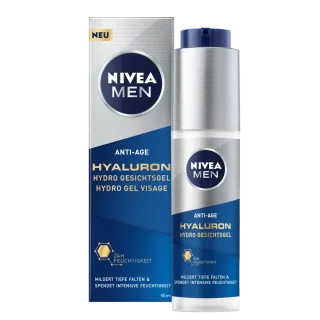
Works for
MoisturizingGlycerin, Sodium hyaluronate + 3 moreWorks
“✓ Instantly moisturizes and revitalizes”
This product contains good ingredients to attract water to the upper layer of the skin. These ingredients are called "humectants": glycerin, sodium hyaluronate.
When humectants are on the surface of the skin, they “pull in” the moisture from the outside environment, or from within deeper layers of the skin. If the air is dry, humectants can speed up the moisture loss from the skin. This is why it is a good idea to use another product on top of this one to help "seal in" the moisture (look for ingredients like dimethicone, squalane, oils and butters).
Anti-agingRetinyl palmitate, TocopherolMay help
“✓ Visibly reduces deep wrinkles”
This product contains retinyl palmitate. There is some human evidence that this ingredient helps reduce and prevent fine lines and wrinkles and improve skin elasticity and firmness, though it is smaller or less consistent than the evidence for the best anti-aging ingredients.
Anti-oxidationSide benefit · TocopherolWorks well
This product contains antioxidants (tocopherol) that can help neutralize free radicals in skin. By doing so, they can lessen the damage the skin gets from the UV light (sun).
Evens skin toneSide benefit · Retinyl palmitateMay help
The following ingredient (ingredients) in this product might be helpful, but there is no evidence to confirm that it actually works: retinyl palmitate.
Can it cause trouble?
Irritancy2 strong irritants: Retinyl palmitate, ParfumMedium risk
Comedogenic1 ingredient rated 2 or more on the 0–5 pore-clogging scale1 flagged
User reviews
Be the first — your take helps the next person decide.
Ingredients
Filter by role to see what each ingredient is doing.
Water~40–60%
Isopropyl palmitate~5.3–8%
- Irritation risk
- Medium
- Comedogenicity
- 3/5
Helps soften the upper layer of the skin and create a thicker product consistency
More about Isopropyl palmitateGlycerin~3.6–5.3%
- Irritation risk
- Low
One of the best moisturizing ingredients. Naturally present in skin. It attracts water to the upper layer of the skin working as a humectant
More about GlycerinButylene glycol~2.7–4.1%
- Irritation risk
- Low
Used to create a nice product texture and help delivery of other ingredients. Might be somewhat helpful in attracting water to the upper layer of the skin
More about Butylene glycolMethylpropanediol~2.1–3.1%
Sodium hyaluronate~1.6–2.4%
- Irritation risk
- Low
One of the best moisturizing ingredients. Attracts water into the upper layer of the skin
More about Sodium hyaluronateRetinyl palmitate~1.4–2%
- Irritation risk
- High
Three steps removed from the active form of vitamin A - retinoic acid. To have an effect in the skin, it first needs to be converted twice to become the retinoic acid. This means it is less potent than retinol, but could also be less irritating. Once converted to the retinoic acid in the skin, it helps against all signs of aging, improves skin cell turnover and helps fight blemishes and clogged pores. However, in many cosmetic formulations, it is used in a concentration that is too low to have the full effect
More about Retinyl palmitateTocopherol~1.1–1.7%
- Irritation risk
- Low
Pure form of vitamin E. Can help moisturise and protect the skin from free radicals. Often used to help stabilise other ingredients or the formula itself
More about TocopherolTapioca starch~1–1.5%
Hydroxyethylcellulose~0.8–1.2%
- Irritation risk
- Low
Used to thicken product formulations and create gel-like textures
More about HydroxyethylcelluloseDehydroxanthan gum~0.5–1.1%
- Irritation risk
- Low
Helps create thicker product formulations and stabilize emulsions
More about Dehydroxanthan gumCitric acid~0.4–0.9%
- Irritation risk
- Medium
Can work as an exfoliant but is typically used to adjust the product pH
More about Citric acidSodium sulfate~0.4–0.9%
- Irritation risk
- Medium
Used to improve the product consistency and stabilize formulations
More about Sodium sulfateSodium phosphate~0.2–0.7%
Sodium chloride~0.15–0.6%
- Irritation risk
- Low
Used to stabilize mixtures of oil and water, and create thicker, gel-like product textures
More about Sodium chlorideDisodium phosphate~0.1–0.4%
- Irritation risk
- Low
Helps adjust the product pH and stabilize the formulation
More about Disodium phosphatePhenoxyethanol~0.1–0.3%
- Irritation risk
- Low
A preservative. It helps prevent bacterial growth in cosmetic products
More about PhenoxyethanolParfum~0.05–0.15%
- Irritation risk
- High
An aromatic blend of unspecified and possibly irritating ingredients
More about ParfumCi 42090~0.05–0.15%
Ingredient list view
Water, Isopropyl palmitate, Glycerin, Butylene glycol, Methylpropanediol, Sodium hyaluronate, Retinyl palmitate, Tocopherol, Tapioca starch, Hydroxyethylcellulose, Dehydroxanthan gum, Citric acid, Sodium sulfate, Sodium phosphate, Sodium chloride, Disodium phosphate, Phenoxyethanol, Parfum, Ci 42090
Compare prices
Retailers ranked by price — lowest first.

Affiliate links
Worth comparing, line by line.
Match % combines shared ingredients, the first five ingredients, shared actives and hero ingredients, irritancy (lower counts in the alternative's favour), texture and body area. Only products in the same routine step are compared.
| NiveaMen Anti-Age Hyaluron Hydro GelYOUR PRODUCT | Sofie Pavitt FaceSkin Jelly Oil-Free Gel Moisturizer | UriageBariederm-Cica Daily Gel-Cream | Paula's choiceSkin Balancing Invisible Finish Moisture Gel Full size | |
|---|---|---|---|---|
| Match | — | 42% | 41% | 40% |
| Price | $14.99 | $54.00+$39.01 | $20.79+$5.80 | $31.00+$16.01 |
| Shared key ingredients | — | 2 of 4 | 2 of 4 | 2 of 4 |
| Key difference | — | Panthenol | Panthenol | Niacinamide |
| Irritancy | Medium | Low | Low | Low |
| Drying alcohol | — | — | — | — |
| View product | Shop | Shop | Shop |



More alternatives: Clinique Moisture Surge Intense Skin Fortifying HydratorJuJu Aquamoist All In One Moisturizing Gel
Sources cited in this review
Every concentration estimate and effectiveness label is anchored to one of these 7 studies and safety reviews.
- 1Final Report on the Safety Assessment of Isopropyl Isostearatejournals.sagepub.com
- 2
- 3Hyaluronic acid: A key molecule in skin agingncbi.nlm.nih.gov
- 4
- 5Vitamin E in dermatologyncbi.nlm.nih.gov
- 6Vitamin E and Skin Healthlpi.oregonstate.edu

Affiliate links · As an Amazon Associate, WIMJ earns from qualifying purchases.