Works for
CleansingCoco-glucoside, Coco-betaineCleanses gently
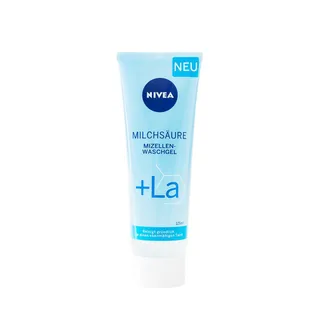
“This cleansing gel formulated with Nivea’s MicellAIR® complex removes make-up and impurities.”
This product works by removing dirt and oil from the surface of the skin. It uses a combination of mild cleansing agents (coco-betaine, coco-glucoside) and should be able to cleanse the skin gently. Still keep in mind that any cleansing can disrupt the skin barrier, and most people do not need to cleanse their skin more than once per day.
Even though this formulation is mild, the following cleansing agents could trigger an irritation or allergy for some people: coco-betaine, coco-glucoside
ExfoliationSide benefit · Lactic acidWorks well
This product can help exfoliate the skin. In other words, it helps break down the bonds between dead cells on the surface of the skin and speed up the skin turnover. Skin often appears softer and brighter after exfoliation, but overdoing it can result in disrupted skin barrier. The following ingredient is doing the exfoliating job in this product: lactic acid.
Can it cause trouble?
Irritancy2 strong irritants: Benzophenone-4, ParfumMedium risk
ComedogenicClean of flagged comedogenic ingredientsNone flagged
User reviews
Be the first — your take helps the next person decide.
Ingredients
Filter by role to see what each ingredient is doing.
Water~40–60%
Coco-glucoside~9.3–14%
- Irritation risk
- High
Used as a cleansing agent (surfactant) in cleansers. Helps water and oil mix together in lotions. Can be irritating
More about Coco-glucosideCoco-betaine~5–7.5%
- Irritation risk
- High
Helps oil and water mix together and works as a cleansing agent. Can be allergenic
More about Coco-betaineAcrylates/c10-30 alkyl acrylate crosspolymer~2.8–4.2%
- Irritation risk
- Medium
Maintains the texture of skincare products. Allows the product to spread evenly. Helps oil and water mix together
More about Acrylates/c10-30 alkyl acrylate crosspolymerLactic acid~2–3%
- Irritation risk
- Medium
An exfoliating and moisturizing alpha-hydroxy acid (AHA). Typically causes less irritation than other AHAs, for example, glycolic acid. At high concentrations (about 15%), lactic acid can help reduce lines and wrinkles. Recent studies show that lactic acid can support the "good" bacteria living on skin's surface (healthy skin microbiome)
More about Lactic acidSodium chloride~1.5–2.3%
- Irritation risk
- Low
Used to stabilize mixtures of oil and water, and create thicker, gel-like product textures
More about Sodium chlorideSodium benzoate~0.25–0.5%
Sodium hydroxide~0.8–1.2%
Phenoxyethanol~0.3–0.75%
- Irritation risk
- Low
A preservative. It helps prevent bacterial growth in cosmetic products
More about PhenoxyethanolPolyquaternium-10~0.15–0.55%
- Irritation risk
- Low
Helps soften the upper layer of the skin and create a nice product finish
More about Polyquaternium-10Benzophenone-4~0.15–0.55%
- Irritation risk
- High
Sulisobenzone. A UV filter. Is typically used to improve the product stability under exposure to UV light. It is effective against both UVA and UVB rays. It can be used is larger concentrations as a sun protection ingredient for the skin, but can be irritating
More about Benzophenone-4Parfum~0.05–0.15%
- Irritation risk
- High
An aromatic blend of unspecified and possibly irritating ingredients
More about ParfumIngredient list view
Water, Coco-glucoside, Coco-betaine, Acrylates/c10-30 alkyl acrylate crosspolymer, Lactic acid, Sodium chloride, Sodium benzoate, Sodium hydroxide, Phenoxyethanol, Polyquaternium-10, Benzophenone-4, Parfum
Compare prices
Retailers ranked by price — lowest first.
Worth comparing, line by line.
Match % combines shared ingredients, the first five ingredients, shared actives and hero ingredients, irritancy (lower counts in the alternative's favour), texture and body area. Only products in the same routine step are compared.
| NiveaLactic Acid Micellar Wash GelYOUR PRODUCT | CeraVeGel Moussant Anti-Imperfections | OlivalAmino Gel | TOŁPA authenticface wash gel | |
|---|---|---|---|---|
| Match | — | 55% | 54% | 54% |
| Price | — | — | — | — |
| Shared key ingredients | — | 1 of 4 | 1 of 4 | 1 of 4 |
| Key difference | — | Salicylic Acid | Betaine | Lauryl Glucoside |
| Irritancy | Medium | Low | Low | Low |
| Drying alcohol | — | — | — | — |
| View product | Shop | Shop | Shop |

More alternatives: Ren Skincare Evercalm Gentle Cleansing Gel by Ren Clean SkincareEau de Jonzac Pure Purifying Cleansing Gel Organic
Sources cited in this review
Every concentration estimate and effectiveness label is anchored to one of these 6 studies and safety reviews.
- 1
- 2Allergen of the Year—Alkyl Glucosidepracticeupdate.com
- 3Epidermal and dermal effects of topical lactic acidncbi.nlm.nih.gov
- 4Dual Effects of Alpha-Hydroxy Acids on the Skinpdfs.semanticscholar.org
- 5
- 6Benzophenone 4: An emerging allergen in cosmetics and toiletries?pubmed.ncbi.nlm.nih.gov

Affiliate links · As an Amazon Associate, WIMJ earns from qualifying purchases.