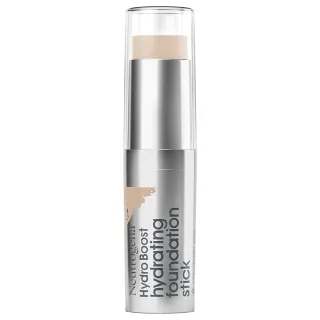
Neutrogena Hydro Boost Hydrating Makeup Stick, Classic Ivory
Works for
1 of 1 advertised claim delivered
Moisturizing10 ingredients credited for this claimGood support
“Hydro Boost Hydrating Makeup Stick, Classic Ivory”
This product can help improve hydration of the skin with the two types of ingredients.
The first type is called “humectants”:
these ingredients help attract water.
When humectants are on the surface of the skin, they “pull in” the moisture from the outside environment, or from
within deeper layers of the skin. The following ingredients in this product do the job:
hydrolyzed hyaluronic acid, caprylyl glycol.
This product also contains ingredients called “occlusives”. They help reduce the speed with which our skin loses moisture to the outside environment. These ingredients also help soften the upper layer of the skin, so it feels less tight and nicer to the touch. The following ingredients in this product do the job: bis-diglyceryl polyacyladipate-2, phytosteryl macadamiate.
Can it cause trouble?
Irritancy4 flagged ingredientsLow risk
ComedogenicClean of flagged comedogenic ingredientsNone flagged
User reviews
Be the first — your take helps the next person decide.
Ingredients
Filter by role to see what each ingredient is doing.
Dicaprylyl carbonate~22–33%
- Irritation risk
- Low
Helps products spread more easily and works as an emollient to soften skin
More about Dicaprylyl carbonatePolyglyceryl-2 triisostearate~4.3–6.4%
- Irritation risk
- Low
Helps to soften the upper layer of the skin and create a nice product texture
More about Polyglyceryl-2 triisostearateHydrogenated polyisobutene~4.3–6.5%
- Irritation risk
- Low
Used to improve the product consistency and soften the upper layer of the skin
More about Hydrogenated polyisobutenePolyethylene~3.5–5.3%
Pentaerythrityl tetraisostearate~2.6–3.9%
- Irritation risk
- Medium
Used to create a thicker product consistency
More about Pentaerythrityl tetraisostearateMethyl methacrylate crosspolymer~1.9–2.9%
- Irritation risk
- Low
Helps thicken the product consistency
More about Methyl methacrylate crosspolymerPolyglyceryl-3 palmitate~1.5–2.3%
Bis-diglyceryl polyacyladipate-2~1.4–2.1%
- Irritation risk
- Low
Helps soften the upper layer of the skin and reduce water loss from its surface
More about Bis-diglyceryl polyacyladipate-2Vp/hexadecene copolymer~1–1.45%
- Irritation risk
- Low
Creates a nice product texture and can support water-resistance of sunscreens
More about Vp/hexadecene copolymerBarium sulfate~0.85–1.25%
- Irritation risk
- Low
Paraffin~0.45–1%
- Irritation risk
- Low
Prevents water loss from the skin surface and thickens the product consistency
More about ParaffinCetyl peg/ppg-10/1 dimethicone~0.4–0.9%
- Irritation risk
- Low
A type of silicone that helps water and oil mix together. Can help to soften upper layer of the skin
More about Cetyl peg/ppg-10/1 dimethiconeSorbitan isostearate~0.35–0.8%
- Irritation risk
- Low
Helps oil and water mix together
More about Sorbitan isostearateAluminum starch octenylsuccinate~0.3–0.75%
- Irritation risk
- Medium
Used to thicken the product's consistency
More about Aluminum starch octenylsuccinatePolyglyceryl-4 isostearate~0.2–0.8%
- Irritation risk
- Medium
Helps water and oil mix together
More about Polyglyceryl-4 isostearatePhytosteryl macadamiate~0.4–0.95%
- Irritation risk
- Low
Helps soften the upper layer of the skin
More about Phytosteryl macadamiateSilica~0.45–1.1%
Microcrystalline wax~0.2–0.75%
Triethoxycaprylylsilane~0.15–0.55%
- Irritation risk
- Low
A type of silicone that helps oil and water mix well together. Helps to disperse other ingredients, e.g. pigments, evenly in a formulation
More about TriethoxycaprylylsilaneCaprylyl glycol~0.15–0.65%
- Irritation risk
- Medium
Helps preserve products and creates a nice product texture
More about Caprylyl glycolGlyceryl caprylate~0.15–0.65%
- Irritation risk
- Low
An emollient that can also help water and oil mix together, as well as prevent bacteria growth in products
More about Glyceryl caprylateHydrolyzed hyaluronic acid~0.1–0.4%
- Irritation risk
- Low
One of the best moisturizing ingredients. Attracts water into the upper layer of the skin. A version of it is naturally present in skin
More about Hydrolyzed hyaluronic acidMagnesium myristate~0.1–0.45%
- Irritation risk
- Low
Titanium dioxide~0.15–0.6%
- Irritation risk
- Low
Works as a UV filter when used in high concentrations. It is photostable and is effective mostly against the UVB light, with some protection in the UVA range. In small concentrations, used for its ability to improve the color of cosmetic products. Is usually well tolerated by the skin
More about Titanium dioxideMica~0.1–0.3%
- Irritation risk
- Low
Creates an illusion of smoother and more radiant skin tone. Adds shimmer to the skin by reflecting light
More about MicaIron oxides~0.05–0.15%
- Irritation risk
- Low
An umbrella term for the following three colorants: CI 77491, CI 77492, CI 77499. They might be able to offer some protection against visible light, but the degree of the protection is not clear
More about Iron oxidesIngredient list view
Dicaprylyl carbonate, Polyglyceryl-2 triisostearate, Hydrogenated polyisobutene, Polyethylene, Pentaerythrityl tetraisostearate, Methyl methacrylate crosspolymer, Polyglyceryl-3 palmitate, Unknown, Bis-diglyceryl polyacyladipate-2, Vp/hexadecene copolymer, Barium sulfate, Paraffin, Cetyl peg/ppg-10/1 dimethicone, Sorbitan isostearate, Aluminum starch octenylsuccinate, Polyglyceryl-4 isostearate, Phytosteryl macadamiate, Silica, Microcrystalline wax, Triethoxycaprylylsilane, Caprylyl glycol, Glyceryl caprylate, Hydrolyzed hyaluronic acid, Magnesium myristate, Titanium dioxide, Mica, Iron oxides
Compare prices
Retailers ranked by price — lowest first.

Affiliate links · prices updated regularly
Sources cited in this review
Every concentration estimate and effectiveness label is anchored to one of these 7 studies and safety reviews.
- 1
- 2
- 3
- 4
- 5Safety Assessment of Phytosterols as Used in Cosmeticscir-safety.org
- 6Efficacy of a New Topical Nano-hyaluronic Acid in Humansncbi.nlm.nih.gov

Affiliate links · As an Amazon Associate, WIMJ earns from qualifying purchases.