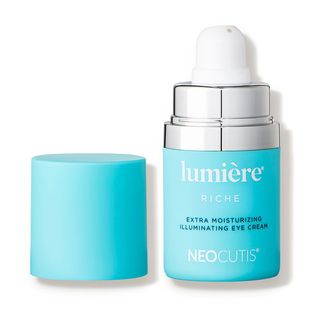
Neocutis LUMIÈRE RICHE Extra Moisturizing Illuminating Eye Cream
Works for
1 of 1 advertised claim delivered
Moisturizing13 ingredients credited for this claimStrong support
“LUMIÈRE RICHE Extra Moisturizing Illuminating Eye Cream”
This product can help improve hydration of the skin with the two types of ingredients.
The first type is called “humectants”:
these ingredients help attract water.
When humectants are on the surface of the skin, they “pull in” the moisture from the outside environment, or from
within deeper layers of the skin. The following ingredients in this product do the job:
glycerin, saccharide isomerate.
This product also contains ingredients called “occlusives”. They help reduce the speed with which our skin loses moisture to the outside environment. These ingredients also help soften the upper layer of the skin, so it feels less tight and nicer to the touch. The following ingredients in this product do the job: caprylic/capric triglyceride, squalane.
The following ingredients in this product are especially good for supporting the skin barrier and helping with the hydration level: petrolatum
Anti-oxidationNot advertised by the brand · 6 ingredients credited for this claimStrong support
This product contains antioxidants (glycyrrhetinic acid, tocotrienols) that can help neutralize free radicals in skin. By doing so, they can lessen the damage the skin gets from the UV light (sun).
Anti-agingNot advertised by the brand · 3 ingredients credited for this claimModerate support
This product contains tocotrienols. This ingredient might be able to help reduce and prevent fine lines and wrinkles, improve skin elasticity and firmness, but there is not enough evidence that it actually works.
Evens skin toneNot advertised by the brand · 2 ingredients credited for this claimModerate support
The following ingredient (ingredients) in this product might be helpful, but there is no evidence to confirm that it actually works: glycyrrhetinic acid.
Can it cause trouble?
Irritancy17 flagged ingredientsMedium risk
ComedogenicClean of flagged comedogenic ingredientsNone flagged
User reviews
Be the first — your take helps the next person decide.
Ingredients
Filter by role to see what each ingredient is doing.
Water~45–55%
C12-20 acid peg-8 ester~6.5–8%
- Irritation risk
- Medium
Helps oil and water mix together
More about C12-20 acid peg-8 esterPetrolatum~4.5–5.5%
- Irritation risk
- Low
One of the most effective and the most studied occlusive ingredients that creates a protective layer on top of the skin preventing moisture loss
More about PetrolatumCaprylic/capric triglyceride~3.3–4%
- Irritation risk
- Medium
A good mix of fatty acids that forms a protective layer on the skin. Improves the shelf life of products. Derived from coconut and glycerin
More about Caprylic/capric triglycerideHydrogenated polyisobutene~2.5–3%
- Irritation risk
- Low
Used to improve the product consistency and soften the upper layer of the skin
More about Hydrogenated polyisobuteneGlycerin~2–2.4%
- Irritation risk
- Low
One of the best moisturizing ingredients. Naturally present in skin. It attracts water to the upper layer of the skin working as a humectant
More about GlycerinSaccharide isomerate~1.6–2%
- Irritation risk
- Low
Helps attract water to the upper layer of the skin
More about Saccharide isomerateHydroxyethyl acrylate/sodium acryloyldimethyl taurate copolymer~1.4–1.7%
- Irritation risk
- Medium
A gelling agent that thickens the product consistency and leaves the skin with a velvety finish
More about Hydroxyethyl acrylate/sodium acryloyldimethyl taurate copolymerButylene glycol~1.2–1.4%
- Irritation risk
- Low
Used to create a nice product texture and help delivery of other ingredients. Might be somewhat helpful in attracting water to the upper layer of the skin
More about Butylene glycolEthylhexylglycerin~0.95–1.15%
Isohexadecane~0.8–1.2%
- Irritation risk
- Low
Improves the texture of the product and helps soften the skin. Helps oil and water mix together and can be used as a cleansing agent
More about IsohexadecanePotassium cetyl phosphate~0.6–0.9%
- Irritation risk
- Medium
Helps oil and water mix together
More about Potassium cetyl phosphateDioscorea villosa root extract~0.5–0.75%
- Irritation risk
- Low
Bisabolol~0.45–0.65%
- Irritation risk
- Low
An active component of chamomile plant that historically has been used to calm down irritated skin. A recent study shows that bisabolol indeed can have some anti-inflammatory effect on skin, even though conclusive data is lacking. Bisabolol has a sweet floral scent and can be added to products for its aromatic properties
More about BisabololTetrahexyldecyl ascorbate~0.45–0.65%
- Irritation risk
- Medium
Being a lipid soluble form of vitamin C, it is more stable than ascorbic acid, but still degrades quickly and needs to be stabilized in a formulation with another ingredient. It is claimed to penetrate skin better than pure vitamin C and have the the similar benefits, but solid studies of its effectiveness are lacking. Is likely to require a higher concentration in a product than pure vitamin C to be effective. It might be able to help reduce pore clogging.
More about Tetrahexyldecyl ascorbateCaffeine~0.45–0.65%
- Irritation risk
- Medium
Might be helpful in neutralizing free radicals. Can have a dehydration effect that might somewhat decrease the look of puffy eyes
More about CaffeineDisodium edta~0.4–0.6%
Lecithin~0.45–0.65%
- Irritation risk
- Low
Used mostly for creating emulsions - helping oil and water mix together. Helps soften the upper layer of the skin
More about LecithinGlycyrrhetinic acid~0.3–0.55%
- Irritation risk
- Medium
Active compound of licorice root. Works to calm down inflammation, as an anti-oxidant, and might be helpful in lightening the skin and reducing hyperpigmentation
More about Glycyrrhetinic acidSodium hyaluronate~0.3–0.55%
- Irritation risk
- Low
One of the best moisturizing ingredients. Attracts water into the upper layer of the skin
More about Sodium hyaluronateAcrylates/c10-30 alkyl acrylate crosspolymer~0.3–0.55%
- Irritation risk
- Medium
Maintains the texture of skincare products. Allows the product to spread evenly. Helps oil and water mix together
More about Acrylates/c10-30 alkyl acrylate crosspolymerCitric acid~0.25–0.5%
- Irritation risk
- Medium
Can work as an exfoliant but is typically used to adjust the product pH
More about Citric acidSodium citrate~0.25–0.45%
- Irritation risk
- Medium
Helps to control the skin's pH level. Maintains the skin's natural film of amino-lactic acids and oils. Helps to preserve products
More about Sodium citrateSodium hydroxide~0.25–0.45%
Tocopherol~0.25–0.45%
- Irritation risk
- Low
Pure form of vitamin E. Can help moisturise and protect the skin from free radicals. Often used to help stabilise other ingredients or the formula itself
More about TocopherolFagus sylvatica bud extract~0.25–0.45%
- Irritation risk
- Low
Elaeis guineensis extract~0.25–0.45%
- Irritation risk
- Low
Elaeis guineensis oil~0.25–0.5%
- Irritation risk
- Low
Helps soften the upper layer of the skin
More about Elaeis guineensis oilTocotrienols~0.25–0.45%
- Irritation risk
- Low
A type of vitamin E that is more powerful in neutralizing free radicals compared to its other forms
More about TocotrienolsSqualane~0.3–0.5%
- Irritation risk
- Low
An oil naturally present in skin. Works as an emollient to soften the skin and form a protective layer on its surface without a greasy feeling.
More about SqualanePhytosterols~0.25–0.5%
- Irritation risk
- Medium
Lipids that work as an emollient and can be helpful in repairing skin barrier function
More about PhytosterolsSorbitan isostearate~0.2–0.35%
- Irritation risk
- Low
Helps oil and water mix together
More about Sorbitan isostearatePhenoxyethanol~0.15–0.3%
- Irritation risk
- Low
A preservative. It helps prevent bacterial growth in cosmetic products
More about PhenoxyethanolChlorphenesin~0.15–0.25%
Polysorbate 60~0.15–0.25%
Benzyl alcohol~0.1–0.2%
- Irritation risk
- High
A preservative. Can be used to mask unpleasant smell. Can be irritating
More about Benzyl alcoholBenzoic acid~0.1–0.2%
Ingredient list view
Water, C12-20 acid peg-8 ester, Petrolatum, Caprylic/capric triglyceride, Hydrogenated polyisobutene, Glycerin, Saccharide isomerate, Hydroxyethyl acrylate/sodium acryloyldimethyl taurate copolymer, Butylene glycol, Ethylhexylglycerin, Isohexadecane, Potassium cetyl phosphate, Dioscorea villosa root extract, Bisabolol, Tetrahexyldecyl ascorbate, Caffeine, Disodium edta, Lecithin, Glycyrrhetinic acid, Sodium hyaluronate, Acrylates/c10-30 alkyl acrylate crosspolymer, Citric acid, Sodium citrate, Sodium hydroxide, Tocopherol, Fagus sylvatica bud extract, Elaeis guineensis extract, Elaeis guineensis oil, Tocotrienols, Squalane, Phytosterols, Sorbitan isostearate, Phenoxyethanol, Chlorphenesin, Polysorbate 60, Benzyl alcohol, Benzoic acid
Compare prices
Retailers ranked by price — lowest first.
Affiliate links · prices updated regularly · As an Amazon Associate, WIMJ earns from qualifying purchases.
Product summary
Based on the ingredients included, "Neocutis - LUMIÈRE RICHE Extra Moisturizing Illuminating Eye Cream" works well for moisturizing the skin. As we expect from a proper moisturizer, the formula includes a combo of effective humectants and emollients. These are the two different types of ingredients that are essential for improving the skin hydration and supporting a healthy skin barrier. Humectants in this product (glycerin, saccharide isomerate, sodium hyaluronate and butylene glycol) help to increase the water content in the upper layer of the skin. (These ingredients do so by "capturing" water molecules from the outside air or from within the deeper layers of the skin). Emollients in this formulation (petrolatum, phytosterols, caprylic/capric triglyceride, squalane and elaeis guineensis oil) help to reduce the moisture loss from the skin. They also soften the skin surface and relieve the feeling of dryness and tightness.
Irritation risk
There are some common irritants in this product, including ingredients that do not have benefits for the skin. We assess the overall irritancy of this moisturizer to be medium. For a detailed overview of all potential irritants: click here
You can see the detailed formula review with the breakdown of all actives in the product and the full ingredient list with estimated concentrations in the tables below.
Price
The product retails for 118.00$ in the United States.
For a detailed price comparison: click here.
Sources cited in this review
Every concentration estimate and effectiveness label is anchored to one of these 19 studies and safety reviews.
- 1
- 2
- 3
- 4
- 5
- 6

Affiliate links · As an Amazon Associate, WIMJ earns from qualifying purchases.