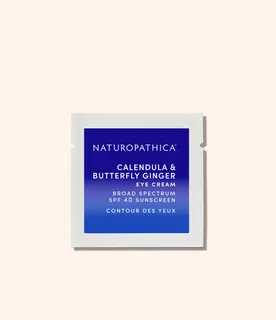
Naturopathica Calendula & Butterfly Ginger Eye Cream Broad Spectrum SPF 40 Sunscreen
Works for
Sun protectionSPF 40 · 1 UV filterBroad spectrum
This product offers a good level of protection against both UVB and UVA rays.
It is a mineral sunscreen. In other words, it contains non-organic UV filters. It will probably not sting your eyes but might leave a white cast.
This product can be considered "reef safe" because it does not contain the UV filters (oxybenzone and octinoxate) that can be harmful to coral reefs when present in the water in high concentrations.
Anti-agingSide benefit the brand mentions · Camellia sinensis leaf extractWorks well
“Its non-whitening micronized zinc protects from UVA/UVB rays, premature aging, and future damage, including the risk of skin cancer.”
This product can help prevent early signs of skin aging because it offers a good level of broad spectrum sun protection. Sun damage is the main cause of premature skin aging, and protecting your skin from the sun is the best anti-aging strategy.
Evens skin toneSide benefit · Camellia sinensis leaf extractWorks well
This product offers broad spectrum sun protection. It means that it can prevent hyperpigmentation and help keep the skin tone even (sun damage is the main factor causing age spots, darkening of post-acne marks and other discolorations).
Anti-oxidationSide benefit · Camellia sinensis leaf extract, Polygonum aviculare extract + 6 moreWorks well
This product contains antioxidants (polygonum aviculare extract) that can help neutralize free radicals in skin. By doing so, they can lessen the damage the skin gets from the UV light (sun).
The following ingredients - camellia sinensis leaf extract also can have an antioxidant effect, but there is less evidence to confirm their effectiveness in skin.
MoisturizingSide benefit · Coco-caprylate/caprate, Glycerin + 19 moreWorks
This product can help improve hydration of the skin with the two types of ingredients.
The first type is called “humectants”:
these ingredients help attract water.
When humectants are on the surface of the skin, they “pull in” the moisture from the outside environment, or from
within deeper layers of the skin. The following ingredients in this product do the job:
anhydroxylitol, galactoarabinan.
This product also contains ingredients called “occlusives”. They help reduce the speed with which our skin loses moisture to the outside environment. These ingredients also help soften the upper layer of the skin, so it feels less tight and nicer to the touch. The following ingredients in this product do the job: caprylic/capric triglyceride, borago officinalis seed oil.
Can it cause trouble?
Irritancy1 strong irritant: Calendula officinalis flower extractMedium risk
Comedogenic1 ingredient rated 2 or more on the 0–5 pore-clogging scale1 flagged
User reviews
Be the first — your take helps the next person decide.
Ingredients
Filter by role to see what each ingredient is doing.
Zinc oxide19%
- Irritation risk
- Low
A broad spectrum sunblock (protects from both UVA and UVB rays). Is suitable for most sensitive skins. In small concentrations, can be used as a colorant
More about Zinc oxideWater~45–55%
Coco-caprylate/caprate~5.6–6.9%
- Irritation risk
- Low
Helps to soften the upper layer of the skin without creating a greasy texture
More about Coco-caprylate/caprateGlycerin~4.9–5.9%
- Irritation risk
- Low
One of the best moisturizing ingredients. Naturally present in skin. It attracts water to the upper layer of the skin working as a humectant
More about GlycerinGalactoarabinan~3.1–3.8%
- Irritation risk
- Medium
Helps attract water to the upper layer of the skin
More about GalactoarabinanC12-16 alcohols~2.4–2.9%
- Irritation risk
- Medium
Helps soften the upper layer of the skin and improve the product's texture
More about C12-16 alcoholsNeopentyl glycol diheptanoate~1.9–2.4%
- Irritation risk
- Low
Helps soften the upper layer of the skin and create a nice product consistency
More about Neopentyl glycol diheptanoateCetearyl alcohol~1.7–2%
- Irritation risk
- Low
- Comedogenicity
- 2/5
A non-drying alcohol. Works as an emollient. Helps water and oil mix together and creates a nice product texture
More about Cetearyl alcoholButyloctyl salicylate~1.5–1.8%
- Irritation risk
- Medium
A synthetic ester of salicylic acid that is used to help disperse pigments and boost effectiveness of sunscreen ingredients. It is able to absorb UV light (working as an organic, or chemical filter), but is not approved as a sunscreen ingredient on its own
More about Butyloctyl salicylateIsododecane~1.3–1.6%
- Irritation risk
- Low
An emollient that helps soften the skin and can decrease moisture loss. Helps create a nice product texture
More about IsododecanePropanediol~1.1–1.3%
- Irritation risk
- Low
Acts as a solvent for other ingredients. Speeds up the absorption of other ingredients into the skin
More about PropanediolGriffonia simplicifolia seed extract~0.75–1.1%
- Irritation risk
- Low
Caprylic/capric triglyceride~0.7–1.05%
- Irritation risk
- Medium
A good mix of fatty acids that forms a protective layer on the skin. Improves the shelf life of products. Derived from coconut and glycerin
More about Caprylic/capric triglycerideUndaria pinnatifida extract~0.55–0.85%
- Irritation risk
- Low
A seaweed extract that helps attract water to the upper layer of the skin and might have an anti-oxidant effect
More about Undaria pinnatifida extractPolyglyceryl-3 polyricinoleate~0.55–0.85%
- Irritation risk
- Medium
Helps oil and water mix together
More about Polyglyceryl-3 polyricinoleateHydrogenated lecithin~0.5–0.8%
- Irritation risk
- Low
Helps to retain moisture by creating a protective barrier on the skin. Rich in fatty acids. Improves product texture and helps with the penetration of other ingredients.
More about Hydrogenated lecithinPalmitic acid~0.55–0.85%
- Irritation risk
- Low
An emollient that is naturally present in skin and helps soften it
More about Palmitic acid1,2-hexanediol~0.5–0.7%
Borago officinalis seed oil~0.5–0.7%
- Irritation risk
- Low
A plant oil that is effective in reducing irritation in skin, restore the barrier function and support its hydration
More about Borago officinalis seed oilCaprylyl glycol~0.45–0.7%
- Irritation risk
- Medium
Helps preserve products and creates a nice product texture
More about Caprylyl glycolHydrolyzed vegetable protein~0.35–0.65%
Xylitylglucoside~0.35–0.6%
- Irritation risk
- Low
Helps attract water to the upper layer of the skin and repair the skin barrier function
More about XylitylglucosideIsostearic acid~0.45–0.7%
- Irritation risk
- Low
Used to create a nice product texture
More about Isostearic acidCetearyl glucoside~0.35–0.6%
- Irritation risk
- Medium
Helps water and oil in the product mix well together and improves product texture
More about Cetearyl glucosideXanthan gum~0.3–0.6%
- Irritation risk
- Low
Used to create a thicker product consistency
More about Xanthan gumAnhydroxylitol~0.3–0.6%
- Irritation risk
- Low
Helps attract water to the upper layer of the skin and repair the skin barrir function
More about AnhydroxylitolCitric acid~0.3–0.55%
- Irritation risk
- Medium
Can work as an exfoliant but is typically used to adjust the product pH
More about Citric acidTrehalose~0.3–0.55%
- Irritation risk
- Low
A sugar that attracts water to the upper layer of the skin
More about TrehaloseCamellia sinensis leaf extract~0.35–0.6%
- Irritation risk
- Low
Can contain potent anti-oxidant compounds (abbreviated ECG, GCG, EGC, and EGCG) that might help protect the skin from free radicals. Can help calm down inflammation and has some anti-bacterial properties. Unfortunately, these antioxidants are unstable and lose their effectiveness very quickly in products. The concentration of the antioxidant compounds in the extract also tends to be low to be effective in topical formulation
More about Camellia sinensis leaf extractLactobacillus ferment lysate~0.3–0.5%
- Irritation risk
- Low
A "broth" with parts of dead cells of lactobacteria. Might be helpful supporting diverse microbiome in skin, but evidence is lacking
More about Lactobacillus ferment lysatePunica granatum flower extract~0.3–0.5%
- Irritation risk
- Low
Xylitol~0.25–0.5%
- Irritation risk
- Low
Helps attract water to the upper layer of the skin and repair the skin barrier function
More about XylitolPolyhydroxystearic acid~0.3–0.55%
- Irritation risk
- Medium
Used to create a thicker product consistency and stabilize the formulation
More about Polyhydroxystearic acidLecithin~0.3–0.6%
- Irritation risk
- Low
Used mostly for creating emulsions - helping oil and water mix together. Helps soften the upper layer of the skin
More about LecithinHedychium coronarium root extract~0.25–0.5%
- Irritation risk
- Low
Lactobacillus ferment~0.25–0.45%
- Irritation risk
- Low
A fermentation product created by bacteria Lactobacillus. The fermented product has anti-bacterial properties and might be helpful in calming down inflammation, but studies are lacking. Helps attract water to the upper layer of the skin. Can be used as a preservative
More about Lactobacillus fermentLeuconostoc/radish root ferment filtrate~0.25–0.45%
- Irritation risk
- Medium
A preservative that comes from radishes fermented by a bacteria. New research suggests that the preservation properties in the ingredient come from an ammonium salt that is not present naturally in radish root but used in its cultivation. Is problematic because the exact amount of the preservative agents is difficult to determine
More about Leuconostoc/radish root ferment filtratePolygonum aviculare extract~0.3–0.5%
- Irritation risk
- Medium
A plant extract that contains a flavanol Juglanin. It can help neutralize free radicals in skin and reduce inflammation
More about Polygonum aviculare extractCaffeine~0.2–0.35%
- Irritation risk
- Medium
Might be helpful in neutralizing free radicals. Can have a dehydration effect that might somewhat decrease the look of puffy eyes
More about CaffeinePotassium sorbate~0.15–0.25%
Sodium benzoate~0.15–0.3%
Carthamus tinctorius seed oil~0.2–0.35%
- Irritation risk
- Low
An emollient that helps soften the skin and might help calm down inflammation
More about Carthamus tinctorius seed oilCalendula officinalis flower extract~0.1–0.15%
- Irritation risk
- High
A plant extract that has some anti-oxidant and anti-bacterial properties. Can be irritating
More about Calendula officinalis flower extractXanthophylls~0.1–0.2%
Ingredient list view
Zinc oxide, Water, Coco-caprylate/caprate, Glycerin, Galactoarabinan, C12-16 alcohols, Neopentyl glycol diheptanoate, Cetearyl alcohol, Butyloctyl salicylate, Isododecane, Propanediol, Griffonia simplicifolia seed extract, Caprylic/capric triglyceride, Undaria pinnatifida extract, Polyglyceryl-3 polyricinoleate, Hydrogenated lecithin, Palmitic acid, 1,2-hexanediol, Borago officinalis seed oil, Caprylyl glycol, Hydrolyzed vegetable protein, Xylitylglucoside, Isostearic acid, Cetearyl glucoside, Xanthan gum, Anhydroxylitol, Citric acid, Trehalose, Camellia sinensis leaf extract, Lactobacillus ferment lysate, Punica granatum flower extract, Xylitol, Polyhydroxystearic acid, Lecithin, Hedychium coronarium root extract, Lactobacillus ferment, Leuconostoc/radish root ferment filtrate, Polygonum aviculare extract, Caffeine, Potassium sorbate, Sodium benzoate, Carthamus tinctorius seed oil, Calendula officinalis flower extract, Xanthophylls
Compare prices
Retailers ranked by price — lowest first.
Worth comparing, line by line.
Match % combines shared ingredients, the first five ingredients, shared actives and hero ingredients, irritancy (lower counts in the alternative's favour), texture and body area. Only products in the same routine step are compared.
| NaturopathicaCalendula & Butterfly Ginger Eye Cream Broad Spectrum SPF 40 SunscreenYOUR PRODUCT | .25 fl ozLuminous Eye Corrector SPF 41 - Tan | EltaMDUV Active Broad-Spectrum SPF50+ Cream | LieracSunissime Protective Eye Care Global Anti-Aging SPF50 | |
|---|---|---|---|---|
| Match | — | 40% | 38% | 37% |
| Price | — | — | $45.00 | — |
| Shared key ingredients | — | 4 of 14 | 4 of 14 | 3 of 14 |
| Key difference | — | Ceramide Ap | Dimethicone | Persea Gratissima Oil |
| Irritancy | Medium | Medium | Low | Low |
| SPF | SPF 40 | SPF 41 | SPF 50 | SPF 50 |
| Drying alcohol | — | — | — | — |
| View product | Shop | Shop | Shop |



More alternatives: Hello Sunday The One For Your Eyes Mineral Eye Cream SPF50Everyday Humans Rosé S'Il Vous Plait SPF30 Gentle Mineral Sunscreen
Product summary
We believe that "Naturopathica - Calendula & Butterfly Ginger Eye Cream Broad Spectrum SPF 40 Sunscreen" can provide reliable sun protection based on the ingredients listed. We love that it can protect from both UVA and UVB rays (not all sunscreens with SPF ratings give UVA protection. UVA rays do not cause sunburn, but still damage our skin and lead to early aging).
This moisturizer should also be hydrating enough to use without an additional moisturizer during the day. Like all broad-spectrum sunscreens, this product helps prevent early signs of aging.
Sunscreen filters
This is a "mixed" sunscreen in the sense that it uses both mineral and organic (so-called "chemical") sun filters. Here are the organic filters this product uses: butyloctyl salicylate. As for the mineral filters, this sunscreen uses zinc oxide.
Irritation risk
This formulation includes some common irritants, including ingredients that do not provide a benefit for the skin. We assess the overall irritancy of this moisturizer to be medium. For a detailed overview of all potential irritants: click here
You can see the detailed formula review with the breakdown of all actives in the product and the full ingredient list with estimated concentrations in the tables below.
Sources cited in this review
Every concentration estimate and effectiveness label is anchored to one of these 19 studies and safety reviews.
- 1A review of inorganic UV filters zinc oxide and titanium dioxideonlinelibrary.wiley.com
- 2
- 3
- 4
- 5
- 6Safety Assessment of Alkyl Esters as Used in Cosmeticscir-safety.org

Affiliate links · As an Amazon Associate, WIMJ earns from qualifying purchases.