Works for
1 of 1 advertised claim delivered
MoisturizingCaprylic/capric triglyceride, Glycerin + 3 moreGood evidence
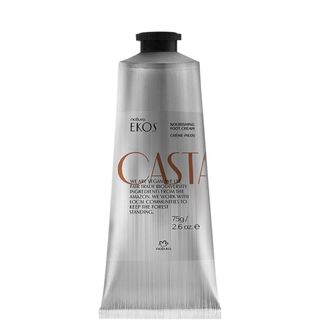
“Natura Ekos Castanha Nourishing Foot Cream 75 g / 2.”
This product can help improve hydration of the skin with the two types of ingredients.
The first type is called “humectants”:
these ingredients help attract water.
When humectants are on the surface of the skin, they “pull in” the moisture from the outside environment, or from
within deeper layers of the skin. The following ingredients in this product do the job:
glycerin.
This product also contains ingredients called “occlusives”. They help reduce the speed with which our skin loses moisture to the outside environment. These ingredients also help soften the upper layer of the skin, so it feels less tight and nicer to the touch. The following ingredients in this product do the job: caprylic/capric triglyceride, glyceryl stearate.
Can it cause trouble?
Irritancy9 strong irritants: Parfum, Linalool + 7 more — patch-test recommendedHigh risk
ComedogenicClean of flagged comedogenic ingredientsNone flagged
User reviews
Be the first — your take helps the next person decide.
Ingredients
Filter by role to see what each ingredient is doing.
Water~45–55%
Caprylic/capric triglyceride~6.9–8.4%
- Irritation risk
- Medium
A good mix of fatty acids that forms a protective layer on the skin. Improves the shelf life of products. Derived from coconut and glycerin
More about Caprylic/capric triglycerideDistearyldimonium chloride~4.4–5.4%
- Irritation risk
- Low
Stearyl alcohol~2.7–3.3%
- Irritation risk
- Low
An emollient that helps soften the skin
More about Stearyl alcoholGlycerin~2.4–3%
- Irritation risk
- Low
One of the best moisturizing ingredients. Naturally present in skin. It attracts water to the upper layer of the skin working as a humectant
More about GlycerinPropanediol~2–2.4%
- Irritation risk
- Low
Acts as a solvent for other ingredients. Speeds up the absorption of other ingredients into the skin
More about PropanediolTheobroma grandiflorum seed butter~1.6–2%
- Irritation risk
- Medium
Helps soften the upper layer of the skin and might as well help to attract moisture to its upper layer
More about Theobroma grandiflorum seed butterBertholletia excelsa seed oil~1.4–1.7%
- Irritation risk
- Low
Myristyl theobroma grandiflorum seedate~1.2–1.4%
- Irritation risk
- Low
Glyceryl dipalmitate~0.95–1.15%
Glyceryl palmitate~0.7–1.05%
- Irritation risk
- Low
Glyceryl distearate~0.6–0.9%
- Irritation risk
- Low
Glyceryl stearate~0.55–0.8%
- Irritation risk
- Low
An emollient that softens the skin and forms a protective layer on its surface. Helps water and oil mix together
More about Glyceryl stearateParfum~0.4–0.65%
- Irritation risk
- High
An aromatic blend of unspecified and possibly irritating ingredients
More about ParfumHydroxyacetophenone~0.4–0.6%
Hydroxyethylcellulose~0.45–0.65%
- Irritation risk
- Low
Used to thicken product formulations and create gel-like textures
More about HydroxyethylcelluloseTocopherol~0.35–0.65%
- Irritation risk
- Low
Pure form of vitamin E. Can help moisturise and protect the skin from free radicals. Often used to help stabilise other ingredients or the formula itself
More about TocopherolSodium gluconate~0.3–0.55%
Polyglyceryl-3 caprylate~0.3–0.6%
Sodium hydroxide~0.25–0.5%
Sodium acetate~0.25–0.5%
- Irritation risk
- Low
Cellulose~0.25–0.5%
- Irritation risk
- Low
Can be used to help absorb oil as well as add volume and imporve texture of products.
More about CelluloseSodium carbonate~0.25–0.45%
Sodium chloride~0.25–0.45%
- Irritation risk
- Low
Used to stabilize mixtures of oil and water, and create thicker, gel-like product textures
More about Sodium chlorideLinalool~0.2–0.35%
Benzyl salicylate~0.15–0.3%
Limonene~0.15–0.25%
- Irritation risk
- High
A common frangrance that can easily irritate skin, especially if exposed to air, light or heat
More about LimoneneCoumarin~0.1–0.2%
Alpha-isomethyl ionone~0.1–0.2%
- Irritation risk
- High
A fragrance. Potential allergen and can be irritating
More about Alpha-isomethyl iononeEugenol~0.05–0.1%
Citral~0.05–0.1%
Hydroxycitronellal~0.05%
- Irritation risk
- High
A fragrance. A likely allergen and can be irritating
More about HydroxycitronellalIngredient list view
Water, Caprylic/capric triglyceride, Distearyldimonium chloride, Stearyl alcohol, Glycerin, Propanediol, Theobroma grandiflorum seed butter, Bertholletia excelsa seed oil, Myristyl theobroma grandiflorum seedate, Glyceryl dipalmitate, Glyceryl palmitate, Glyceryl distearate, Glyceryl stearate, Parfum, Hydroxyacetophenone, Hydroxyethylcellulose, Tocopherol, Sodium gluconate, Polyglyceryl-3 caprylate, Sodium hydroxide, Sodium acetate, Cellulose, Sodium carbonate, Sodium chloride, Linalool, Benzyl salicylate, Limonene, Coumarin, Alpha-isomethyl ionone, Eugenol, Citral, Hydroxycitronellal
Compare prices
Retailers ranked by price — lowest first.
Affiliate links · prices updated regularly · As an Amazon Associate, WIMJ earns from qualifying purchases.
Sources cited in this review
Every concentration estimate and effectiveness label is anchored to one of these 4 studies and safety reviews.
- 1
- 2Advanced Skin Care – A Novel Ingredientncbi.nlm.nih.gov
- 3Vitamin E in dermatologyncbi.nlm.nih.gov
- 4Vitamin E and Skin Healthlpi.oregonstate.edu

Affiliate links · As an Amazon Associate, WIMJ earns from qualifying purchases.