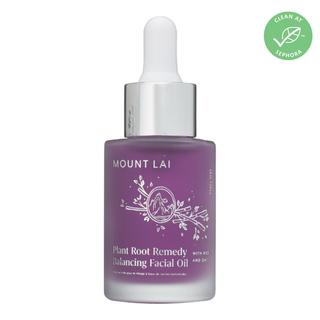
Mount Lai Plant Root Remedy Balancing Facial Oil
Works for
1 of 1 advertised claim delivered
Moisturizing8 ingredients credited for this claimGood support
“A balancing facial oil that penetrates deep into the skin, nourishing it with nutrient-rich plant oils and antioxidant-rich plant root adaptogens used in Traditional Chinese Medicine.”
This product can help soften the skin and reduce its moisture loss with emollients and occlusives: simmondsia chinensis seed oil, squalane.
Keep in mind that this product does not contain effective ingredients to attract water to the upper layer of the skin. This is why an additional product with humectants like glycerin or hyaluronic acid can be helpful (apply it before this product for the best results).
Can it cause trouble?
Irritancy3 strong irritants: Achillea millefolium oil, Rosmarinus officinalis extract + 1 more — patch-test recommendedHigh risk
ComedogenicClean of flagged comedogenic ingredientsNone flagged
User reviews
Be the first — your take helps the next person decide.
Ingredients
Filter by role to see what each ingredient is doing.
Squalane~25–38%
- Irritation risk
- Low
An oil naturally present in skin. Works as an emollient to soften the skin and form a protective layer on its surface without a greasy feeling.
More about SqualaneLimnanthes alba seed oil~5.8–8.7%
- Irritation risk
- Low
This oil's cmposition is closest to rapeseed oil. It is a very stable oil and serves as an emoillient
More about Limnanthes alba seed oilAvena sativa kernel oil~4.5–6.8%
- Irritation risk
- Low
An effective moisturizing and skin barrier repair ingredient. Helps calm down inflammation and has some anti-oxidant properties
More about Avena sativa kernel oilOryza sativa bran oil~3.4–5.1%
- Irritation risk
- Low
Helps soften the upper layer of the skin and might have some anti-oxidant properties
More about Oryza sativa bran oilSimmondsia chinensis seed oil~2.6–3.9%
- Irritation risk
- Medium
Softens the upper layer of skin and helps restore the healthy skin barrier. Has shown to help calm down inflammation in skin. It is a stable oil, meaning that it retains its properties even when exposed to air.
More about Simmondsia chinensis seed oilCarthamus tinctorius seed oil~2.1–3.1%
- Irritation risk
- Low
An emollient that helps soften the skin and might help calm down inflammation
More about Carthamus tinctorius seed oilAchillea millefolium oil~1.5–2.2%
Tocopheryl acetate~1.2–1.8%
- Irritation risk
- Medium
A more stable but less bio-available form of vitamin E compared to Tocopherol. Might help moisturize and protect the skin from free radicals, but mostly used in low concentrations to stabilize other ingredients.
More about Tocopheryl acetateSambucus nigra fruit extract~1.1–1.6%
- Irritation risk
- High
A plant extract that may contain a small amount of essential oils. Might be helpful in neutralizing free radicals in skin
More about Sambucus nigra fruit extractPanax ginseng root extract~0.95–1.45%
- Irritation risk
- High
A plant extract that might have some anti-inflammatory properties, but solid evidence is lacking. It can be irritating
More about Panax ginseng root extractBambusa vulgaris extract~0.55–1.3%
- Irritation risk
- Low
Lithospermum erythrorhizon root extract~0.45–1.1%
- Irritation risk
- High
A plant extract that might help neutralize free radicals in skin. Can be used for its fragrance
More about Lithospermum erythrorhizon root extractGlycyrrhiza glabra root extract~0.35–0.75%
- Irritation risk
- Medium
A plant extract that can help lighten the skin and calm down inflammation. Might be helpful in neutralizing free radicals
More about Glycyrrhiza glabra root extractRhodiola rosea root extract~0.4–0.9%
- Irritation risk
- Low
Astragalus membranaceus root extract~0.35–0.8%
- Irritation risk
- Low
Taraxacum officinale root extract~0.15–0.55%
- Irritation risk
- High
A plant extract that might help neutralize free radicals in skin. Can be irritating
More about Taraxacum officinale root extractAngelica archangelica root extract~0.1–0.35%
- Irritation risk
- Low
Camellia sinensis leaf extract~0.05–0.25%
- Irritation risk
- Low
Can contain potent anti-oxidant compounds (abbreviated ECG, GCG, EGC, and EGCG) that might help protect the skin from free radicals. Can help calm down inflammation and has some anti-bacterial properties. Unfortunately, these antioxidants are unstable and lose their effectiveness very quickly in products. The concentration of the antioxidant compounds in the extract also tends to be low to be effective in topical formulation
More about Camellia sinensis leaf extractRosmarinus officinalis extract~0.05–0.2%
- Irritation risk
- High
Tanacetum annuum flower oil~0.05–0.2%
- Irritation risk
- High
An essential oil that has anti-inflammatory properties but also contains irritating compounds
More about Tanacetum annuum flower oilIngredient list view
Squalane, Limnanthes alba seed oil, Avena sativa kernel oil, Oryza sativa bran oil, Simmondsia chinensis seed oil, Carthamus tinctorius seed oil, Achillea millefolium oil, Tocopheryl acetate, Sambucus nigra fruit extract, Panax ginseng root extract, Bambusa vulgaris extract, Lithospermum erythrorhizon root extract, Glycyrrhiza glabra root extract, Rhodiola rosea root extract, Astragalus membranaceus root extract, Taraxacum officinale root extract, Angelica archangelica root extract, Camellia sinensis leaf extract, Rosmarinus officinalis extract, Tanacetum annuum flower oil
Compare prices
Retailers ranked by price — lowest first.
Sources cited in this review
Every concentration estimate and effectiveness label is anchored to one of these 5 studies and safety reviews.
- 1
- 2Assessment report on Sambucus nigra L., fructusema.europa.eu
- 3
- 4Ginseng in Dermatology: A Reviewncbi.nlm.nih.gov
- 5

Affiliate links · As an Amazon Associate, WIMJ earns from qualifying purchases.