Works for
1 of 1 advertised claim delivered
MoisturizingBetaine, Beeswax + 8 moreGood evidence
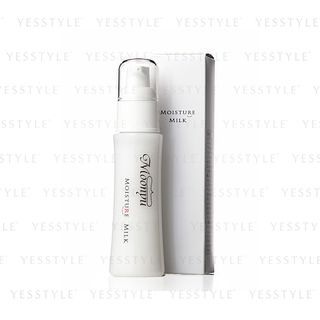
“Moisture Milk”
This product can help improve hydration of the skin with the two types of ingredients.
The first type is called “humectants”:
these ingredients help attract water.
When humectants are on the surface of the skin, they “pull in” the moisture from the outside environment, or from
within deeper layers of the skin. The following ingredients in this product do the job:
betaine, soluble collagen.
This product also contains ingredients called “occlusives”. They help reduce the speed with which our skin loses moisture to the outside environment. These ingredients also help soften the upper layer of the skin, so it feels less tight and nicer to the touch. The following ingredients in this product do the job: beeswax, squalane.
Can it cause trouble?
Irritancy2 strong irritants: Rosa damascena flower water, Lavandula angustifolia flower extractMedium risk
Comedogenic1 ingredient rated 2 or more on the 0–5 pore-clogging scale1 flagged
User reviews
Be the first — your take helps the next person decide.
Ingredients
Filter by role to see what each ingredient is doing.
Water~40–60%
Squalane~5.3–7.9%
- Irritation risk
- Low
An oil naturally present in skin. Works as an emollient to soften the skin and form a protective layer on its surface without a greasy feeling.
More about SqualaneButylene glycol~3.8–5.7%
- Irritation risk
- Low
Used to create a nice product texture and help delivery of other ingredients. Might be somewhat helpful in attracting water to the upper layer of the skin
More about Butylene glycolPentylene glycol~2.7–4.1%
- Irritation risk
- Medium
Used to preserve products, dissolve other ingredients and create a nice product texture
More about Pentylene glycol2-hydroxyethyl acrylate~2.1–3.2%
- Irritation risk
- Low
Helps create a nice product texture and uniform layer on the skin (when used in sunscreens, for example)
More about 2-hydroxyethyl acrylateTaurine~1.7–2.5%
- Irritation risk
- Medium
Could be helpful in reducing inflammation in skin, evening out the skin tone and neutralizing free radicals, but more research is needed to confirm its effectiveness
More about TaurineRosa damascena flower water~1.4–2.1%
- Irritation risk
- High
Used to add a nice rose smell to the product. Might help attract water to the upper layer of the skin and have some anti-oxidant effect. Can be irritating
More about Rosa damascena flower waterHydrolyzed lac~1.3–1.9%
- Irritation risk
- Low
Aloe vera leaf extract~1–1.5%
- Irritation risk
- Low
Lavandula angustifolia flower extract~0.85–1.25%
- Irritation risk
- High
Essential oil that can be irritating
More about Lavandula angustifolia flower extractBeeswax~0.5–1.15%
- Irritation risk
- Low
Forms a protective barrier that holds water and keeps dry skin hydrated. Keeps an emulsion from separating into its oil and liquid components, and increases the thickness of a product. Can be an allergen
More about BeeswaxHydrolyzed elastin~0.4–0.95%
- Irritation risk
- Low
Tocopherol~0.3–0.7%
- Irritation risk
- Low
Pure form of vitamin E. Can help moisturise and protect the skin from free radicals. Often used to help stabilise other ingredients or the formula itself
More about TocopherolGlycyrrhizic acid~0.2–0.7%
- Irritation risk
- Low
Betaine~0.15–0.65%
- Irritation risk
- Low
Helps attract water to the upper layer of the skin and improves the product texture
More about BetaineBehenyl alcohol~0.2–0.75%
- Irritation risk
- Low
Non-drying alcohol that helps water and oil mix together. Also serves as an emollient
More about Behenyl alcoholCarrageenan~0.15–0.55%
- Irritation risk
- Medium
- Comedogenicity
- 3/5
Helps thicken the product formula and create a nice product formulation
More about CarrageenanCitric acid~0.1–0.3%
- Irritation risk
- Medium
Can work as an exfoliant but is typically used to adjust the product pH
More about Citric acidSodium citrate~0.05–0.2%
- Irritation risk
- Medium
Helps to control the skin's pH level. Maintains the skin's natural film of amino-lactic acids and oils. Helps to preserve products
More about Sodium citrateSoluble collagen~0.05–0.2%
- Irritation risk
- Low
A typically plant-derived compound that is supposed mimic human collagen. Cannot penetrate the skin barrier so is not particularly useful in skincare products beyond attracting water to the upper layer of the skin
More about Soluble collagenPolyquaternium-51~0.05–0.15%
- Irritation risk
- Low
An emollient that helps create a nice silky finish on the skin
More about Polyquaternium-51Phenoxyethanol~0.05–0.15%
- Irritation risk
- Low
A preservative. It helps prevent bacterial growth in cosmetic products
More about PhenoxyethanolDimethylaminostyryl heptyl methyl thiazolium iodide~0.01–0.05%
- Irritation risk
- Low
Ingredient list view
Water, Squalane, Butylene glycol, Pentylene glycol, 2-hydroxyethyl acrylate, Unknown, Taurine, Unknown, Rosa damascena flower water, Hydrolyzed lac, Unknown, Aloe vera leaf extract, Unknown, Lavandula angustifolia flower extract, Beeswax, Hydrolyzed elastin, Tocopherol, Glycyrrhizic acid, Betaine, Behenyl alcohol, Carrageenan, Citric acid, Sodium citrate, Soluble collagen, Polyquaternium-51, Phenoxyethanol, Dimethylaminostyryl heptyl methyl thiazolium iodide
Compare prices
Retailers ranked by price — lowest first.

Affiliate links · prices updated regularly
Sources cited in this review
Every concentration estimate and effectiveness label is anchored to one of these 6 studies and safety reviews.
- 1Cosmeceuttical Critigue: Taurinemdedge.com
- 2
- 3
- 4
- 5Vitamin E in dermatologyncbi.nlm.nih.gov
- 6Vitamin E and Skin Healthlpi.oregonstate.edu

Affiliate links · As an Amazon Associate, WIMJ earns from qualifying purchases.