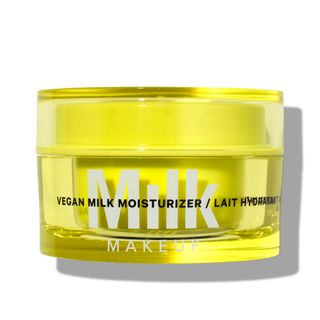
MILK MAKEUP Mini Vegan Milk Moisturizer
Works for
1 of 1 advertised claim delivered
Moisturizing25 ingredients credited for this claimGood support
“Mini Vegan Milk Moisturizer”
This product can help improve hydration of the skin with the two types of ingredients.
The first type is called “humectants”:
these ingredients help attract water.
When humectants are on the surface of the skin, they “pull in” the moisture from the outside environment, or from
within deeper layers of the skin. The following ingredients in this product do the job:
glycerin, sodium hyaluronate.
This product also contains ingredients called “occlusives”. They help reduce the speed with which our skin loses moisture to the outside environment. These ingredients also help soften the upper layer of the skin, so it feels less tight and nicer to the touch. The following ingredients in this product do the job: caprylic/capric triglyceride, helianthus annuus seed oil.
Anti-oxidationNot advertised by the brand · 7 ingredients credited for this claimModerate support
This product contains antioxidants (ficus carica fruit extract) that might be able to help neutralize free radicals in skin to lessen the damage it gets from the UV light (sun). There is not enough evidence to confirm their effectiveness in skin though.
Can it cause trouble?
Irritancy1 strong irritant: Rosmarinus officinalis leaf extractMedium risk
Comedogenic2 ingredients rated 2 or more on the 0–5 pore-clogging scale2 flagged
User reviews
Be the first — your take helps the next person decide.
Ingredients
Filter by role to see what each ingredient is doing.
Water~45–55%
Cetyl alcohol~4.7–5.7%
- Irritation risk
- Low
A non-drying alcohol that works to soften the skin and stabilize product formulations helping oil and water mix together
More about Cetyl alcoholSqualane~4.5–5.5%
- Irritation risk
- Low
An oil naturally present in skin. Works as an emollient to soften the skin and form a protective layer on its surface without a greasy feeling.
More about SqualaneCaprylic/capric triglyceride~3.2–3.9%
- Irritation risk
- Medium
A good mix of fatty acids that forms a protective layer on the skin. Improves the shelf life of products. Derived from coconut and glycerin
More about Caprylic/capric triglycerideStearic acid~2.4–2.9%
- Irritation risk
- Low
Helps oil and water mix together and works as an emollient
More about Stearic acidButylene glycol~1.9–2.3%
- Irritation risk
- Low
Used to create a nice product texture and help delivery of other ingredients. Might be somewhat helpful in attracting water to the upper layer of the skin
More about Butylene glycolStearyl alcohol~1.6–2%
- Irritation risk
- Low
An emollient that helps soften the skin
More about Stearyl alcoholPolyglyceryl-2 diisostearate~1.4–1.7%
Vitis vinifera seed oil~1.1–1.4%
- Irritation risk
- Medium
A great emollient that can also have anti-oxidant properties
More about Vitis vinifera seed oilButyrospermum parkii butter~0.95–1.2%
- Irritation risk
- Low
- Comedogenicity
- 3/5
A great moisturising ingredient that softens the skin and reduces water loss from its upper layer. It also can be helpful in protecting skin from free radicals
More about Butyrospermum parkii butterGlyceryl stearate~0.7–1.05%
- Irritation risk
- Low
An emollient that softens the skin and forms a protective layer on its surface. Helps water and oil mix together
More about Glyceryl stearateGlycerin~0.6–0.85%
- Irritation risk
- Low
One of the best moisturizing ingredients. Naturally present in skin. It attracts water to the upper layer of the skin working as a humectant
More about GlycerinIsocetyl stearate~0.55–0.8%
- Irritation risk
- Low
An emollient that helps soften the skin
More about Isocetyl stearateMyristyl myristate~0.5–0.8%
- Irritation risk
- Medium
- Comedogenicity
- 3/5
An emollient. Is not recommended for acne-prone skin as it can be comedogenic
More about Myristyl myristatePentylene glycol~0.45–0.7%
- Irritation risk
- Medium
Used to preserve products, dissolve other ingredients and create a nice product texture
More about Pentylene glycolSimmondsia chinensis seed oil~0.45–0.7%
- Irritation risk
- Medium
Softens the upper layer of skin and helps restore the healthy skin barrier. Has shown to help calm down inflammation in skin. It is a stable oil, meaning that it retains its properties even when exposed to air.
More about Simmondsia chinensis seed oilHelianthus annuus seed oil~0.45–0.65%
- Irritation risk
- Low
A great emollient due to its high linoleic acid content. One of the most effective plant oils in helping skin hydration and repairing skin barrier function
More about Helianthus annuus seed oilArgania spinosa kernel oil~0.35–0.65%
- Irritation risk
- Medium
An emollient that helps soften the upper layer of the skin. Might have some weak anti-oxidant properties
More about Argania spinosa kernel oilAdansonia digitata seed oil~0.3–0.6%
- Irritation risk
- Medium
Helps soften the upper layer of the skin
More about Adansonia digitata seed oilCitrullus lanatus seed oil~0.3–0.55%
- Irritation risk
- Low
Aloe barbadensis leaf juice~0.25–0.5%
- Irritation risk
- Medium
Traditionally used to treat sunburns, dermatitis and inflammation, but evidence for its effectiveness is lacking. The extract can contain humectants that help attract water into the skin
More about Aloe barbadensis leaf juiceAvena sativa kernel extract~0.25–0.5%
- Irritation risk
- Low
An effective moisturizing and skin barrier repair ingredient. Helps calm down inflammation and has some anti-oxidant properties
More about Avena sativa kernel extractFicus carica fruit extract~0.25–0.45%
- Irritation risk
- Medium
A plant extract that can help neutralize free radicals. The concentrations typically used in cosmetics are too small to have an effect
More about Ficus carica fruit extractAdansonia digitata fruit extract~0.25–0.5%
- Irritation risk
- Low
Rosmarinus officinalis leaf extract~0.2–0.4%
- Irritation risk
- High
Can be helpful in reducing inflammation in skin, including inflamed acne. It can be irritating
More about Rosmarinus officinalis leaf extractSodium hyaluronate~0.25–0.45%
- Irritation risk
- Low
One of the best moisturizing ingredients. Attracts water into the upper layer of the skin
More about Sodium hyaluronatePhospholipids~0.25–0.45%
- Irritation risk
- Low
Emollients that are naturaly present in skin. In addition, they help water and oil mix together in the product
More about PhospholipidsPeg-60 hydrogenated castor oil~0.25–0.5%
- Irritation risk
- Medium
Helps oil and water mix together
More about Peg-60 hydrogenated castor oilPolyglyceryl-10 dioleate~0.25–0.5%
Polyglyceryl-10 oleate~0.25–0.45%
- Irritation risk
- Low
Helps soften the upper layer of the skin
More about Polyglyceryl-10 oleateCeteth-20~0.35–0.65%
Capryloyl glycerin/sebacic acid copolymer~0.25–0.45%
- Irritation risk
- Low
Helps soften the upper layer of the skin
More about Capryloyl glycerin/sebacic acid copolymerDiheptyl succinate~0.25–0.5%
- Irritation risk
- Low
Helps to soften the upper layer of the skin and creates a nice product finish on the skin
More about Diheptyl succinateEthylhexylglycerin~0.25–0.45%
Potassium stearate~0.3–0.6%
Tocopheryl acetate~0.25–0.45%
- Irritation risk
- Medium
A more stable but less bio-available form of vitamin E compared to Tocopherol. Might help moisturize and protect the skin from free radicals, but mostly used in low concentrations to stabilize other ingredients.
More about Tocopheryl acetateGlyceryl caprylate~0.3–0.5%
- Irritation risk
- Low
An emollient that can also help water and oil mix together, as well as prevent bacteria growth in products
More about Glyceryl caprylateGlyceryl undecylenate~0.25–0.5%
- Irritation risk
- Medium
Helps oil and water mix together and helps preserve the product formulation
More about Glyceryl undecylenatePolysorbate 60~0.3–0.5%
Propylene glycol dicaprylate/dicaprate~0.3–0.55%
- Irritation risk
- Low
Sorbitan isostearate~0.25–0.45%
- Irritation risk
- Low
Helps oil and water mix together
More about Sorbitan isostearateXanthan gum~0.25–0.45%
- Irritation risk
- Low
Used to create a thicker product consistency
More about Xanthan gumTrisodium dicarboxymethyl alaninate~0.25–0.45%
- Irritation risk
- Low
Hydroxyethyl acrylate/sodium acryloyldimethyl taurate copolymer~0.2–0.4%
- Irritation risk
- Medium
A gelling agent that thickens the product consistency and leaves the skin with a velvety finish
More about Hydroxyethyl acrylate/sodium acryloyldimethyl taurate copolymerCarbomer~0.2–0.4%
- Irritation risk
- Low
Helps create a thicker or gel-like product texture. It is not a surfactant but can be used in gentle cleansing formulations
More about CarbomerPropanediol~0.2–0.4%
- Irritation risk
- Low
Acts as a solvent for other ingredients. Speeds up the absorption of other ingredients into the skin
More about PropanediolSodium chloride~0.2–0.4%
- Irritation risk
- Low
Used to stabilize mixtures of oil and water, and create thicker, gel-like product textures
More about Sodium chlorideSodium glycolate~0.15–0.3%
- Irritation risk
- Low
Citric acid~0.15–0.25%
- Irritation risk
- Medium
Can work as an exfoliant but is typically used to adjust the product pH
More about Citric acidSodium hydroxide~0.15–0.3%
Sodium benzoate~0.15–0.25%
Potassium sorbate~0.15–0.25%
Phenoxyethanol~0.15–0.25%
- Irritation risk
- Low
A preservative. It helps prevent bacterial growth in cosmetic products
More about PhenoxyethanolIngredient list view
Water, Cetyl alcohol, Squalane, Caprylic/capric triglyceride, Stearic acid, Butylene glycol, Stearyl alcohol, Polyglyceryl-2 diisostearate, Vitis vinifera seed oil, Butyrospermum parkii butter, Glyceryl stearate, Glycerin, Isocetyl stearate, Myristyl myristate, Pentylene glycol, Simmondsia chinensis seed oil, Helianthus annuus seed oil, Argania spinosa kernel oil, Adansonia digitata seed oil, Citrullus lanatus seed oil, Aloe barbadensis leaf juice, Avena sativa kernel extract, Ficus carica fruit extract, Adansonia digitata fruit extract, Rosmarinus officinalis leaf extract, Sodium hyaluronate, Phospholipids, Peg-60 hydrogenated castor oil, Polyglyceryl-10 dioleate, Polyglyceryl-10 oleate, Ceteth-20, Capryloyl glycerin/sebacic acid copolymer, Diheptyl succinate, Ethylhexylglycerin, Potassium stearate, Tocopheryl acetate, Glyceryl caprylate, Glyceryl undecylenate, Polysorbate 60, Propylene glycol dicaprylate/dicaprate, Sorbitan isostearate, Xanthan gum, Trisodium dicarboxymethyl alaninate, Hydroxyethyl acrylate/sodium acryloyldimethyl taurate copolymer, Carbomer, Propanediol, Sodium chloride, Sodium glycolate, Citric acid, Sodium hydroxide, Sodium benzoate, Potassium sorbate, Phenoxyethanol
Compare prices
Retailers ranked by price — lowest first.

Sources cited in this review
Every concentration estimate and effectiveness label is anchored to one of these 11 studies and safety reviews.
- 1
- 2
- 3
- 4Effect of topically applied lipids on surfactant-irritated skinonlinelibrary.wiley.com
- 5
- 6

Affiliate links · As an Amazon Associate, WIMJ earns from qualifying purchases.