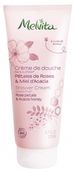
Melvita Shower Cream Rose Petals & Acacia Honey
Works for
1 of 1 advertised claim delivered
Moisturizing8 ingredients credited for this claimGood support
“Shower Cream Rose Petals & Acacia Honey”
This product contains good ingredients to attract water to the upper layer of the skin. These ingredients are called "humectants": glycerin, honey.
When humectants are on the surface of the skin, they “pull in” the moisture from the outside environment, or from within deeper layers of the skin. If the air is dry, humectants can speed up the moisture loss from the skin. This is why it is a good idea to use another product on top of this one to help "seal in" the moisture (look for ingredients like dimethicone, squalane, oils and butters).
Can it cause trouble?
Irritancy5 strong irritants: Rosa damascena flower water, Parfum + 3 more — patch-test recommendedHigh risk
ComedogenicClean of flagged comedogenic ingredientsNone flagged
User reviews
Be the first — your take helps the next person decide.
Ingredients
Filter by role to see what each ingredient is doing.
Water~45–55%
Decyl glucoside~8.5–10.3%
- Irritation risk
- High
Helps oil and water mix together. Can be irritating
More about Decyl glucosideGlycerin~4.2–5.2%
- Irritation risk
- Low
One of the best moisturizing ingredients. Naturally present in skin. It attracts water to the upper layer of the skin working as a humectant
More about GlycerinHordeum vulgare extract~3.2–3.9%
- Irritation risk
- Medium
A plant extract that might have some anti-oxidant properties. Avoid if you are sensitive to gluten
More about Hordeum vulgare extractDisodium cocoyl glutamate~2.5–3.1%
- Irritation risk
- Medium
Helps water and oil mix together and works as a cleansing agent
More about Disodium cocoyl glutamateCoco-betaine~2.4–2.9%
- Irritation risk
- High
Helps oil and water mix together and works as a cleansing agent. Can be allergenic
More about Coco-betaineRosa damascena flower water~1.7–2.1%
- Irritation risk
- High
Used to add a nice rose smell to the product. Might help attract water to the upper layer of the skin and have some anti-oxidant effect. Can be irritating
More about Rosa damascena flower waterMel~1.5–1.8%
- Irritation risk
- Low
Helps to soften the upper layer of the skin and attract water to it
More about MelHoney~1.2–1.4%
- Irritation risk
- Low
Helps attract water to the skin and might have some anti-bacterial properties. Can be an allergen
More about HoneyRoyal jelly~0.95–1.2%
- Irritation risk
- High
Helps attract water to the upper layer of the skin
More about Royal jellySodium cocoyl glutamate~0.75–1.15%
- Irritation risk
- Medium
Helps oil and water mix together
More about Sodium cocoyl glutamateGlyceryl oleate~0.6–0.9%
- Irritation risk
- High
Helps oil and water mix together. Can be irritating
More about Glyceryl oleateSodium levulinate~0.5–0.75%
Levulinic acid~0.45–0.65%
Lactic acid~0.45–0.65%
- Irritation risk
- Medium
An exfoliating and moisturizing alpha-hydroxy acid (AHA). Typically causes less irritation than other AHAs, for example, glycolic acid. At high concentrations (about 15%), lactic acid can help reduce lines and wrinkles. Recent studies show that lactic acid can support the "good" bacteria living on skin's surface (healthy skin microbiome)
More about Lactic acidHydrogenated palm glycerides citrate~0.45–0.7%
- Irritation risk
- Low
Helps soften the upper layer of the skin
More about Hydrogenated palm glycerides citrateLecithin~0.45–0.7%
- Irritation risk
- Low
Used mostly for creating emulsions - helping oil and water mix together. Helps soften the upper layer of the skin
More about LecithinCoco-glucoside~0.5–0.7%
- Irritation risk
- High
Used as a cleansing agent (surfactant) in cleansers. Helps water and oil mix together in lotions. Can be irritating
More about Coco-glucosideXanthan gum~0.35–0.6%
- Irritation risk
- Low
Used to create a thicker product consistency
More about Xanthan gumGellan gum~0.3–0.6%
Sodium chloride~0.3–0.55%
- Irritation risk
- Low
Used to stabilize mixtures of oil and water, and create thicker, gel-like product textures
More about Sodium chlorideCitric acid~0.25–0.5%
- Irritation risk
- Medium
Can work as an exfoliant but is typically used to adjust the product pH
More about Citric acidSilica~0.4–0.6%
Alumina~0.4–0.6%
- Irritation risk
- Low
The same compound that is used safely in dental implants and bone cements. In cosmetics, it is used to improve the consistency of products
More about AluminaTocopherol~0.25–0.45%
- Irritation risk
- Low
Pure form of vitamin E. Can help moisturise and protect the skin from free radicals. Often used to help stabilise other ingredients or the formula itself
More about TocopherolAscorbyl palmitate~0.2–0.4%
- Irritation risk
- Medium
Being a lipid soluble form of vitamin C, it is more stable and can penetrate the skin better than L-Ascorbic acid. It is effective in protecting the skin from free radicals, as well as evening the skin tone, but is less effective in stimulating collagen production compared to L-Ascorbic acid.
More about Ascorbyl palmitateSodium salicylate~0.2–0.4%
- Irritation risk
- Medium
The salt of salicylic acid. Helps exfoliate the upper layer of the skin. Can also work to preserve cosmetic products
More about Sodium salicylateSodium benzoate~0.2–0.35%
Parfum~0.15–0.3%
- Irritation risk
- High
An aromatic blend of unspecified and possibly irritating ingredients
More about ParfumGeraniol~0.15–0.25%
Citronellol~0.15–0.25%
Limonene~0.1–0.2%
- Irritation risk
- High
A common frangrance that can easily irritate skin, especially if exposed to air, light or heat
More about LimoneneCi 77891~0.1–0.15%
- Irritation risk
- Low
Titanium dioxide~0.1–0.2%
- Irritation risk
- Low
Works as a UV filter when used in high concentrations. It is photostable and is effective mostly against the UVB light, with some protection in the UVA range. In small concentrations, used for its ability to improve the color of cosmetic products. Is usually well tolerated by the skin
More about Titanium dioxideIngredient list view
Water, Decyl glucoside, Glycerin, Hordeum vulgare extract, Disodium cocoyl glutamate, Coco-betaine, Rosa damascena flower water, Mel, Honey, Royal jelly, Sodium cocoyl glutamate, Glyceryl oleate, Sodium levulinate, Levulinic acid, Lactic acid, Hydrogenated palm glycerides citrate, Lecithin, Coco-glucoside, Xanthan gum, Gellan gum, Sodium chloride, Citric acid, Silica, Alumina, Tocopherol, Ascorbyl palmitate, Sodium salicylate, Sodium benzoate, Parfum, Geraniol, Citronellol, Limonene, Ci 77891, Titanium dioxide
Compare prices
Retailers ranked by price — lowest first.

Affiliate links · prices updated regularly
Sources cited in this review
Every concentration estimate and effectiveness label is anchored to one of these 16 studies and safety reviews.
- 1
- 2
- 3Celiac Disease & Skin Care Productsbadgut.org
- 4
- 5
- 6

Affiliate links · As an Amazon Associate, WIMJ earns from qualifying purchases.