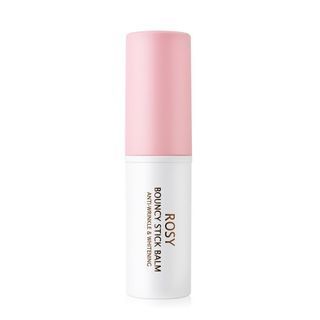
Works for
2 of 2 advertised claims delivered
Moisturizing32 ingredients credited for this claimGood support
“Patented Amino Acid Complex delivers rich nutrients deep into skin for healthy skin.”
This product can help improve hydration of the skin with the two types of ingredients.
The first type is called “humectants”:
these ingredients help attract water.
When humectants are on the surface of the skin, they “pull in” the moisture from the outside environment, or from
within deeper layers of the skin. The following ingredients in this product do the job:
alanine, arginine.
This product also contains ingredients called “occlusives”. They help reduce the speed with which our skin loses moisture to the outside environment. These ingredients also help soften the upper layer of the skin, so it feels less tight and nicer to the touch. The following ingredients in this product do the job: arginine, butyrospermum parkii butter.
Anti-aging8 ingredients credited for this claimModerate support
“Brand from South Korea Medi Flower. Benefits Features with Hydrolyzed Collagen from France to offer delicate elasticity care for plump, youthful skin with radiant glow.”
This product contains aspartic acid, lysine, serine, threonine. These ingredients might be able to help reduce and prevent fine lines and wrinkles, improve skin elasticity and firmness, but there is not enough evidence that it actually works.
Anti-oxidationNot advertised by the brand · 10 ingredients credited for this claimStrong support
This product contains antioxidants (camellia seed oil) that can help neutralize free radicals in skin. By doing so, they can lessen the damage the skin gets from the UV light (sun).
The following ingredients - cysteine also can have an antioxidant effect, but there is less evidence to confirm their effectiveness in skin.
Can it cause trouble?
Irritancy9 flagged ingredientsMedium risk
Comedogenic2 ingredients rated 2 or more on the 0–5 pore-clogging scale2 flagged
User reviews
Be the first — your take helps the next person decide.
Ingredients
Filter by role to see what each ingredient is doing.
Helianthus annuus seed oil~22–33%
- Irritation risk
- Low
A great emollient due to its high linoleic acid content. One of the most effective plant oils in helping skin hydration and repairing skin barrier function
More about Helianthus annuus seed oilPolyglyceryl-2 triisostearate~3–4.5%
- Irritation risk
- Low
Helps to soften the upper layer of the skin and create a nice product texture
More about Polyglyceryl-2 triisostearateButyrospermum parkii butter~4.7–7.1%
- Irritation risk
- Low
- Comedogenicity
- 3/5
A great moisturising ingredient that softens the skin and reduces water loss from its upper layer. It also can be helpful in protecting skin from free radicals
More about Butyrospermum parkii butterOctyldodecanol~3.7–5.6%
- Irritation risk
- Low
An emollient that helps to soften the skin and create a pleasant product texture and stabilize the formulation
More about OctyldodecanolCandelilla cera~3–4.5%
- Irritation risk
- Low
Microcrystalline wax~2.1–3.2%
Diisostearyl malate~1.7–2.6%
- Irritation risk
- Medium
Helps to soften the upper layer of the skin
More about Diisostearyl malatePrunus amygdalus dulcis oil~1.5–2.2%
- Irritation risk
- Low
An emollient that softens the skin
More about Prunus amygdalus dulcis oilTocopheryl acetate~1–1.6%
- Irritation risk
- Medium
A more stable but less bio-available form of vitamin E compared to Tocopherol. Might help moisturize and protect the skin from free radicals, but mostly used in low concentrations to stabilize other ingredients.
More about Tocopheryl acetateRicinus communis seed oil~1–1.5%
- Irritation risk
- Medium
A plant oil that can help soften the skin. It might be helpful in calming down inflammation, but solid research is lacking. Is often used in lip products to create the needed product consistency
More about Ricinus communis seed oilSynthetic wax~0.9–1.35%
- Irritation risk
- Low
Used to stabilize product formulations and thicken product consistency
More about Synthetic waxPolyethylene~0.95–1.45%
Eclipta prostrata extract~0.5–1.15%
- Irritation risk
- High
A plant extract that might help neutralize free radicals in skin. It can be irritating
More about Eclipta prostrata extractMelia azadirachta leaf extract~0.45–1.1%
- Irritation risk
- High
A plant extract that has anti-bacterial properties. Can be used to preserve the product. Can be irritating
More about Melia azadirachta leaf extractMonascus extract~0.45–1%
- Irritation risk
- Low
A yeast extract that might help to attract water to the upper layer of the skin
More about Monascus extractCamellia sinensis seed oil~0.5–1.1%
- Irritation risk
- Low
A plant oil that helps to soften the upper layer of the skin and can help restore the skin barrier. Might have some anti-oxidant effect
More about Camellia sinensis seed oilCamellia seed oil~0.45–1%
- Irritation risk
- Low
Oil from tea seeds. Can help neutralize free radicals in skin
More about Camellia seed oilArgania spinosa kernel oil~0.45–1.05%
- Irritation risk
- Medium
An emollient that helps soften the upper layer of the skin. Might have some weak anti-oxidant properties
More about Argania spinosa kernel oilSimmondsia chinensis seed oil~0.45–1.05%
- Irritation risk
- Medium
Softens the upper layer of skin and helps restore the healthy skin barrier. Has shown to help calm down inflammation in skin. It is a stable oil, meaning that it retains its properties even when exposed to air.
More about Simmondsia chinensis seed oilMacadamia integrifolia seed oil~0.4–0.95%
- Irritation risk
- Low
A plant oil that helps soften the upper layer of the skin
More about Macadamia integrifolia seed oilSimmondsia chinensis seed oil~0.4–0.95%
- Irritation risk
- Medium
Softens the upper layer of skin and helps restore the healthy skin barrier. Has shown to help calm down inflammation in skin. It is a stable oil, meaning that it retains its properties even when exposed to air.
More about Simmondsia chinensis seed oilSodium hyaluronate~0.35–0.75%
- Irritation risk
- Low
One of the best moisturizing ingredients. Attracts water into the upper layer of the skin
More about Sodium hyaluronateBisabolol~0.15–0.7%
- Irritation risk
- Low
An active component of chamomile plant that historically has been used to calm down irritated skin. A recent study shows that bisabolol indeed can have some anti-inflammatory effect on skin, even though conclusive data is lacking. Bisabolol has a sweet floral scent and can be added to products for its aromatic properties
More about BisabololTocopherol~0.2–0.8%
- Irritation risk
- Low
Pure form of vitamin E. Can help moisturise and protect the skin from free radicals. Often used to help stabilise other ingredients or the formula itself
More about TocopherolMoringa oleifera seed oil~0.35–0.85%
- Irritation risk
- Medium
A plant oil that helps soften the upper layer of the skin. Is unlikely to be helpful in restoring skin barrier function due to the low content of linoleic acid
More about Moringa oleifera seed oilHydrolyzed collagen~0.4–1%
- Irritation risk
- Low
A typically plant-derived compound that is supposed mimic human collagen. Cannot penetrate the skin barrier so is not particularly useful in skincare products beyond attracting water to the upper layer of the skin
More about Hydrolyzed collagenEthylhexyl palmitate~0.35–0.85%
- Irritation risk
- Low
- Comedogenicity
- 3/5
An emollient that helps soften the skin and create a nice product texture
More about Ethylhexyl palmitateWater~0.3–0.7%
Butylene glycol~0.3–0.7%
- Irritation risk
- Low
Used to create a nice product texture and help delivery of other ingredients. Might be somewhat helpful in attracting water to the upper layer of the skin
More about Butylene glycolGlycine~0.3–0.7%
- Irritation risk
- Low
Helps to attract water to the upper layer of the skin and can help restore the skin barrier function
More about GlycineTrihydroxystearin~0.3–0.7%
- Irritation risk
- Low
Helps soften the upper layer of the skin and improve the product texture
More about TrihydroxystearinSerine~0.3–0.7%
- Irritation risk
- Low
An amino-acid that helps to attract water to the upper layer of the skin. In combination with other amino-acids, might help to reduce fine lines and wrinkles
More about SerineGlutamic acid~0.3–0.7%
- Irritation risk
- Low
An amino-acid that helps attract water to the upper layer of the skin
More about Glutamic acidAspartic acid~0.3–0.7%
- Irritation risk
- Low
An amino-acid that helps increase skin hydration and might help to slightly improve skin firmness, potentially reducing lines and wrinkles
More about Aspartic acidLeucine~0.3–0.75%
- Irritation risk
- Low
Lysine~0.3–0.75%
- Irritation risk
- Low
An amino-acid that helps to attract water to the upper layer of the skin. In combination with other amino-acids, might help to reduce fine lines and wrinkles
More about LysineAlanine~0.2–0.8%
- Irritation risk
- Low
An amino-acid that helps to attract water to the upper layer of the skin and might help to lighten the skin, but solid evidence is lacking
More about AlanineArginine~0.2–0.75%
- Irritation risk
- Low
An amino acid that is naturally present in skin and helps keep it hydrated. When used together with AHAs, it can reduce their irritating effect on the skin
More about ArginineValine~0.2–0.8%
- Irritation risk
- Low
Isoleucine~0.2–0.8%
- Irritation risk
- Low
An amino acid that can help attract water to the upper layer of the skin and support skin's barrier function
More about IsoleucineTyrosine~0.2–0.75%
Threonine~0.15–0.55%
- Irritation risk
- Low
An amino-acid that helps to attract water to the upper layer of the skin. In combination with other amino-acids, might help to reduce fine lines and wrinkles
More about ThreoninePhenylalanine~0.15–0.55%
- Irritation risk
- Low
Proline~0.15–0.55%
Histidine~0.1–0.45%
Methionine~0.1–0.45%
- Irritation risk
- Low
Cysteine~0.1–0.35%
- Irritation risk
- Low
Might help neutralize free radicals in skin and might be helpful against hyperpigmentation
More about CysteineGlucomannan~0.1–0.35%
- Irritation risk
- Low
Dehydroacetic acid~0.1–0.35%
Ingredient list view
Helianthus annuus seed oil, Polyglyceryl-2 triisostearate, Butyrospermum parkii butter, Octyldodecanol, Candelilla cera, Microcrystalline wax, Diisostearyl malate, Prunus amygdalus dulcis oil, Tocopheryl acetate, Ricinus communis seed oil, Synthetic wax, Polyethylene, Eclipta prostrata extract, Melia azadirachta leaf extract, Monascus extract, Camellia sinensis seed oil, Camellia seed oil, Argania spinosa kernel oil, Simmondsia chinensis seed oil, Macadamia integrifolia seed oil, Simmondsia chinensis seed oil, Sodium hyaluronate, Bisabolol, Tocopherol, Moringa oleifera seed oil, Hydrolyzed collagen, Ethylhexyl palmitate, Water, Butylene glycol, Glycine, Trihydroxystearin, Serine, Glutamic acid, Aspartic acid, Leucine, Lysine, Alanine, Arginine, Valine, Isoleucine, Tyrosine, Threonine, Phenylalanine, Proline, Histidine, Methionine, Cysteine, Glucomannan, Dehydroacetic acid
Compare prices
Retailers ranked by price — lowest first.

Affiliate links · prices updated regularly
Sources cited in this review
Every concentration estimate and effectiveness label is anchored to one of these 33 studies and safety reviews.
- 1
- 2
- 3Effect of topically applied lipids on surfactant-irritated skinonlinelibrary.wiley.com
- 4
- 5
- 6

Affiliate links · As an Amazon Associate, WIMJ earns from qualifying purchases.