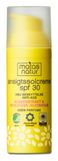
Matas Natur Ansigtssolcreme SPF 30
Works for
2 of 2 advertised claims delivered
Sun protectionSPF 30 · 7 UV filtersBroad spectrum
This product offers a good level of protection against both UVB and UVA rays.
This sunscreen uses organic (so-called "chemical") sunscreen filters. Organic, or "chemical" filters usually provide reliable sun protection and rarely leave a white cast. Sunscreens with organic filters can sting eyes.
This product can be considered "reef safe" because it does not contain the UV filters (oxybenzone and octinoxate) that can be harmful to coral reefs when present in the water in high concentrations.
Anti-aging1 ingredient credited for this claimStrong support
“Matas Natur Ansigtssolcreme SPF 30 er en parfumefri ansigtssolcreme med anti-age aktiver, der tr&#x E6;nger hurtigt ind i huden og beskytter den mod solens str&#x E5;ler.<br><br>I ansigtssolcremen fra Matas Natur, er der lagt v&#x E6;gt p&#x E5; gode og &#x F8;kologiske ingredienser, der b&#x E5;de har din velv&#x E6;re og sundhed for &#x F8;je.<br><br>Hyaluronsyre har en sk&#x F8;n, fugtgivende effekt, der s&#x F8;rger for at bl&#x F8;dg&#x F8;re din hud, samt reducere rynker.”
This product can help prevent early signs of skin aging because it offers a good level of broad spectrum sun protection. Sun damage is the main cause of premature skin aging, and protecting your skin from the sun is the best anti-aging strategy.
Evens skin toneNot advertised by the brand · No ingredient credited for this claimStrong support
This product offers broad spectrum sun protection. It means that it can prevent hyperpigmentation and help keep the skin tone even (sun damage is the main factor causing age spots, darkening of post-acne marks and other discolorations).
MoisturizingNot advertised by the brand · 11 ingredients credited for this claimGood support
This product contains good ingredients to attract water to the upper layer of the skin. These ingredients are called "humectants": glycerin, sodium hyaluronate.
When humectants are on the surface of the skin, they “pull in” the moisture from the outside environment, or from within deeper layers of the skin. If the air is dry, humectants can speed up the moisture loss from the skin. This is why it is a good idea to use another product on top of this one to help "seal in" the moisture (look for ingredients like dimethicone, squalane, oils and butters).
Can it cause trouble?
Irritancy15 flagged ingredientsLow risk
Comedogenic2 ingredients rated 2 or more on the 0–5 pore-clogging scale2 flagged
User reviews
Be the first — your take helps the next person decide.
Ingredients
Filter by role to see what each ingredient is doing.
Water~45–55%
C12-15 alkyl benzoate~6.2–7.6%
- Irritation risk
- Low
Enhances the product texture and makes it more spreadable. Helps reduce water loss from the outer layer of skin. Extands the shelf life by preventing bacteria growth
More about C12-15 alkyl benzoateGlycerin~4.2–5.2%
- Irritation risk
- Low
One of the best moisturizing ingredients. Naturally present in skin. It attracts water to the upper layer of the skin working as a humectant
More about GlycerinButylene glycol cocoate~2.7–3.3%
- Irritation risk
- Medium
Helps oil and water mix together
More about Butylene glycol cocoateDiethylamino hydroxybenzoyl hexyl benzoate~3.2–3.9%
- Irritation risk
- Medium
Uvinul A Plus. A new generation broad spectrum sunscreen that offers an effective protection especially in the UVA range. It is stable in formulations. Unfortunately, is not approved by the FDA (US) yet
More about Diethylamino hydroxybenzoyl hexyl benzoateDiethylhexyl butamido triazone~2.6–3.1%
- Irritation risk
- Medium
Uvasorb HEB. A UV filter. Is effective against UVB and UVA II rays (but not UVA I). It is photostable. Unfortunately, is not approved by FDA (US) yet
More about Diethylhexyl butamido triazonePolysilicone-15~2.2–2.7%
- Irritation risk
- Medium
A UV filter. Effective against UVB rays, but does not protect against the most aging UVA light
More about Polysilicone-15Butyl methoxydibenzoylmethane~2–2.4%
- Irritation risk
- Medium
Avobenzone. An organic, or so-called "chemical" UV filter. Protects against both UVA and UVB rays. Needs to be combined with other filters in a formulation to be stable.
More about Butyl methoxydibenzoylmethaneHydrogenated dimer dilinoleyl/dimethylcarbonate copolymer~1.2–1.5%
- Irritation risk
- Low
Pentylene glycol~1–1.2%
- Irritation risk
- Medium
Used to preserve products, dissolve other ingredients and create a nice product texture
More about Pentylene glycolPhenylbenzimidazole sulfonic acid~1.2–1.4%
- Irritation risk
- Medium
Ensulizole. A UV filter that is effective against UVB rays. Does not protect against UVA light. It is photostable and can be used to help stabilize other sunscreen ingredients. It is water-soluble meaning that it can help create lighter sunscreen formulations
More about Phenylbenzimidazole sulfonic acidGlyceryl stearate~0.6–0.95%
- Irritation risk
- Low
An emollient that softens the skin and forms a protective layer on its surface. Helps water and oil mix together
More about Glyceryl stearateSimmondsia chinensis seed oil~0.55–0.85%
- Irritation risk
- Medium
Softens the upper layer of skin and helps restore the healthy skin barrier. Has shown to help calm down inflammation in skin. It is a stable oil, meaning that it retains its properties even when exposed to air.
More about Simmondsia chinensis seed oilBis-ethylhexyloxyphenol methoxyphenyl triazine~0.65–1%
- Irritation risk
- Medium
Tinosorb S. One of the most effective broad spectrum sunscreen ingredients. Protects from both UVA and UVB rays. It is photostable. Unfortunately, not approved by FDA (US) yet.
More about Bis-ethylhexyloxyphenol methoxyphenyl triazineEthylhexyl triazone~0.6–0.85%
- Irritation risk
- Medium
Uvinul T. A UV filter. Effective against UVB rays. It is photostable. Can increase water resistance properties of the sunscreen. Unfortunately, not approved by the FDA (US) yet
More about Ethylhexyl triazoneSodium hyaluronate~0.4–0.65%
- Irritation risk
- Low
One of the best moisturizing ingredients. Attracts water into the upper layer of the skin
More about Sodium hyaluronateAlaria esculenta extract~0.35–0.65%
- Irritation risk
- Low
Works as a humectant helping to attract water to the upper layer of the skin and might be effective as an anti-oxidant.
More about Alaria esculenta extractCaprylyl glycol~0.3–0.55%
- Irritation risk
- Medium
Helps preserve products and creates a nice product texture
More about Caprylyl glycolCaprylic/capric triglyceride~0.3–0.55%
- Irritation risk
- Medium
A good mix of fatty acids that forms a protective layer on the skin. Improves the shelf life of products. Derived from coconut and glycerin
More about Caprylic/capric triglycerideCetearyl alcohol~0.3–0.55%
- Irritation risk
- Low
- Comedogenicity
- 2/5
A non-drying alcohol. Works as an emollient. Helps water and oil mix together and creates a nice product texture
More about Cetearyl alcoholCetyl palmitate~0.25–0.45%
- Irritation risk
- Low
An emollient that helps soften the skin and is used to improve product texture and stability
More about Cetyl palmitateCeteareth-20~0.3–0.55%
- Irritation risk
- Medium
- Comedogenicity
- 2/5
Helps oil and water mix together. Has some emollient properties
More about Ceteareth-20Ceteareth-12~0.15–0.3%
Acrylates/c10-30 alkyl acrylate crosspolymer~0.15–0.3%
- Irritation risk
- Medium
Maintains the texture of skincare products. Allows the product to spread evenly. Helps oil and water mix together
More about Acrylates/c10-30 alkyl acrylate crosspolymerSodium gluconate~0.1–0.2%
Sodium hydroxide~0.1–0.2%
Phenoxyethanol~0.1–0.2%
- Irritation risk
- Low
A preservative. It helps prevent bacterial growth in cosmetic products
More about PhenoxyethanolIngredient list view
Water, C12-15 alkyl benzoate, Glycerin, Butylene glycol cocoate, Diethylamino hydroxybenzoyl hexyl benzoate, Diethylhexyl butamido triazone, Polysilicone-15, Butyl methoxydibenzoylmethane, Hydrogenated dimer dilinoleyl/dimethylcarbonate copolymer, Pentylene glycol, Phenylbenzimidazole sulfonic acid, Glyceryl stearate, Simmondsia chinensis seed oil, Bis-ethylhexyloxyphenol methoxyphenyl triazine, Ethylhexyl triazone, Sodium hyaluronate, Alaria esculenta extract, Caprylyl glycol, Caprylic/capric triglyceride, Cetearyl alcohol, Cetyl palmitate, Ceteareth-20, Ceteareth-12, Acrylates/c10-30 alkyl acrylate crosspolymer, Sodium gluconate, Sodium hydroxide, Phenoxyethanol
Compare prices
Retailers ranked by price — lowest first.

Affiliate links · prices updated regularly
Product summary
Based on the ingredient list, we assess that "Matas Natur - Ansigtssolcreme SPF 30" can provide reliable sun protection. We love that it can protect from both UVA and UVB rays (not all sunscreens with SPF ratings give UVA protection. UVA rays do not cause sunburn, but still damage our skin and lead to early aging).
Because it includes good moisturizing ingredients, it can also work as a hydrating day cream. This product prevents early signs of aging by protecting against sun damage (all broad spectrum sunscreens do that).
Sunscreen filters
This is a so-called "chemical" sunscreen. It means that it uses organic UV filters. They typically offer good sun protection and rarely leave a white cast, but they can be irritating for some people with sensitive skin. The UV filters in this sunscreen are: tinosorb s 0.65% - 1.00%, avobenzone 2.00% - 2.40%, uvinul a plus 3.20% - 3.90%, uvasorb heb 2.60% - 3.10%, uvinul t 0.60% - 0.85%, ensulizole 1.20% - 1.40% and polysilicone-15 2.20% - 2.70%.
Irritation risk
This product does not contain known common irritants and is suitable for sensitive skin. We assess the overall irritancy of this product to be low. For a detailed overview of all potential irritants: click here
You can see the detailed formula review with the breakdown of all actives in the product and the full ingredient list with estimated concentrations in the tables below.
Sources cited in this review
Every concentration estimate and effectiveness label is anchored to one of these 3 studies and safety reviews.
- 1
- 2Hyaluronic acid: A key molecule in skin agingncbi.nlm.nih.gov
- 3

Affiliate links · As an Amazon Associate, WIMJ earns from qualifying purchases.