Works for
MoisturizingCeramide np, Panthenol + 19 moreWorks well
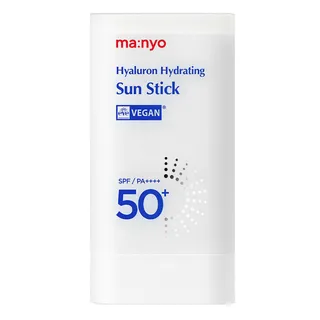
“Ma:nyo Hyaluron Hydrating Sun Stick helps to hydrate and protect skin.”
This product can help improve hydration of the skin with the two types of ingredients.
The first type is called “humectants”:
these ingredients help attract water.
When humectants are on the surface of the skin, they “pull in” the moisture from the outside environment, or from
within deeper layers of the skin. The following ingredients in this product do the job:
glycerin, hyaluronic acid.
This product also contains ingredients called “occlusives”. They help reduce the speed with which our skin loses moisture to the outside environment. These ingredients also help soften the upper layer of the skin, so it feels less tight and nicer to the touch. The following ingredients in this product do the job: squalane, vinyl dimethicone.
The following ingredients in this product are especially good for supporting the skin barrier and helping with the hydration level: ceramide np, panthenol
Anti-oxidationSide benefit · Centella asiatica extract, Ginkgo biloba leaf extract + 4 moreMay help
This product contains antioxidants (camellia sinensis leaf extract, centella asiatica extract, ficus carica fruit extract, ginkgo biloba leaf extract) that might be able to help neutralize free radicals in skin to lessen the damage it gets from the UV light (sun). There is not enough evidence to confirm their effectiveness in skin though.
Anti-agingSide benefit · Centella asiatica extract, Camellia sinensis leaf extract + 2 moreMay help
This product contains centella asiatica extract. This ingredient might be able to help reduce and prevent fine lines and wrinkles, improve skin elasticity and firmness, but there is not enough evidence that it actually works.
Can it cause trouble?
Irritancy1 strong irritant: ParfumMedium risk
Comedogenic2 ingredients rated 2 or more on the 0–5 pore-clogging scale2 flagged
User reviews
Be the first — your take helps the next person decide.
Ingredients
Filter by role to see what each ingredient is doing.
Methyl methacrylate crosspolymer~22–33%
- Irritation risk
- Low
Helps thicken the product consistency
More about Methyl methacrylate crosspolymerPolyethylene~3.6–5.4%
Caprylyl methicone~4.5–6.7%
- Irritation risk
- Low
A type of silicone that helps to soften the upper layer of the skin and create a nice product finish on the skin
More about Caprylyl methiconeCoco-caprylate/caprate~3.8–5.7%
- Irritation risk
- Low
Helps to soften the upper layer of the skin without creating a greasy texture
More about Coco-caprylate/caprateEthylhexyl palmitate~2.9–4.3%
- Irritation risk
- Low
- Comedogenicity
- 3/5
An emollient that helps soften the skin and create a nice product texture
More about Ethylhexyl palmitateIsopropyl palmitate~2–3.1%
- Irritation risk
- Medium
- Comedogenicity
- 3/5
Helps soften the upper layer of the skin and create a thicker product consistency
More about Isopropyl palmitateDicaprylyl carbonate~1.7–2.5%
- Irritation risk
- Low
Helps products spread more easily and works as an emollient to soften skin
More about Dicaprylyl carbonateSynthetic fluorphlogopite~1.4–2.1%
- Irritation risk
- Low
A mineral that is used as an optical filter (makes the skin looks nicer through light reflection) and to improve the texture of cosmetic products
More about Synthetic fluorphlogopiteDibutyl adipate~1.4–2%
- Irritation risk
- Low
Helps soften the upper layer of the skin and create a nice product consistency
More about Dibutyl adipateDiethylamino hydroxybenzoyl hexyl benzoate~1.3–1.9%
- Irritation risk
- Medium
Uvinul A Plus. A new generation broad spectrum sunscreen that offers an effective protection especially in the UVA range. It is stable in formulations. Unfortunately, is not approved by the FDA (US) yet
More about Diethylamino hydroxybenzoyl hexyl benzoateOzokerite~0.85–1.25%
Vinyl dimethicone/methicone silsesquioxane crosspolymer~0.5–1.1%
- Irritation risk
- Low
A type of silicone that create a smooth product finish and can create an optical soft-focus effect on the skin. Helps to thicken the product consistency
More about Vinyl dimethicone/methicone silsesquioxane crosspolymerEthylhexyl triazone~0.8–1.2%
- Irritation risk
- Medium
Uvinul T. A UV filter. Effective against UVB rays. It is photostable. Can increase water resistance properties of the sunscreen. Unfortunately, not approved by the FDA (US) yet
More about Ethylhexyl triazoneVinyl dimethicone~0.45–1.1%
- Irritation risk
- Low
A type of silicone that helps to create a nice product texture and soften the upper layer of the skin
More about Vinyl dimethiconePolysilicone-15~0.55–1.25%
- Irritation risk
- Medium
A UV filter. Effective against UVB rays, but does not protect against the most aging UVA light
More about Polysilicone-15Bis-ethylhexyloxyphenol methoxyphenyl triazine~0.5–1.2%
- Irritation risk
- Medium
Tinosorb S. One of the most effective broad spectrum sunscreen ingredients. Protects from both UVA and UVB rays. It is photostable. Approved by the US FDA in 2026 (listed as bemotrizinol on US labels).
More about Bis-ethylhexyloxyphenol methoxyphenyl triazineGlyceryl caprylate~0.45–1.05%
- Irritation risk
- Low
An emollient that can also help water and oil mix together, as well as prevent bacteria growth in products
More about Glyceryl caprylatePolyglyceryl-4 diisostearate/polyhydroxystearate/sebacate~0.35–0.85%
- Irritation risk
- Medium
Helps water and oil mix together
More about Polyglyceryl-4 diisostearate/polyhydroxystearate/sebacateTriethoxycaprylylsilane~0.35–0.75%
- Irritation risk
- Low
A type of silicone that helps oil and water mix well together. Helps to disperse other ingredients, e.g. pigments, evenly in a formulation
More about TriethoxycaprylylsilaneParfum~0.2–0.8%
- Irritation risk
- High
An aromatic blend of unspecified and possibly irritating ingredients
More about ParfumTocopherol~0.3–0.7%
- Irritation risk
- Low
Pure form of vitamin E. Can help moisturise and protect the skin from free radicals. Often used to help stabilise other ingredients or the formula itself
More about TocopherolWater~0.2–0.8%
Hydrolyzed hyaluronic acid~0.2–0.7%
- Irritation risk
- Low
One of the best moisturizing ingredients. Attracts water into the upper layer of the skin. A version of it is naturally present in skin
More about Hydrolyzed hyaluronic acidSqualane~0.35–0.8%
- Irritation risk
- Low
An oil naturally present in skin. Works as an emollient to soften the skin and form a protective layer on its surface without a greasy feeling.
More about SqualanePanthenol~0.2–0.75%
- Irritation risk
- Low
Helps attract water to the upper layer of the skin and can help improve skin barrier function
More about PanthenolGlycerin~0.3–0.7%
- Irritation risk
- Low
One of the best moisturizing ingredients. Naturally present in skin. It attracts water to the upper layer of the skin working as a humectant
More about GlycerinButylene glycol~0.2–0.75%
- Irritation risk
- Low
Used to create a nice product texture and help delivery of other ingredients. Might be somewhat helpful in attracting water to the upper layer of the skin
More about Butylene glycol1,2-hexanediol~0.2–0.75%
Camellia sinensis leaf extract~0.2–0.8%
- Irritation risk
- Low
Can contain potent anti-oxidant compounds (abbreviated ECG, GCG, EGC, and EGCG) that might help protect the skin from free radicals. Can help calm down inflammation and has some anti-bacterial properties. Unfortunately, these antioxidants are unstable and lose their effectiveness very quickly in products. The concentration of the antioxidant compounds in the extract also tends to be low to be effective in topical formulation
More about Camellia sinensis leaf extractGinkgo biloba leaf extract~0.2–0.75%
- Irritation risk
- High
A plant extract that might help neutralize free radicals and reduce inflammation in skin. It can be irritating
More about Ginkgo biloba leaf extractTriticum vulgare sprout extract~0.2–0.75%
- Irritation risk
- Low
Hydrogenated lecithin~0.2–0.8%
- Irritation risk
- Low
Helps to retain moisture by creating a protective barrier on the skin. Rich in fatty acids. Improves product texture and helps with the penetration of other ingredients.
More about Hydrogenated lecithinCamellia japonica leaf extract~0.2–0.75%
- Irritation risk
- Medium
A plant extract that might help neutralize free radicals in skin
More about Camellia japonica leaf extractBrassica oleracea italica sprout extract~0.35–0.75%
- Irritation risk
- Low
Eruca sativa leaf extract~0.2–0.75%
- Irritation risk
- Low
Ficus carica fruit extract~0.2–0.7%
- Irritation risk
- Medium
A plant extract that can help neutralize free radicals. The concentrations typically used in cosmetics are too small to have an effect
More about Ficus carica fruit extractCentella asiatica extract~0.3–0.75%
- Irritation risk
- Medium
A plant extract that has been shown to be able to reduce inflammation in skin, support restoration of skin barrier function, as well as support collagen production. Contains active compounds called centelloids: asiaticoside, madecasosside, asiatic acid and madecassic acid. Might be helpful in preventing stretch marks. It can be itself be irritating though.
More about Centella asiatica extractBambusa vulgaris leaf/stem extract~0.2–0.75%
- Irritation risk
- Medium
The extract can contain up to 70% of silica. In cosmetics, silica helps absorb oil and creates a thicker product texture
More about Bambusa vulgaris leaf/stem extractBambusa vulgaris water~0.15–0.7%
- Irritation risk
- Low
Bambusa vulgaris shoot extract~0.2–0.8%
- Irritation risk
- Low
Hydrangea macrophylla leaf extract~0.15–0.65%
- Irritation risk
- Low
Ceramide np~0.2–0.8%
- Irritation risk
- Low
A type of lipid similar to ceramides naturally present in skin. Helps to soften the upper layer of the skin and supports the skin barrier function to keep it hydrated. Can help to prevent inflammation in skin
More about Ceramide npDimethylsilanol hyaluronate~0.15–0.6%
- Irritation risk
- Low
Hydrolyzed sodium hyaluronate~0.15–0.55%
- Irritation risk
- Low
Attracts water into the upper layer of the skin
More about Hydrolyzed sodium hyaluronatePotassium hyaluronate~0.15–0.5%
- Irritation risk
- Low
Hyaluronic acid~0.1–0.4%
- Irritation risk
- Low
One of the best moisturizing ingredients. Attracts water into the upper layer of the skin. Naturally present in skin. Typically has large molecule size unless advertised otherwise on the product label. Helps support skin's barrier function and may help to reduce inflammation
More about Hyaluronic acidSodium hyaluronate crosspolymer~0.1–0.4%
- Irritation risk
- Medium
Attracts water into the upper layer of the skin
More about Sodium hyaluronate crosspolymerHydroxypropyltrimonium hyaluronate~0.15–0.65%
- Irritation risk
- Low
Sodium hyaluronate dimethylsilanol~0.1–0.3%
- Irritation risk
- Low
Sodium acetylated hyaluronate~0.05–0.25%
- Irritation risk
- Low
A type of hyaluronic acid that works as an excellent moisturizer by attracting water into the upper layer of the skin. Is typically feels less sticky on the skin compared to the usual hyaluronic acid
More about Sodium acetylated hyaluronateIngredient list view
Methyl methacrylate crosspolymer, Polyethylene, Caprylyl methicone, Coco-caprylate/caprate, Ethylhexyl palmitate, Isopropyl palmitate, Dicaprylyl carbonate, Synthetic fluorphlogopite, Dibutyl adipate, Diethylamino hydroxybenzoyl hexyl benzoate, Ozokerite, Vinyl dimethicone/methicone silsesquioxane crosspolymer, Ethylhexyl triazone, Vinyl dimethicone, Polysilicone-15, Bis-ethylhexyloxyphenol methoxyphenyl triazine, Glyceryl caprylate, Polyglyceryl-4 diisostearate/polyhydroxystearate/sebacate, Triethoxycaprylylsilane, Parfum, Tocopherol, Water, Hydrolyzed hyaluronic acid, Squalane, Panthenol, Glycerin, Butylene glycol, 1,2-hexanediol, Camellia sinensis leaf extract, Ginkgo biloba leaf extract, Triticum vulgare sprout extract, Hydrogenated lecithin, Camellia japonica leaf extract, Brassica oleracea italica sprout extract, Eruca sativa leaf extract, Ficus carica fruit extract, Centella asiatica extract, Bambusa vulgaris leaf/stem extract, Bambusa vulgaris water, Bambusa vulgaris shoot extract, Hydrangea macrophylla leaf extract, Ceramide np, Dimethylsilanol hyaluronate, Hydrolyzed sodium hyaluronate, Potassium hyaluronate, Hyaluronic acid, Sodium hyaluronate crosspolymer, Hydroxypropyltrimonium hyaluronate, Sodium hyaluronate dimethylsilanol, Sodium acetylated hyaluronate
Compare prices
Retailers ranked by price — lowest first.

Worth comparing, line by line.
Match % combines shared ingredients, the first five ingredients, shared actives and hero ingredients, irritancy (lower counts in the alternative's favour), texture and body area. Only products in the same routine step are compared.
| ManyoHyaluron Hydrating Sun StickYOUR PRODUCT | MISSHASafe Block RX Brightening Tone Up Sun | |
|---|---|---|
| Match | — | 31% |
| Price | — | $15.12 |
| Shared key ingredients | — | 2 of 20 |
| Key difference | — | Niacinamide |
| Irritancy | Medium | Medium |
| Drying alcohol | — | — |
| View product | Shop |


Product summary
"Manyo - Buy Ma: nyo Hyaluron Hydrating Sun Stick in Australia - Korean Skincare Online" is effective for: Moisturizing
Ingredient callouts
- Ceramides (ceramide np 0.20% - 0.80%). Ceramides are an important part of our natural skin barrier. The Ceramides used in skincare are synthetic or come from plants. They help soften the skin and can help "fill the gaps" in the skin barrier, keeping the skin hydrated and resilient for longer.
- Humectants (sodium acetylated hyaluronate 0.05% - 0.25%, sodium hyaluronate crosspolymer 0.10% - 0.40%, hyaluronic acid 0.10% - 0.40%, glycerin 0.30% - 0.70% and hydrolyzed hyaluronic acid 0.20% - 0.70%). These ingredients help attract water to the upper layer of the skin and improve the skin hydration.
Price
The product retails for 19.50A$ in Australia.
For a detailed price comparison: click here.
Sources cited in this review
Every concentration estimate and effectiveness label is anchored to one of these 23 studies and safety reviews.
- 1Safety Assessment of Alkyl Esters as Used in Cosmeticscir-safety.org
- 2Final Report on the Safety Assessment of Isopropyl Isostearatejournals.sagepub.com
- 3Vitamin E in dermatologyncbi.nlm.nih.gov
- 4Vitamin E and Skin Healthlpi.oregonstate.edu
- 5Efficacy of a New Topical Nano-hyaluronic Acid in Humansncbi.nlm.nih.gov
- 6Physiochemical properties and application of hyaluronic acid: a systematic reviewonlinelibrary.wiley.com

Affiliate links · As an Amazon Associate, WIMJ earns from qualifying purchases.