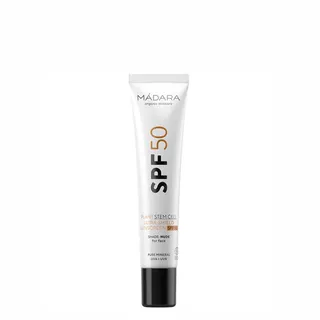
Madara Cosmetics Plant Stem Cell Ultra-Shield Sunscreen SPF50
Works for
Sun protectionSPF 50 · 1 UV filterBroad spectrum
This product offers a good level of protection against both UVB and UVA rays.
It is a mineral sunscreen. In other words, it contains non-organic UV filters. It will probably not sting your eyes but might leave a white cast.
This product can be considered "reef safe" because it does not contain the UV filters (oxybenzone and octinoxate) that can be harmful to coral reefs when present in the water in high concentrations.
Anti-agingSide benefit the brand mentions · Vitis vinifera seed extract, Aloe barbadensis leaf juice + 3 moreWorks well
“wrinkles”
This product can help prevent early signs of skin aging because it offers a good level of broad spectrum sun protection. Sun damage is the main cause of premature skin aging, and protecting your skin from the sun is the best anti-aging strategy.
These ingredients in the product can also help reduce and prevent fine lines and wrinkles and improve skin elasticity. There is some human evidence for them, though it is smaller or less consistent than the evidence for the best anti-aging ingredients: vitis vinifera seed extract.
Evens skin toneSide benefit the brand mentions · Camellia sinensis leaf extractWorks well
“pigmentation”
This product offers broad spectrum sun protection. It means that it can prevent hyperpigmentation and help keep the skin tone even (sun damage is the main factor causing age spots, darkening of post-acne marks and other discolorations).
Anti-oxidationSide benefit · Vitis vinifera seed extract, Camellia sinensis leaf extract + 2 moreWorks well
This product contains antioxidants (vitis vinifera seed extract) that can help neutralize free radicals in skin. By doing so, they can lessen the damage the skin gets from the UV light (sun).
The following ingredients - camellia sinensis leaf extract also can have an antioxidant effect, but there is less evidence to confirm their effectiveness in skin.
MoisturizingSide benefit the brand mentions · Vegetable oil, Helianthus annuus seed wax + 11 moreWorks
“hyaluronic acid”
This product can help improve hydration of the skin with the two types of ingredients.
The first type is called “humectants”:
these ingredients help attract water.
When humectants are on the surface of the skin, they “pull in” the moisture from the outside environment, or from
within deeper layers of the skin. The following ingredients in this product do the job:
hydrolyzed hyaluronic acid, sodium hyaluronate.
This product also contains ingredients called “occlusives”. They help reduce the speed with which our skin loses moisture to the outside environment. These ingredients also help soften the upper layer of the skin, so it feels less tight and nicer to the touch. The following ingredients in this product do the job: helianthus annuus seed wax, jojoba esters.
Can it cause trouble?
Irritancy4 strong irritants: Aroma, Linalool + 2 more — patch-test recommendedHigh risk
Comedogenic1 ingredient rated 2 or more on the 0–5 pore-clogging scale1 flagged
User reviews
Be the first — your take helps the next person decide.
Ingredients
Filter by role to see what each ingredient is doing.
Aloe barbadensis leaf juice~26–32%
- Irritation risk
- Medium
Traditionally used to treat sunburns, dermatitis and inflammation, but evidence for its effectiveness is lacking. The extract can contain humectants that help attract water into the skin
More about Aloe barbadensis leaf juiceZinc oxide~12–15%
- Irritation risk
- Low
A broad spectrum sunblock (protects from both UVA and UVB rays). Is suitable for most sensitive skins. In small concentrations, can be used as a colorant
More about Zinc oxideDicaprylyl carbonate~7–8.5%
- Irritation risk
- Low
Helps products spread more easily and works as an emollient to soften skin
More about Dicaprylyl carbonateIsoamyl laurate~5.3–6.5%
- Irritation risk
- Medium
Helps stabilize emulsions and create a nice product texture
More about Isoamyl laurateCi 77891~4.2–5.1%
- Irritation risk
- Low
Polyglyceryl-3 polyricinoleate~3.1–3.8%
- Irritation risk
- Medium
Helps oil and water mix together
More about Polyglyceryl-3 polyricinoleateHydrated silica~2.8–3.5%
Oryza sativa bran oil~2.3–2.8%
- Irritation risk
- Low
Helps soften the upper layer of the skin and might have some anti-oxidant properties
More about Oryza sativa bran oilVegetable oil~1.9–2.3%
- Irritation risk
- Low
An oil from a mixture of different vegetables. Helps soften the upper layer of the skin
More about Vegetable oilPolyhydroxystearic acid~1.5–1.8%
- Irritation risk
- Medium
Used to create a thicker product consistency and stabilize the formulation
More about Polyhydroxystearic acidSilica~1.4–1.8%
Helianthus annuus seed wax~1–1.3%
- Irritation risk
- Low
Helps soften the upper layer of the skin and support skin's barrier function while creating a thicker product consistency
More about Helianthus annuus seed waxOryza sativa bran oil~0.8–1.2%
- Irritation risk
- Low
Helps soften the upper layer of the skin and might have some anti-oxidant properties
More about Oryza sativa bran oilRhus succedanea fruit wax~0.7–1.05%
- Irritation risk
- Low
Polyglyceryl-3 diisostearate~0.7–1.05%
- Irritation risk
- Medium
- Comedogenicity
- 3/5
Helps oil and water mix together
More about Polyglyceryl-3 diisostearateButylene glycol~0.65–0.95%
- Irritation risk
- Low
Used to create a nice product texture and help delivery of other ingredients. Might be somewhat helpful in attracting water to the upper layer of the skin
More about Butylene glycolJojoba esters~0.7–1.05%
- Irritation risk
- Medium
An emollient made of jojoba oil. Helps soften the skin and support its barrier function
More about Jojoba estersSodium chloride~0.65–1%
- Irritation risk
- Low
Used to stabilize mixtures of oil and water, and create thicker, gel-like product textures
More about Sodium chlorideAroma~0.6–0.85%
Xanthan gum~0.6–0.85%
- Irritation risk
- Low
Used to create a thicker product consistency
More about Xanthan gumSodium dehydroacetate~0.3–0.6%
Citric acid~0.55–0.8%
- Irritation risk
- Medium
Can work as an exfoliant but is typically used to adjust the product pH
More about Citric acidCaprylic/capric triglyceride~0.6–0.9%
- Irritation risk
- Medium
A good mix of fatty acids that forms a protective layer on the skin. Improves the shelf life of products. Derived from coconut and glycerin
More about Caprylic/capric triglycerideDracocephalum ruyschiana callus extract~0.5–0.75%
- Irritation risk
- Low
Camellia sinensis leaf extract~0.55–0.8%
- Irritation risk
- Low
Can contain potent anti-oxidant compounds (abbreviated ECG, GCG, EGC, and EGCG) that might help protect the skin from free radicals. Can help calm down inflammation and has some anti-bacterial properties. Unfortunately, these antioxidants are unstable and lose their effectiveness very quickly in products. The concentration of the antioxidant compounds in the extract also tends to be low to be effective in topical formulation
More about Camellia sinensis leaf extractQuercus robur bark extract~0.5–0.8%
- Irritation risk
- Low
Vitis vinifera seed extract~0.55–0.8%
- Irritation risk
- Low
A plant extract that contains resveratrol and other anti-oxidant compounds that can help neutralize free radicals, reduce inflammation in skin and even out its tone. Can be also used to stabilize the product formulation
More about Vitis vinifera seed extractCi 77491~0.5–0.75%
- Irritation risk
- Low
A red colorant made of iron oxide. Typically is not irritating
More about Ci 77491Ci 77492~0.5–0.75%
Ci 77499~0.5–0.75%
Ascorbyl palmitate~0.5–0.75%
- Irritation risk
- Medium
Being a lipid soluble form of vitamin C, it is more stable and can penetrate the skin better than L-Ascorbic acid. It is effective in protecting the skin from free radicals, as well as evening the skin tone, but is less effective in stimulating collagen production compared to L-Ascorbic acid.
More about Ascorbyl palmitateTocopherol~0.5–0.8%
- Irritation risk
- Low
Pure form of vitamin E. Can help moisturise and protect the skin from free radicals. Often used to help stabilise other ingredients or the formula itself
More about TocopherolWater~0.5–0.75%
Isostearic acid~0.55–0.85%
- Irritation risk
- Low
Used to create a nice product texture
More about Isostearic acidSodium phytate~0.5–0.7%
Lecithin~0.55–0.85%
- Irritation risk
- Low
Used mostly for creating emulsions - helping oil and water mix together. Helps soften the upper layer of the skin
More about LecithinGlycolipids~0.45–0.65%
- Irritation risk
- Low
Hydrolyzed hyaluronic acid~0.3–0.55%
- Irritation risk
- Low
One of the best moisturizing ingredients. Attracts water into the upper layer of the skin. A version of it is naturally present in skin
More about Hydrolyzed hyaluronic acidSodium hyaluronate~0.35–0.6%
- Irritation risk
- Low
One of the best moisturizing ingredients. Attracts water into the upper layer of the skin
More about Sodium hyaluronateLinalool~0.3–0.6%
Limonene~0.3–0.55%
- Irritation risk
- High
A common frangrance that can easily irritate skin, especially if exposed to air, light or heat
More about LimoneneCitral~0.25–0.5%
Ingredient list view
Aloe barbadensis leaf juice, Zinc oxide, Dicaprylyl carbonate, Isoamyl laurate, Ci 77891, Polyglyceryl-3 polyricinoleate, Hydrated silica, Oryza sativa bran oil, Vegetable oil, Polyhydroxystearic acid, Silica, Helianthus annuus seed wax, Oryza sativa bran oil, Rhus succedanea fruit wax, Polyglyceryl-3 diisostearate, Butylene glycol, Jojoba esters, Sodium chloride, Aroma, Xanthan gum, Sodium dehydroacetate, Citric acid, Caprylic/capric triglyceride, Dracocephalum ruyschiana callus extract, Camellia sinensis leaf extract, Quercus robur bark extract, Vitis vinifera seed extract, Ci 77491, Ci 77492, Ci 77499, Ascorbyl palmitate, Tocopherol, Water, Isostearic acid, Sodium phytate, Lecithin, Glycolipids, Hydrolyzed hyaluronic acid, Sodium hyaluronate, Linalool, Limonene, Citral
Compare prices
Retailers ranked by price — lowest first.


Worth comparing, line by line.
Match % combines shared ingredients, the first five ingredients, shared actives and hero ingredients, irritancy (lower counts in the alternative's favour), texture and body area. Only products in the same routine step are compared.
| Madara CosmeticsPlant Stem Cell Ultra-Shield Sunscreen SPF50YOUR PRODUCT | Lion PoseUnghosted 100% Mineral Sunscreen SPF 42 with Zinc & Squalane | Stream2SeaSPF 45 with EcoSafe Zinc Every Day Tint Mineral Sunscreen | MÁDARA Organic SkincareSPF50 Mineral Sunscreen Stick | |
|---|---|---|---|---|
| Match | — | 37% | 37% | 36% |
| Price | — | $39.00 | $28.95 | $240.93 |
| Shared key ingredients | — | 5 of 11 | 5 of 11 | 6 of 11 |
| Key difference | — | Isosorbide Dicaprylate | Glycerin | Glycosphingolipids |
| Irritancy | High | Low | Medium | Medium |
| SPF | SPF 50 | SPF 42 | SPF 45 | SPF 50 |
| Drying alcohol | — | — | — | — |
| View product | Shop | Shop | Shop |

More alternatives: Riversol Early Access SPF 30 Lightweight Broad Spectrum SunscreenBlue Lizard Sheer Mineral Sunscreen Lotion for Face SPF 50+ * Tube
Product summary
Based on the ingredients included, we believe that "MADARA - Plant Stem Cell Ultra-Shield Sunscreen SPF50" can offer reliable sun protection. We love that it can protect from both UVA and UVB rays (not all sunscreens with SPF ratings give UVA protection. UVA rays do not cause sunburn, but still damage our skin and lead to early aging).
It contains good moisturizing ingredients and can double as a hydrating day cream. This product prevents early signs of aging by protecting against sun damage (all broad spectrum sunscreens do that).
Sunscreen filters
This sunscreen is a mineral sunscreen. It uses titanium dioxide and zinc oxide for sun protection. Both titanium dioxide and zinc oxide almost never irritate even the most sensitive skin and eyes, but can leave a white cast.
Irritation risk
We assess the overall irritancy of this product to be high. For a detailed overview of all potential irritants: click here
You can see the detailed formula review with the breakdown of all actives in the product and the full ingredient list with estimated concentrations in the tables below.
Price
The product retails from 28.30£ up to 30.05£ in the United Kingdom and for 29.25£ in the United Kingdom.
For a detailed price comparison: click here.
Sources cited in this review
Every concentration estimate and effectiveness label is anchored to one of these 17 studies and safety reviews.
- 1A review of inorganic UV filters zinc oxide and titanium dioxideonlinelibrary.wiley.com
- 2
- 3
- 4
- 5
- 6

Affiliate links · As an Amazon Associate, WIMJ earns from qualifying purchases.