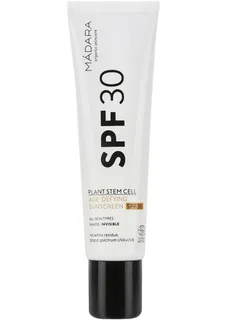
Madara Cosmetics Plant Stem Cell Age Defying Sunscreen SPF30
Works for
Sun protectionSPF 30 · 1 UV filter · Broad spectrumWeak protectionLow zinc dose
This product uses a single UV filter (zinc oxide) in a relatively low concentration and might not be able to provide a reliable sun protection.
This product can be considered "reef safe" because it does not contain the UV filters (oxybenzone and octinoxate) that can be harmful to coral reefs when present in the water in high concentrations.
Anti-agingAloe barbadensis leaf juice, Camellia sinensis leaf extract + 2 moreNot delivered
“Plant Stem Cell Age Defying Sunscreen SPF30”
This product does not contain ingredients that are able to reduce fine lines and wrinkles or help with skin elasticity, but it can improve the look of the skin temporarily through moisturization. Well-moisturized skin might also be able to repair the sun damage better.This ingredient - camellia sinensis leaf extract - could be helpful for preventing or repairing signs of aging in theory, but there is no evidence that it actually works.
This ingredient camellia sinensis leaf extract might be able to help neutralize free radicals in skin and help it fight off some of the sun damage.
The biggest anti-aging effect in this product comes from sun protection. Sun damage is the main factor causing early signs of skin aging. We, however, do not recommend using this product as a sunscreen because the protection it offers is not strong enough).
Anti-oxidationSide benefit · Camellia sinensis leaf extract, Rubus idaeus seed oil + 3 moreMay help
This product contains antioxidants (camellia sinensis leaf extract, rubus idaeus seed oil) that can help neutralize free radicals in skin to lessen the damage it gets from the UV light (sun). There is some human evidence for this effect in skin, though it is smaller or less consistent than the evidence for the best antioxidants.
MoisturizingSide benefit the brand mentions · Glycerin, Beeswax + 11 moreWorks
“Ultra light, subtly tinted texture, 100% invisible on the skin and suitable for both him and her, this SPF is perfect to keep skin protected and nourished in the sun.”
This product can help improve hydration of the skin with the two types of ingredients.
The first type is called “humectants”:
these ingredients help attract water.
When humectants are on the surface of the skin, they “pull in” the moisture from the outside environment, or from
within deeper layers of the skin. The following ingredients in this product do the job:
glycerin, hydrolyzed hyaluronic acid.
This product also contains ingredients called “occlusives”. They help reduce the speed with which our skin loses moisture to the outside environment. These ingredients also help soften the upper layer of the skin, so it feels less tight and nicer to the touch. The following ingredients in this product do the job: beeswax, vitis vinifera seed oil.
Can it cause trouble?
Irritancy6 strong irritants: Aroma, Benzyl salicylate + 4 more — patch-test recommendedHigh risk
ComedogenicClean of flagged comedogenic ingredientsNone flagged
User reviews
Be the first — your take helps the next person decide.
Ingredients
Filter by role to see what each ingredient is doing.
Aloe barbadensis leaf juice~26–31%
- Irritation risk
- Medium
Traditionally used to treat sunburns, dermatitis and inflammation, but evidence for its effectiveness is lacking. The extract can contain humectants that help attract water into the skin
More about Aloe barbadensis leaf juiceZinc oxide~12–14%
- Irritation risk
- Low
A broad spectrum sunblock (protects from both UVA and UVB rays). Is suitable for most sensitive skins. In small concentrations, can be used as a colorant
More about Zinc oxideIsoamyl laurate~6.2–7.6%
- Irritation risk
- Medium
Helps stabilize emulsions and create a nice product texture
More about Isoamyl laurateDicaprylyl carbonate~4.9–6%
- Irritation risk
- Low
Helps products spread more easily and works as an emollient to soften skin
More about Dicaprylyl carbonateGlycerin~3.7–4.6%
- Irritation risk
- Low
One of the best moisturizing ingredients. Naturally present in skin. It attracts water to the upper layer of the skin working as a humectant
More about GlycerinSorbitan olivate~2.8–3.4%
Beeswax~2.5–3.1%
- Irritation risk
- Low
Forms a protective barrier that holds water and keeps dry skin hydrated. Keeps an emulsion from separating into its oil and liquid components, and increases the thickness of a product. Can be an allergen
More about BeeswaxLecithin~2–2.4%
- Irritation risk
- Low
Used mostly for creating emulsions - helping oil and water mix together. Helps soften the upper layer of the skin
More about LecithinPolyglyceryl-2 dipolyhydroxystearate~1.5–1.8%
- Irritation risk
- Low
Helps to soften the upper layer of the skin
More about Polyglyceryl-2 dipolyhydroxystearateSilica~1.5–1.9%
Cellulose~1.2–1.5%
- Irritation risk
- Low
Can be used to help absorb oil as well as add volume and imporve texture of products.
More about CelluloseDracocephalum ruyschiana callus extract~0.95–1.15%
- Irritation risk
- Low
Camellia sinensis leaf extract~0.8–1.15%
- Irritation risk
- Low
Can contain potent anti-oxidant compounds (abbreviated ECG, GCG, EGC, and EGCG) that might help protect the skin from free radicals. Can help calm down inflammation and has some anti-bacterial properties. Unfortunately, these antioxidants are unstable and lose their effectiveness very quickly in products. The concentration of the antioxidant compounds in the extract also tends to be low to be effective in topical formulation
More about Camellia sinensis leaf extractQuercus robur bark extract~0.7–1.1%
- Irritation risk
- Low
Vitis vinifera seed oil~0.75–1.15%
- Irritation risk
- Medium
A great emollient that can also have anti-oxidant properties
More about Vitis vinifera seed oilHydrolyzed hyaluronic acid~0.65–0.95%
- Irritation risk
- Low
One of the best moisturizing ingredients. Attracts water into the upper layer of the skin. A version of it is naturally present in skin
More about Hydrolyzed hyaluronic acidSodium hyaluronate~0.65–1%
- Irritation risk
- Low
One of the best moisturizing ingredients. Attracts water into the upper layer of the skin
More about Sodium hyaluronateSodium chloride~0.65–1%
- Irritation risk
- Low
Used to stabilize mixtures of oil and water, and create thicker, gel-like product textures
More about Sodium chlorideAroma~0.6–0.9%
Rubus idaeus seed oil~0.65–1%
- Irritation risk
- Medium
A plant oil that might be able to help neutralize free radicals in skin
More about Rubus idaeus seed oilSorbitan caprylate~0.6–0.85%
- Irritation risk
- Medium
Helps oil and water mix together
More about Sorbitan caprylateCi 77492~0.55–0.8%
Palmitic acid~0.65–0.95%
- Irritation risk
- Low
An emollient that is naturally present in skin and helps soften it
More about Palmitic acidStearic acid~0.65–1%
- Irritation risk
- Low
Helps oil and water mix together and works as an emollient
More about Stearic acidPropanediol~0.55–0.8%
- Irritation risk
- Low
Acts as a solvent for other ingredients. Speeds up the absorption of other ingredients into the skin
More about PropanediolBenzoic acid~0.25–0.5%
Ci 77499~0.5–0.75%
Ci 77491~0.5–0.75%
- Irritation risk
- Low
A red colorant made of iron oxide. Typically is not irritating
More about Ci 77491Water~0.5–0.75%
Ascorbyl palmitate~0.45–0.7%
- Irritation risk
- Medium
Being a lipid soluble form of vitamin C, it is more stable and can penetrate the skin better than L-Ascorbic acid. It is effective in protecting the skin from free radicals, as well as evening the skin tone, but is less effective in stimulating collagen production compared to L-Ascorbic acid.
More about Ascorbyl palmitateSodium phytate~0.45–0.65%
Tocopherol~0.45–0.65%
- Irritation risk
- Low
Pure form of vitamin E. Can help moisturise and protect the skin from free radicals. Often used to help stabilise other ingredients or the formula itself
More about TocopherolPotassium hydroxide~0.3–0.6%
Benzyl salicylate~0.2–0.4%
Limonene~0.2–0.35%
- Irritation risk
- High
A common frangrance that can easily irritate skin, especially if exposed to air, light or heat
More about LimoneneCitral~0.15–0.3%
Linalool~0.15–0.3%
Eugenol~0.15–0.25%
Ingredient list view
Aloe barbadensis leaf juice, Zinc oxide, Isoamyl laurate, Dicaprylyl carbonate, Glycerin, Sorbitan olivate, Beeswax, Lecithin, Polyglyceryl-2 dipolyhydroxystearate, Silica, Cellulose, Dracocephalum ruyschiana callus extract, Camellia sinensis leaf extract, Quercus robur bark extract, Vitis vinifera seed oil, Hydrolyzed hyaluronic acid, Sodium hyaluronate, Sodium chloride, Aroma, Rubus idaeus seed oil, Sorbitan caprylate, Ci 77492, Palmitic acid, Stearic acid, Propanediol, Benzoic acid, Ci 77499, Ci 77491, Water, Ascorbyl palmitate, Sodium phytate, Tocopherol, Potassium hydroxide, Benzyl salicylate, Limonene, Citral, Linalool, Eugenol
Compare prices
Retailers ranked by price — lowest first.
Affiliate links · As an Amazon Associate, WIMJ earns from qualifying purchases.
Worth comparing, line by line.
Match % combines shared ingredients, the first five ingredients, shared actives and hero ingredients, irritancy (lower counts in the alternative's favour), texture and body area. Only products in the same routine step are compared.
| Madara CosmeticsPlant Stem Cell Age Defying Sunscreen SPF30YOUR PRODUCT | All GoodSPF 30 Sport Sunscreen Lotion | M-61Perfect Sheer Mineral Sunscreen SPF 50 | Babo BotanicalsDaily Sheer Non-Nano Zinc SPF 40 Fragrance Free Mineral Sunscreen | |
|---|---|---|---|---|
| Match | — | 38% | 37% | 37% |
| Price | — | $16.08 | $40.80 | $23.00 |
| Shared key ingredients | — | 5 of 10 | 5 of 10 | 4 of 10 |
| Key difference | — | Bisabolol | Allantoin | Butyrospermum Parkii Butter |
| Irritancy | High | Medium | Medium | Medium |
| SPF | SPF 30 | SPF 30 | SPF 50 | SPF 40 |
| Drying alcohol | — | — | — | — |
| View product | Shop | Shop | Shop |


More alternatives: Bloomeffects Tulip Dew Sunscreen Serum SPF 50thinkbaby thinksport Thinkbaby Clear Zinc Sunscreen SPF 30
Product summary
"MADARA - Plant Stem Cell Age Defying Sunscreen SPF30" uses a single UV filter (zinc oxide) in a relatively low concentration and might not be able to provide reliable sun protection.
Its formula is also hydrating, so you might not need an additional moistruizer during the day.
Sunscreen filters
This sunscreen is a mineral sunscreen. It uses zinc oxide for sun protection. Zinc oxide almost never irritates the skin or stings eyes, but it can leave a white cast.
Irritation risk
There are quite a few common irritants in this product, including ingredients without particular skin benefits. We would not recommend it for sensitive skin. We assess the overall irritancy of this sunscreen to be high. For a detailed overview of all potential irritants: click here
You can see the detailed formula review with the breakdown of all actives in the product and the full ingredient list with estimated concentrations in the tables below.
Price
The product retails from 0.50£ up to 30.56£ in the United Kingdom.
For a detailed price comparison: click here.
Sources cited in this review
Every concentration estimate and effectiveness label is anchored to one of these 12 studies and safety reviews.
- 1A review of inorganic UV filters zinc oxide and titanium dioxideonlinelibrary.wiley.com
- 2
- 3
- 4
- 5
- 6

Affiliate links · As an Amazon Associate, WIMJ earns from qualifying purchases.