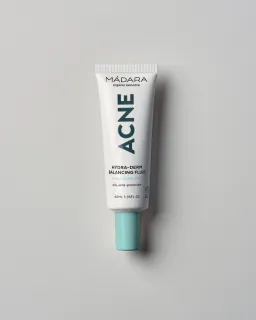
Madara Cosmetics Hydra-Derm -tasapainottava emulsio
Works for
1 of 2 advertised claims delivered
MoisturizingSodium pca, Argania spinosa kernel oil + 12 moreGood evidence
“This lightweight, non-comedogenic moisturiser hydrates delivers deep and balanced hydration to oily and breakout-prone complexions without feeling heavy.”
This product can help improve hydration of the skin with the two types of ingredients.
The first type is called “humectants”:
these ingredients help attract water.
When humectants are on the surface of the skin, they “pull in” the moisture from the outside environment, or from
within deeper layers of the skin. The following ingredients in this product do the job:
glycerin, sodium hyaluronate.
This product also contains ingredients called “occlusives”. They help reduce the speed with which our skin loses moisture to the outside environment. These ingredients also help soften the upper layer of the skin, so it feels less tight and nicer to the touch. The following ingredients in this product do the job: argania spinosa kernel oil, cetearyl alcohol.
Anti-blemishZinc pca, KaolinLimited evidence
“Hyaluronic acid, fermented polysaccharides and juniper stem cells team up to soothe, support the microbiome and help reduce the appearance of breakouts.”
This product contains ingredients (zinc pca) that could help reduce blemishes and clogged pores in theory, but there is not enough evidence that they actually work.
Anti-oxidationNot advertised by the brand · Ilex paraguariensis leaf extract, Zinc pca + 3 moreModerate evidence
This product contains antioxidants (ilex paraguariensis leaf extract) that might be able to help neutralize free radicals in skin to lessen the damage it gets from the UV light (sun). There is not enough evidence to confirm their effectiveness in skin though.
Can it cause trouble?
Irritancy7 strong irritants: Parfum, Alcohol + 5 more — patch-test recommendedHigh risk
Comedogenic1 ingredient rated 2 or more on the 0–5 pore-clogging scale1 flagged
User reviews
Be the first — your take helps the next person decide.
Ingredients
Filter by role to see what each ingredient is doing.
Water~45–55%
Glycerin~4.4–5.4%
- Irritation risk
- Low
One of the best moisturizing ingredients. Naturally present in skin. It attracts water to the upper layer of the skin working as a humectant
More about GlycerinArgania spinosa kernel oil~4.2–5.1%
- Irritation risk
- Medium
An emollient that helps soften the upper layer of the skin. Might have some weak anti-oxidant properties
More about Argania spinosa kernel oilPentylene glycol~3.1–3.8%
- Irritation risk
- Medium
Used to preserve products, dissolve other ingredients and create a nice product texture
More about Pentylene glycolPolyglyceryl-6 stearate~2.4–2.9%
- Irritation risk
- Low
Helps soften the upper layer of the skin
More about Polyglyceryl-6 stearateCetearyl alcohol~1.9–2.4%
- Irritation risk
- Low
- Comedogenicity
- 2/5
A non-drying alcohol. Works as an emollient. Helps water and oil mix together and creates a nice product texture
More about Cetearyl alcoholCellulose~1.7–2%
- Irritation risk
- Low
Can be used to help absorb oil as well as add volume and imporve texture of products.
More about CelluloseSodium pca~1.4–1.7%
- Irritation risk
- Low
Naturally present in skin and helps to attract water to its upper layer
More about Sodium pcaIsoamyl laurate~1.2–1.4%
- Irritation risk
- Medium
Helps stabilize emulsions and create a nice product texture
More about Isoamyl laurateZinc pca~0.95–1.15%
- Irritation risk
- Low
A compound that combines zinc with a hydrating ingredient PCA. Might to be helpful against acne and clogged pores. Can help calm down inflammation in skin. Could be helpful in reducing the formation of free radicals in skin. Might help to reduce fine lines in wrinkles, but solid evidence is missing
More about Zinc pcaParfum~0.65–0.95%
- Irritation risk
- High
An aromatic blend of unspecified and possibly irritating ingredients
More about ParfumCaprylic/capric triglyceride~0.6–0.95%
- Irritation risk
- Medium
A good mix of fatty acids that forms a protective layer on the skin. Improves the shelf life of products. Derived from coconut and glycerin
More about Caprylic/capric triglyceridePropanediol~0.5–0.75%
- Irritation risk
- Low
Acts as a solvent for other ingredients. Speeds up the absorption of other ingredients into the skin
More about PropanediolPolyglyceryl-6 behenate~0.45–0.7%
Alcohol~0.4–0.65%
- Irritation risk
- High
Can be drying and contribute to skin irritation. Used in formulars to dissolve other ingredients, create a thinner product consistency or for its antibacterial properties
More about AlcoholXanthan gum~0.45–0.65%
- Irritation risk
- Low
Used to create a thicker product consistency
More about Xanthan gumIlex paraguariensis leaf extract~0.3–0.6%
- Irritation risk
- High
A plant extract that can help neutralize free radicals in skin. Can contain fragrand compounds like linalool that can be irritating
More about Ilex paraguariensis leaf extractPalmitic acid~0.45–0.65%
- Irritation risk
- Low
An emollient that is naturally present in skin and helps soften it
More about Palmitic acidStearic acid~0.55–0.85%
- Irritation risk
- Low
Helps oil and water mix together and works as an emollient
More about Stearic acidAscorbyl palmitate~0.25–0.5%
- Irritation risk
- Medium
Being a lipid soluble form of vitamin C, it is more stable and can penetrate the skin better than L-Ascorbic acid. It is effective in protecting the skin from free radicals, as well as evening the skin tone, but is less effective in stimulating collagen production compared to L-Ascorbic acid.
More about Ascorbyl palmitateTocopherol~0.25–0.5%
- Irritation risk
- Low
Pure form of vitamin E. Can help moisturise and protect the skin from free radicals. Often used to help stabilise other ingredients or the formula itself
More about TocopherolPotassium hydroxide~0.25–0.5%
Sodium phytate~0.25–0.45%
Sodium hyaluronate~0.25–0.45%
- Irritation risk
- Low
One of the best moisturizing ingredients. Attracts water into the upper layer of the skin
More about Sodium hyaluronateUsnea barbata extract~0.25–0.4%
- Irritation risk
- Low
Rhamnose~0.25–0.4%
- Irritation risk
- Low
Helps oil and water mix together. It also helps attract water to the upper layer of the skin
More about RhamnoseCi 75810~0.2–0.4%
- Irritation risk
- Low
Ultramarines~0.2–0.4%
- Irritation risk
- Low
Glucose~0.2–0.35%
- Irritation risk
- Low
Helps attract water to the upper layer of the skin. Could be helpful in restoring the skin barrier function
More about GlucoseGlucuronic acid~0.2–0.35%
- Irritation risk
- Low
Silica~0.3–0.55%
Kaolin~0.3–0.5%
- Irritation risk
- Low
A type of clay that consists mainly of aluminum silicate. Helps absorb oil and creates a thicker product consistency. Can be used to add a white color
More about KaolinMaltodextrin~0.15–0.3%
- Irritation risk
- Low
Used to stabilize the product formulation and can help absorb oil
More about MaltodextrinLinalool~0.1–0.2%
Citral~0.1–0.15%
Limonene~0.05–0.1%
- Irritation risk
- High
A common frangrance that can easily irritate skin, especially if exposed to air, light or heat
More about LimoneneCitronellol~0.05–0.1%
Ingredient list view
Water, Glycerin, Argania spinosa kernel oil, Pentylene glycol, Polyglyceryl-6 stearate, Cetearyl alcohol, Cellulose, Sodium pca, Isoamyl laurate, Zinc pca, Parfum, Caprylic/capric triglyceride, Propanediol, Polyglyceryl-6 behenate, Alcohol, Xanthan gum, Ilex paraguariensis leaf extract, Palmitic acid, Stearic acid, Ascorbyl palmitate, Tocopherol, Potassium hydroxide, Sodium phytate, Sodium hyaluronate, Usnea barbata extract, Rhamnose, Ci 75810, Ultramarines, Glucose, Glucuronic acid, Silica, Kaolin, Maltodextrin, Linalool, Citral, Limonene, Citronellol
Compare prices
Retailers ranked by price — lowest first.

Affiliate links · prices updated regularly
Sources cited in this review
Every concentration estimate and effectiveness label is anchored to one of these 13 studies and safety reviews.
- 1
- 2
- 3
- 4Zinc Therapy in Dermatology: A Review hindawi.com
- 5
- 6

Affiliate links · As an Amazon Associate, WIMJ earns from qualifying purchases.