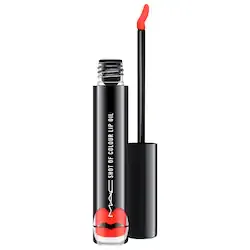
M.A.C Cosmetics Shot Of Colour Tinted Lip Oil
Works for
MoisturizingDiisostearyl malate, Octyldodecyl neopentanoate + 7 moreWorks
“An innovative moisture-oil gloss that is ultra nourishing and provides moisture the moment you apply it to lips.”
This product can help soften the skin and reduce its moisture loss with emollients and occlusives: bis-diglyceryl polyacyladipate-2, caprylic/capric triglyceride.
Keep in mind that this product does not contain effective ingredients to attract water to the upper layer of the skin. This is why an additional product with humectants like glycerin or hyaluronic acid can be helpful (apply it before this product for the best results).
Can it cause trouble?
Irritancy1 strong irritant: Sorbitan sesquioleateMedium risk
Comedogenic3 ingredients rated 2 or more on the 0–5 pore-clogging scale3 flagged
User reviews
Be the first — your take helps the next person decide.
Ingredients
Filter by role to see what each ingredient is doing.
Diisostearyl malate~23–34%
- Irritation risk
- Medium
Helps to soften the upper layer of the skin
More about Diisostearyl malatePolyglyceryl-10 nonaisostearate~4.6–6.8%
- Irritation risk
- Low
Octyldodecyl neopentanoate~4.8–7.3%
- Irritation risk
- Low
An emollient that helps soften the skin. Often used to stabilize other ingredients, for example, sunscreen
More about Octyldodecyl neopentanoateHydrogenated polyisobutene~4.1–6.1%
- Irritation risk
- Low
Used to improve the product consistency and soften the upper layer of the skin
More about Hydrogenated polyisobuteneTrimethylsiloxyphenyl dimethicone~2.8–4.2%
- Irritation risk
- Low
Hydrogenated castor oil isostearate~2.2–3.2%
- Irritation risk
- Low
Tridecyl trimellitate~1.8–2.7%
- Irritation risk
- Medium
Used to create a thicker product consistency and soften the upper layer of the skin
More about Tridecyl trimellitateCaprylic/capric triglyceride~1.7–2.5%
- Irritation risk
- Medium
A good mix of fatty acids that forms a protective layer on the skin. Improves the shelf life of products. Derived from coconut and glycerin
More about Caprylic/capric triglycerideRicinus communis seed oil~1.4–2.2%
- Irritation risk
- Medium
A plant oil that can help soften the skin. It might be helpful in calming down inflammation, but solid research is lacking. Is often used in lip products to create the needed product consistency
More about Ricinus communis seed oilSilica dimethyl silylate~1.1–1.6%
Bis-diglyceryl polyacyladipate-2~0.9–1.35%
- Irritation risk
- Low
Helps soften the upper layer of the skin and reduce water loss from its surface
More about Bis-diglyceryl polyacyladipate-2Bis-behenyl/isostearyl/phytosteryl dimer dilinoleyl dimer dilinoleate~0.6–1.35%
- Irritation risk
- High
Dimer dilinoleyl dimer dilinoleate~0.55–1.25%
- Irritation risk
- Low
Helps create a nice product texture and soften the upper layer of the skin
More about Dimer dilinoleyl dimer dilinoleatePoly c10-30 alkyl acrylate~0.45–1.05%
- Irritation risk
- Low
Tocopheryl acetate~0.45–1%
- Irritation risk
- Medium
A more stable but less bio-available form of vitamin E compared to Tocopherol. Might help moisturize and protect the skin from free radicals, but mostly used in low concentrations to stabilize other ingredients.
More about Tocopheryl acetateCamellia japonica seed oil~0.5–1.1%
- Irritation risk
- Low
A plant oil that helps to soften the upper layer of the skin and can help restore skin's barrier function. Might have an anti-oxidant effect
More about Camellia japonica seed oilPolyglyceryl-6 polyricinoleate~0.45–1%
- Irritation risk
- Medium
Helps oil and water mix together
More about Polyglyceryl-6 polyricinoleateEthylhexylglycerin~0.4–0.9%
Hdi/trimethylol hexyllactone crosspolymer~0.35–0.8%
- Irritation risk
- Low
Used to create a silky product texture and add volume to products
More about Hdi/trimethylol hexyllactone crosspolymerMethyl methacrylate crosspolymer~0.4–0.95%
- Irritation risk
- Low
Helps thicken the product consistency
More about Methyl methacrylate crosspolymerSorbitan sesquioleate~0.3–0.75%
- Irritation risk
- High
Used to help oil and water mix together. Can be irritating
More about Sorbitan sesquioleate1,2-hexanediol~0.3–0.7%
Vanillin~0.2–0.8%
- Irritation risk
- Low
Pentaerythrityl tetra-di-t-butyl hydroxyhydrocinnamate~0.3–0.7%
- Irritation risk
- Low
Used to increase stability of product formulations
More about Pentaerythrityl tetra-di-t-butyl hydroxyhydrocinnamateTitanium dioxide~0.4–0.9%
- Irritation risk
- Low
Works as a UV filter when used in high concentrations. It is photostable and is effective mostly against the UVB light, with some protection in the UVA range. In small concentrations, used for its ability to improve the color of cosmetic products. Is usually well tolerated by the skin
More about Titanium dioxideCi 77891~0.2–0.7%
- Irritation risk
- Low
Iron oxides~0.2–0.7%
- Irritation risk
- Low
An umbrella term for the following three colorants: CI 77491, CI 77492, CI 77499. They might be able to offer some protection against visible light, but the degree of the protection is not clear
More about Iron oxidesCi 77491~0.2–0.75%
- Irritation risk
- Low
A red colorant made of iron oxide. Typically is not irritating
More about Ci 77491Iron oxides~0.2–0.7%
- Irritation risk
- Low
An umbrella term for the following three colorants: CI 77491, CI 77492, CI 77499. They might be able to offer some protection against visible light, but the degree of the protection is not clear
More about Iron oxidesCi 77492~0.2–0.8%
Iron oxides~0.2–0.7%
- Irritation risk
- Low
An umbrella term for the following three colorants: CI 77491, CI 77492, CI 77499. They might be able to offer some protection against visible light, but the degree of the protection is not clear
More about Iron oxidesCi 77499~0.2–0.75%
Blue 1 lake~0.2–0.75%
Ci 42090~0.2–0.75%
Ci 15850~0.15–0.7%
Ci 45380~0.15–0.6%
Ci 15850~0.15–0.5%
Ci 45410~0.15–0.5%
Ci 15850~0.1–0.45%
Ci 45410~0.1–0.45%
Ci 19140~0.1–0.4%
Ci 15985~0.1–0.4%
Ingredient list view
Diisostearyl malate, Polyglyceryl-10 nonaisostearate, Octyldodecyl neopentanoate, Hydrogenated polyisobutene, Trimethylsiloxyphenyl dimethicone, Hydrogenated castor oil isostearate, Tridecyl trimellitate, Caprylic/capric triglyceride, Ricinus communis seed oil, Silica dimethyl silylate, Bis-diglyceryl polyacyladipate-2, Bis-behenyl/isostearyl/phytosteryl dimer dilinoleyl dimer dilinoleate, Dimer dilinoleyl dimer dilinoleate, Poly c10-30 alkyl acrylate, Tocopheryl acetate, Camellia japonica seed oil, Polyglyceryl-6 polyricinoleate, Ethylhexylglycerin, Hdi/trimethylol hexyllactone crosspolymer, Methyl methacrylate crosspolymer, Sorbitan sesquioleate, 1,2-hexanediol, Vanillin, Pentaerythrityl tetra-di-t-butyl hydroxyhydrocinnamate, Titanium dioxide, Ci 77891, Iron oxides, Ci 77491, Iron oxides, Ci 77492, Iron oxides, Ci 77499, Blue 1 lake, Ci 42090, Ci 15850, Unknown, Ci 45380, Ci 15850, Ci 45410, Ci 15850, Ci 45410, Ci 19140, Ci 15985
Compare prices
Retailers ranked by price — lowest first.
Worth comparing, line by line.
Match % combines shared ingredients, the first five ingredients, shared actives and hero ingredients, irritancy (lower counts in the alternative's favour), texture and body area. Only products in the same routine step are compared.
| M.A.C CosmeticsShot Of Colour Tinted Lip OilYOUR PRODUCT | Wander BeautyLip Retreat Oil Oasis | AlmayColor & Care Lip Oil-In-Stick | Paula's choicePro-Collagen Peptide Gloss Balm | |
|---|---|---|---|---|
| Match | — | 36% | 35% | 33% |
| Price | — | — | $6.68 | $23.79 |
| Shared key ingredients | — | 2 of 6 | 2 of 6 | 3 of 6 |
| Key difference | — | Niacinamide | Beeswax | Palmitoyl Tripeptide-1 |
| Irritancy | Medium | Low | Medium | Low |
| Drying alcohol | — | — | — | — |
| View product | Shop | Shop | Shop |


More alternatives: Sigma Beauty Renew Lip OilSleek MakeUP Major Morphosis Lip Lacquer
Sources cited in this review
Every concentration estimate and effectiveness label is anchored to one of these 12 studies and safety reviews.
- 1
- 2
- 3
- 4
- 5
- 6

Affiliate links · As an Amazon Associate, WIMJ earns from qualifying purchases.