Works for
2 of 2 advertised claims delivered
Moisturizing21 ingredients credited for this claimStrong evidence
“Botanical extracts help soothe dry skin by adding moisture.”
This product can help improve hydration of the skin with the two types of ingredients.
The first type is called “humectants”:
these ingredients help attract water.
When humectants are on the surface of the skin, they “pull in” the moisture from the outside environment, or from
within deeper layers of the skin. The following ingredients in this product do the job:
faex, saccharomyces lysate extract.
This product also contains ingredients called “occlusives”. They help reduce the speed with which our skin loses moisture to the outside environment. These ingredients also help soften the upper layer of the skin, so it feels less tight and nicer to the touch. The following ingredients in this product do the job: dimethicone, helianthus annuus seed oil.
The following ingredients in this product are especially good for supporting the skin barrier and helping with the hydration level: paraffinum liquidum, petrolatum, phytosphingosine
Anti-aging2 ingredients credited for this claimModerate evidence
“Fast Response Eye Cream mattes the skin and contains optical diffusers which diminish the appearance of fine lines.”
This product contains centella asiatica extract. This ingredient might be able to help reduce and prevent fine lines and wrinkles, improve skin elasticity and firmness, but there is not enough evidence that it actually works.
Evens skin toneNot advertised by the brand · 3 ingredients credited for this claimStrong evidence
This product can help reduce hypepigmentation and even out the skin tone because it contains the following effective ingredients: hydroquinone.
Keep in mind that you would need to apply any topical skincare targetted at hypigmentation consistently for a couple of months to get a result. No topical skincare product can help get rid of hyperpigmentation (including post-acne marks and age spots) instantly.
Anti-oxidationNot advertised by the brand · 8 ingredients credited for this claimModerate evidence
This product contains antioxidants (centella asiatica extract) that might be able to help neutralize free radicals in skin to lessen the damage it gets from the UV light (sun). There is not enough evidence to confirm their effectiveness in skin though.
Can it cause trouble?
Irritancy4 strong irritants: Parfum, Hydroquinone + 2 more — patch-test recommendedHigh risk
Comedogenic3 ingredients rated 2 or more on the 0–5 pore-clogging scale3 flagged
User reviews
Be the first — your take helps the next person decide.
Ingredients
Filter by role to see what each ingredient is doing.
Parfum~26–31%
- Irritation risk
- High
An aromatic blend of unspecified and possibly irritating ingredients
More about ParfumFormaldehyde~11–14%
- Irritation risk
- Low
Hydroquinone~6.4–7.9%
- Irritation risk
- High
A potent anti-pigmentation active. It can have serious side-effects though and ideally is used under supervision of a doctor. It should not be used over a long period of time (over a year).
More about HydroquinoneTriclosan~0.15–0.3%
- Irritation risk
- Low
Coal tar~4.4–5.4%
- Irritation risk
- Low
- Comedogenicity
- 3/5
Toluene~3.2–4%
- Irritation risk
- Low
Sodium laureth sulfate~2.8–3.5%
- Irritation risk
- High
- Comedogenicity
- 2/5
Works as a foaming cleansing agent
More about Sodium laureth sulfateParaffinum liquidum~2.6–3.2%
- Irritation risk
- Low
Mineral oil. One of the most effective and well studied occlusive and emollient moisturizing ingredients. Helps reduce moisture loss in skin and repair skin barrier function
More about Paraffinum liquidumPetrolatum~2.1–2.6%
- Irritation risk
- Low
One of the most effective and the most studied occlusive ingredients that creates a protective layer on top of the skin preventing moisture loss
More about PetrolatumPolyethylene~1.8–2.2%
Benzophenone-3~1.3–1.6%
- Irritation risk
- High
Same as oxybenzone. Protects in the UVB and short UVA range. In small concentrations, used to stabilize product formulation. Can be irritating. Is shown to be harmful to coral reefs - consider avoiding bathing in coral reef areas when wearing a product with this ingredient. It can penetrate the skin and get absorbed into bloodstream faster than other popular filters available in the US. The study that produced this finding did not address any potential health effects of the absorption
More about Benzophenone-3Dimethicone~0.95–1.2%
- Irritation risk
- Low
A silicone that helps to reduce water loss from the surface of the skin. Can temporarily "fill in" lines and wrinkles, absorb oil, and create a nice product finish
More about DimethiconeIsododecane~0.65–1%
- Irritation risk
- Low
An emollient that helps soften the skin and can decrease moisture loss. Helps create a nice product texture
More about IsododecaneWater~0.65–0.95%
Polysilicone-11~0.9–1.1%
- Irritation risk
- Low
A silicone that forms a light film on the skin surface helping to bind water and temporarily absorb oils creating a matt and powdery feel
More about Polysilicone-11Polyethylene~1–1.2%
Butylene glycol~0.55–0.85%
- Irritation risk
- Low
Used to create a nice product texture and help delivery of other ingredients. Might be somewhat helpful in attracting water to the upper layer of the skin
More about Butylene glycolCyclopentasiloxane~0.6–0.9%
- Irritation risk
- Low
A silicone that helps improve the product texture and spreadability. Can absorb oil creating a short-term mattifying effect on the skin
More about CyclopentasiloxaneHexyldecyl stearate~0.55–0.85%
- Irritation risk
- Medium
Helps create a nice product feeling on the skin and help soften its upper layer
More about Hexyldecyl stearateCaffeine~0.45–0.7%
- Irritation risk
- Medium
Might be helpful in neutralizing free radicals. Can have a dehydration effect that might somewhat decrease the look of puffy eyes
More about CaffeineTocopheryl acetate~0.5–0.8%
- Irritation risk
- Medium
A more stable but less bio-available form of vitamin E compared to Tocopherol. Might help moisturize and protect the skin from free radicals, but mostly used in low concentrations to stabilize other ingredients.
More about Tocopheryl acetateSodium hyaluronate~0.5–0.75%
- Irritation risk
- Low
One of the best moisturizing ingredients. Attracts water into the upper layer of the skin
More about Sodium hyaluronateRetinyl palmitate~0.45–0.7%
- Irritation risk
- High
Three steps removed from the active form of vitamin A - retinoic acid. To have an effect in the skin, it first needs to be converted twice to become the retinoic acid. This means it is less potent than retinol, but could also be less irritating. Once converted to the retinoic acid in the skin, it helps against all signs of aging, improves skin cell turnover and helps fight blemishes and clogged pores. However, in many cosmetic formulations, it is used in a concentration that is too low to have the full effect
More about Retinyl palmitateYeast extract~0.5–0.75%
- Irritation risk
- Low
Helps attract water to the upper layer of the skin and might have some anti-oxidant and skin lightening properties. It can help calm down inflammation in skin
More about Yeast extractFaex~0.45–0.65%
- Irritation risk
- Low
Yeast extract. Helps to attract water to the upper layer of the skin
More about FaexYeast extract~0.5–0.75%
- Irritation risk
- Low
Helps attract water to the upper layer of the skin and might have some anti-oxidant and skin lightening properties. It can help calm down inflammation in skin
More about Yeast extractTriticum vulgare germ oil~0.55–0.85%
- Irritation risk
- Low
- Comedogenicity
- 3/5
A good emoillient. Contains vitamin E which can help neutralise free radicals, however the oil is unstable. Avoid if you have gluten or wheat sensitivity (including food allergies).
More about Triticum vulgare germ oilHordeum vulgare extract~0.5–0.75%
- Irritation risk
- Medium
A plant extract that might have some anti-oxidant properties. Avoid if you are sensitive to gluten
More about Hordeum vulgare extractPyrus malus fruit extract~0.5–0.7%
- Irritation risk
- Medium
Can have some moisturizing properties due to its sugar content
More about Pyrus malus fruit extractCucumis sativus fruit extract~0.45–0.65%
- Irritation risk
- Medium
Might be somewhat helpful in reducing hyperpigmentation and neutralizing free radicals but its typical concentration in a product is too low for having an effect
More about Cucumis sativus fruit extractHelianthus annuus seed oil~0.5–0.75%
- Irritation risk
- Low
A great emollient due to its high linoleic acid content. One of the most effective plant oils in helping skin hydration and repairing skin barrier function
More about Helianthus annuus seed oilCentella asiatica extract~0.5–0.75%
- Irritation risk
- Medium
A plant extract that has been shown to be able to reduce inflammation in skin, support restoration of skin barrier function, as well as support collagen production. Contains active compounds called centelloids: asiaticoside, madecasosside, asiatic acid and madecassic acid. Might be helpful in preventing stretch marks. It can be itself be irritating though.
More about Centella asiatica extractSaccharomyces lysate extract~0.5–0.7%
- Irritation risk
- Low
Helps attract water to the upper layer of the skin. Can have some anti-inflammatory effect
More about Saccharomyces lysate extractSqualane~0.6–0.85%
- Irritation risk
- Low
An oil naturally present in skin. Works as an emollient to soften the skin and form a protective layer on its surface without a greasy feeling.
More about SqualaneMethyldihydrojasmonate~0.45–0.65%
Phytosphingosine~0.55–0.85%
- Irritation risk
- Low
A type of lipid that is naturally present in skin. It might help in repairing skin barrier function and has anti-bacterial effect
More about PhytosphingosineQuaternium-18 bentonite~0.5–0.7%
- Irritation risk
- Low
Propylene carbonate~0.5–0.75%
- Irritation risk
- Low
Is used to dissolve other ingredients and create nice product texture
More about Propylene carbonatePolymethyl methacrylate~0.6–0.9%
- Irritation risk
- Low
Is used to enhance product texture and can help to optically mask skin imperfections
More about Polymethyl methacrylateCetyl peg/ppg-10/1 dimethicone~0.4–0.6%
- Irritation risk
- Low
A type of silicone that helps water and oil mix together. Can help to soften upper layer of the skin
More about Cetyl peg/ppg-10/1 dimethiconePropylene glycol~0.3–0.55%
- Irritation risk
- High
Helps oil and water mix together and can enhance the penetration of other ingredients into the skin. It can be irritating
More about Propylene glycolDimethicone~0.45–0.7%
- Irritation risk
- Low
A silicone that helps to reduce water loss from the surface of the skin. Can temporarily "fill in" lines and wrinkles, absorb oil, and create a nice product finish
More about DimethiconeTetrasodium edta~0.3–0.55%
Sodium dehydroacetate~0.3–0.55%
Phenoxyethanol~0.3–0.6%
- Irritation risk
- Low
A preservative. It helps prevent bacterial growth in cosmetic products
More about PhenoxyethanolIngredient list view
Parfum, Unknown, Formaldehyde, Hydroquinone, Triclosan, Coal tar, Toluene, Sodium laureth sulfate, Unknown, Paraffinum liquidum, Petrolatum, Polyethylene, Unknown, Benzophenone-3, Dimethicone, Isododecane, Water, Polysilicone-11, Polyethylene, Butylene glycol, Cyclopentasiloxane, Hexyldecyl stearate, Caffeine, Tocopheryl acetate, Sodium hyaluronate, Retinyl palmitate, Yeast extract, Faex, Yeast extract, Triticum vulgare germ oil, Hordeum vulgare extract, Pyrus malus fruit extract, Cucumis sativus fruit extract, Helianthus annuus seed oil, Centella asiatica extract, Saccharomyces lysate extract, Squalane, Methyldihydrojasmonate, Phytosphingosine, Quaternium-18 bentonite, Propylene carbonate, Polymethyl methacrylate, Cetyl peg/ppg-10/1 dimethicone, Unknown, Propylene glycol, Unknown, Dimethicone, Tetrasodium edta, Sodium dehydroacetate, Phenoxyethanol
Compare prices
Retailers ranked by price — lowest first.

Product summary
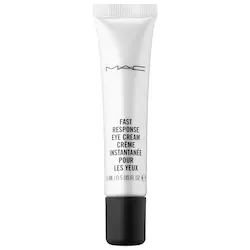
"MAC - Fast Response Eye Cream" has a good moisturizing formula. The formulation is based on a combination of good humectants and emollients. Both are needed to increase the skin hydration level. Faex, saccharomyces lysate extract, sodium hyaluronate and butylene glycol in this product (humectants) attract water molecules to the upper layer of the skin (the water comes from the outside air or from the deeper layers of the skin if the air is dry). Emollients in this formulation (phytosphingosine, paraffinum liquidum, petrolatum, triticum vulgare germ oil and dimethicone) help to reduce the moisture loss from the skin. They also soften the skin surface and relieve the feeling of dryness and tightness.
Ingredient callouts
- this moisturizer includes a form of retinoids (vitamin A) - retinyl palmitate 0.45% - 0.70%, but this type of vitamin A is not very effective. It could in theory help with fine lines and wrinkles, but the effect is most likely minimal.
- As a plus, this moisturizer also contains ceramides (phytosphingosine 0.55% - 0.85%). Ceramides are a type of lipids that our skin produces itself. They are a building block of the skin's barrier. Ceramides used in skincare are synthetic or extracted from plants. They work well for softening the skin surface and "patch holes" in the skin's barrier.
Irritation risk
There are some common irritants in this product, including ingredients that do not have benefits for the skin. We assess the overall irritancy of this moisturizer to be high. For a detailed overview of all potential irritants: click here
You can see the detailed formula review with the breakdown of all actives in the product and the full ingredient list with estimated concentrations in the tables below.
Price
The product retails for 116.70A$ in Australia, from 34.00$ up to 40.00$ in the United States, from 24.00£ up to 33.93£ in the United Kingdom and for 43.00CA$ in Canada.
For a detailed price comparison: click here.
Sources cited in this review
Every concentration estimate and effectiveness label is anchored to one of these 29 studies and safety reviews.
- 1Surfactants and experimental irritant contact dermatitisncbi.nlm.nih.gov
- 2A review on the extensive skin benefits of mineral oilncbi.nlm.nih.gov
- 3
- 4
- 5On Photostability of Oxybenzonecore.ac.uk
- 6

Affiliate links · As an Amazon Associate, WIMJ earns from qualifying purchases.