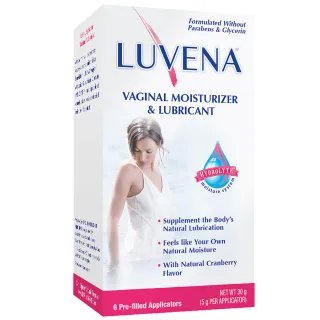
Works for
MoisturizingSimmondsia chinensis seed oil, Lactoperoxidase + 2 moreWorks
“Vaginal Moisturizer and Lubricant”
This product can help improve hydration of the skin with the two types of ingredients.
The first type is called “humectants”:
these ingredients help attract water.
When humectants are on the surface of the skin, they “pull in” the moisture from the outside environment, or from
within deeper layers of the skin. The following ingredients in this product do the job:
glycogen.
This product also contains ingredients called “occlusives”. They help reduce the speed with which our skin loses moisture to the outside environment. These ingredients also help soften the upper layer of the skin, so it feels less tight and nicer to the touch. The following ingredients in this product do the job: simmondsia chinensis seed oil.
Can it cause trouble?
Irritancy6 flagged ingredientsLow risk
ComedogenicClean of flagged comedogenic ingredientsNone flagged
User reviews
Be the first — your take helps the next person decide.
Ingredients
Filter by role to see what each ingredient is doing.
Water~40–60%
Propanediol~4.5–6.8%
- Irritation risk
- Low
Acts as a solvent for other ingredients. Speeds up the absorption of other ingredients into the skin
More about PropanediolPeg-20~3.3–5%
- Irritation risk
- Low
Peg-150 pentaerythrityl tetrastearate~2.3–3.5%
- Irritation risk
- Medium
Helps oil and water mix together
More about Peg-150 pentaerythrityl tetrastearatePeg-150 distearate~1.9–2.8%
- Irritation risk
- Medium
Helps oil and water mix together
More about Peg-150 distearateSimmondsia chinensis seed oil~1.5–2.3%
- Irritation risk
- Medium
Softens the upper layer of skin and helps restore the healthy skin barrier. Has shown to help calm down inflammation in skin. It is a stable oil, meaning that it retains its properties even when exposed to air.
More about Simmondsia chinensis seed oilVaccinium macrocarpon fruit extract~1.1–1.6%
- Irritation risk
- High
A berry extract. Might have some anti-oxidant properties
More about Vaccinium macrocarpon fruit extractLysozyme~0.6–1.4%
- Irritation risk
- Low
Lactoferrin~0.45–1.05%
- Irritation risk
- Low
Lactoperoxidase~0.35–0.85%
- Irritation risk
- Low
Helps attract water to the upper layer of the skin. In theory, could support healthy skin's microbiome, but evidence of effectiveness in skin is lacking
More about LactoperoxidaseLactic acid~0.15–0.6%
- Irritation risk
- Medium
An exfoliating and moisturizing alpha-hydroxy acid (AHA). Typically causes less irritation than other AHAs, for example, glycolic acid. At high concentrations (about 15%), lactic acid can help reduce lines and wrinkles. Recent studies show that lactic acid can support the "good" bacteria living on skin's surface (healthy skin microbiome)
More about Lactic acidPotassium thiocyanate~0.1–0.4%
- Irritation risk
- Low
Glycogen~0.05–0.2%
- Irritation risk
- Low
Helps attract water to the upper layer of the skin
More about GlycogenMannose~0.01–0.1%
- Irritation risk
- Low
Tocopheryl acetate~0.01–0.05%
- Irritation risk
- Medium
A more stable but less bio-available form of vitamin E compared to Tocopherol. Might help moisturize and protect the skin from free radicals, but mostly used in low concentrations to stabilize other ingredients.
More about Tocopheryl acetateIngredient list view
Water, Propanediol, Peg-20, Peg-150 pentaerythrityl tetrastearate, Peg-150 distearate, Simmondsia chinensis seed oil, Vaccinium macrocarpon fruit extract, Lysozyme, Lactoferrin, Lactoperoxidase, Lactic acid, Potassium thiocyanate, Glycogen, Mannose, Tocopheryl acetate
Worth comparing, line by line.
Match % combines shared ingredients, the first five ingredients, shared actives and hero ingredients, irritancy (lower counts in the alternative's favour), texture and body area. Only products in the same routine step are compared.
| LuvenaVaginal Moisturizer and LubricantYOUR PRODUCT | EveredenTri-Water After Sun Serum | Grahams NaturalSkin C+ Eczema & Dermatitis Relief Cream | Eucerin10% Urea Body Lotion Dry Skin Relief | |
|---|---|---|---|---|
| Match | — | 25% | 23% | 23% |
| Price | — | $19.00 | $17.00 | $18.35 |
| Shared key ingredients | — | 1 of 3 | 1 of 3 | 1 of 3 |
| Key difference | — | Glycerin | Lanolin | Lactic Acid |
| Irritancy | Low | Low | Low | Low |
| Drying alcohol | — | — | — | — |
| View product | Shop | Shop | Shop |



More alternatives: ShiKai Borage Therapy Dry Skin LotionSkincare by Dr V Dr V Kids Magic Cream
Sources cited in this review
Every concentration estimate and effectiveness label is anchored to one of these 2 studies and safety reviews.
- 1Epidermal and dermal effects of topical lactic acidncbi.nlm.nih.gov
- 2Dual Effects of Alpha-Hydroxy Acids on the Skinpdfs.semanticscholar.org
