Works for
MoisturizingBetaine, Sodium hyaluronate + 2 moreWorks
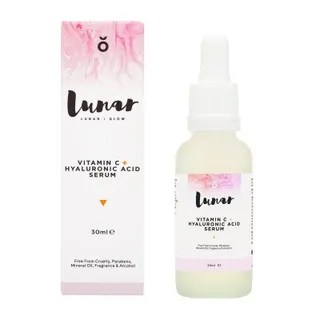
“Lunar’s Vitamin C + Hyaluronic Acid Serum with Lactic Acid support is designed for rapid absorbing, ultra-hydration of the skin.”
This product contains good ingredients to attract water to the upper layer of the skin. These ingredients are called "humectants": betaine, glycerin.
When humectants are on the surface of the skin, they “pull in” the moisture from the outside environment, or from within deeper layers of the skin. If the air is dry, humectants can speed up the moisture loss from the skin. This is why it is a good idea to use another product on top of this one to help "seal in" the moisture (look for ingredients like dimethicone, squalane, oils and butters).
Anti-agingSodium ascorbyl phosphate, Lactic acidNot delivered
“Its oil-free base allows the active ingredients to penetrate the skin quickly, creating fullness and a youthful radiance, helping to protect your skin from signs of ageing.”
Effective ingredients missing or their concentration is too low.
Can it cause trouble?
Irritancy1 strong irritant: Sodium anisateMedium risk
ComedogenicClean of flagged comedogenic ingredientsNone flagged


User reviews
Be the first — your take helps the next person decide.
Ingredients
Filter by role to see what each ingredient is doing.
Water~40–60%
Propylene glycol~4.5–6.7%
- Irritation risk
- High
Helps oil and water mix together and can enhance the penetration of other ingredients into the skin. It can be irritating
More about Propylene glycolBetaine~3.4–5.1%
- Irritation risk
- Low
Helps attract water to the upper layer of the skin and improves the product texture
More about BetaineSodium ascorbyl phosphate~2.7–4%
- Irritation risk
- Medium
A stable derivative of vitamin C. It is oil-soluble which means it is more likely to penetrate the skin compared to the pure form of vitamin C (which is water-soluble), but it is less bio-available and is way less effective in stimulating collagen and reducing wrinkles compared to the pure form of vitamin C (L-ascorbic acid) and its other derivatives (for example, magnesium ascorbyl phosphate). At the same time, this vitamin C derivative has been shown in studies to be effective in reducing acne, blemishes and clogged pores. It is less irritating then the pure form of vitamin C
More about Sodium ascorbyl phosphateSodium hyaluronate~2–3%
- Irritation risk
- Low
One of the best moisturizing ingredients. Attracts water into the upper layer of the skin
More about Sodium hyaluronateLactic acid~1.5–2.2%
- Irritation risk
- Medium
An exfoliating and moisturizing alpha-hydroxy acid (AHA). Typically causes less irritation than other AHAs, for example, glycolic acid. At high concentrations (about 15%), lactic acid can help reduce lines and wrinkles. Recent studies show that lactic acid can support the "good" bacteria living on skin's surface (healthy skin microbiome)
More about Lactic acidCaprylyl caprylate~1.3–2%
- Irritation risk
- Low
Glycerin~0.9–1.35%
- Irritation risk
- Low
One of the best moisturizing ingredients. Naturally present in skin. It attracts water to the upper layer of the skin working as a humectant
More about GlycerinSodium anisate~0.45–1.1%
Xanthan gum~0.3–0.75%
- Irritation risk
- Low
Used to create a thicker product consistency
More about Xanthan gumPhenoxyethanol~0.15–0.55%
- Irritation risk
- Low
A preservative. It helps prevent bacterial growth in cosmetic products
More about PhenoxyethanolTetrasodium edta~0.1–0.3%
Sodium levulinate~0.05–0.2%
Sodium hydroxide~0.05–0.15%
Ingredient list view
Water, Propylene glycol, Betaine, Sodium ascorbyl phosphate, Sodium hyaluronate, Lactic acid, Caprylyl caprylate, Unknown, Glycerin, Sodium anisate, Xanthan gum, Phenoxyethanol, Tetrasodium edta, Sodium levulinate, Sodium hydroxide
Compare prices
Retailers ranked by price — lowest first.
Affiliate links · As an Amazon Associate, WIMJ earns from qualifying purchases.
Worth comparing, line by line.
Match % combines shared ingredients, the first five ingredients, shared actives and hero ingredients, irritancy (lower counts in the alternative's favour), texture and body area. Only products in the same routine step are compared.
| Lunar GlowVitamin C SerumYOUR PRODUCT | frank bodyCollagen Boost Serum | Balance Active FormulaVitamin C 12% Supershot Advanced Brightening Serum | Q+AHyaluronic Acid Facial Serum | |
|---|---|---|---|---|
| Match | — | 65% | 61% | 59% |
| Price | — | $19.67 | — | $7.01 |
| Shared key ingredients | — | 3 of 5 | 2 of 5 | 4 of 5 |
| Key difference | — | Ferulic Acid | — | — |
| Irritancy | Medium | Low | Low | Medium |
| Drying alcohol | — | — | — | — |
| View product | Shop | Shop | Shop |


More alternatives: eb5 Anti-Aging Vitamin C Serum ConcentrateOne two free Vitamin C Super Glow Serum
Sources cited in this review
Every concentration estimate and effectiveness label is anchored to one of these 15 studies and safety reviews.
- 1Surfactants and experimental irritant contact dermatitisncbi.nlm.nih.gov
- 2Propylene Glycolpubmed.ncbi.nlm.nih.gov
- 3Skin-sensitizing and irritant properties of propylene glycolonlinelibrary.wiley.com
- 4
- 5Sodium ascorbyl phosphate in topical microemulsionssciencedirect.com
- 6

Affiliate links · As an Amazon Associate, WIMJ earns from qualifying purchases.