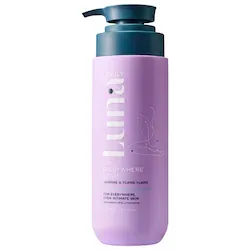
Luna Daily The Everywhere Wash - pH + Microbiome-Balancing Body Wash For All Skin
Works for
CleansingCocamidopropyl betaine, Decyl glucoside + 8 moreCleanses gently
“What it is: A microbiome-balancing body wash with notes of jasmine and ylang ylang that gently cleanses all skin, including sensitive and intimate areas.”
This product works by removing dirt and oil from the surface of the skin. It uses a combination of mild cleansing agents (cetearyl alcohol, cocamidopropyl betaine, decyl glucoside, glyceryl stearate, linoleic acid, linolenic acid, oleic acid, palmitic acid, xanthan gum) and should be able to cleanse the skin gently. Still keep in mind that any cleansing can disrupt the skin barrier, and most people do not need to cleanse their skin more than once per day.
Even though this formulation is mild, the following cleansing agents could trigger an irritation or allergy for some people: cocamidopropyl betaine, decyl glucoside
Can it cause trouble?
Irritancy1 strong irritant: ParfumMedium risk
Comedogenic2 ingredients rated 2 or more on the 0–5 pore-clogging scale2 flagged
User reviews
Be the first — your take helps the next person decide.
Ingredients
Filter by role to see what each ingredient is doing.
Water~45–55%
Cocamidopropyl betaine~8.8–10.8%
- Irritation risk
- High
Helps water and oil mix together. Used as a cleansing ingredient. Could be an allergen
More about Cocamidopropyl betaineDecyl glucoside~4.7–5.8%
- Irritation risk
- High
Helps oil and water mix together. Can be irritating
More about Decyl glucosideGlycerin~3.1–3.8%
- Irritation risk
- Low
One of the best moisturizing ingredients. Naturally present in skin. It attracts water to the upper layer of the skin working as a humectant
More about GlycerinCetearyl alcohol~2.4–2.9%
- Irritation risk
- Low
- Comedogenicity
- 2/5
A non-drying alcohol. Works as an emollient. Helps water and oil mix together and creates a nice product texture
More about Cetearyl alcoholXanthan gum~1.9–2.3%
- Irritation risk
- Low
Used to create a thicker product consistency
More about Xanthan gumCocos nucifera oil~1.7–2.1%
- Irritation risk
- Low
- Comedogenicity
- 3/5
An emollient. Found to be as effective as a moisturizer for dry skin as mineral oil. Could be comedogenic
More about Cocos nucifera oilGlyceryl stearate~1.5–1.8%
- Irritation risk
- Low
An emollient that softens the skin and forms a protective layer on its surface. Helps water and oil mix together
More about Glyceryl stearateParfum~1.2–1.4%
- Irritation risk
- High
An aromatic blend of unspecified and possibly irritating ingredients
More about ParfumSodium benzoate~0.25–0.5%
Potassium sorbate~0.3–0.6%
Citric acid~0.55–0.85%
- Irritation risk
- Medium
Can work as an exfoliant but is typically used to adjust the product pH
More about Citric acidPolyquaternium-39~0.55–0.85%
- Irritation risk
- Low
Helps soften the upper layer of the skin and create a nice product finish
More about Polyquaternium-39Sodium chloride~0.55–0.8%
- Irritation risk
- Low
Used to stabilize mixtures of oil and water, and create thicker, gel-like product textures
More about Sodium chlorideTocopherol~0.45–0.65%
- Irritation risk
- Low
Pure form of vitamin E. Can help moisturise and protect the skin from free radicals. Often used to help stabilise other ingredients or the formula itself
More about TocopherolInulin~0.4–0.6%
- Irritation risk
- Low
Helps attract water to the upper layer of the skin. Is claimed to support the growth of "good" bacteria in skin (as a "prebiotic"), but the research is lacking
More about InulinPanthenol~0.3–0.55%
- Irritation risk
- Low
Helps attract water to the upper layer of the skin and can help improve skin barrier function
More about PanthenolSodium ascorbyl phosphate~0.25–0.5%
- Irritation risk
- Medium
A stable derivative of vitamin C. It is oil-soluble which means it is more likely to penetrate the skin compared to the pure form of vitamin C (which is water-soluble), but it is less bio-available and is way less effective in stimulating collagen and reducing wrinkles compared to the pure form of vitamin C (L-ascorbic acid) and its other derivatives (for example, magnesium ascorbyl phosphate). At the same time, this vitamin C derivative has been shown in studies to be effective in reducing acne, blemishes and clogged pores. It is less irritating then the pure form of vitamin C
More about Sodium ascorbyl phosphateTocopheryl acetate~0.25–0.45%
- Irritation risk
- Medium
A more stable but less bio-available form of vitamin E compared to Tocopherol. Might help moisturize and protect the skin from free radicals, but mostly used in low concentrations to stabilize other ingredients.
More about Tocopheryl acetateLactic acid~0.2–0.4%
- Irritation risk
- Medium
An exfoliating and moisturizing alpha-hydroxy acid (AHA). Typically causes less irritation than other AHAs, for example, glycolic acid. At high concentrations (about 15%), lactic acid can help reduce lines and wrinkles. Recent studies show that lactic acid can support the "good" bacteria living on skin's surface (healthy skin microbiome)
More about Lactic acidLinoleic acid~0.3–0.6%
- Irritation risk
- Low
An excellent emollient. Helps soften the skin, restore its barrier function, and can help to calm down inflammation. It can be helpful to prevent blemishes and clogged pores
More about Linoleic acidOleic acid~0.2–0.4%
- Irritation risk
- Medium
Helps soften the upper layer of the skin. At the same time, it can weaken the skin's barrier enhancing penetration of other ingredients and increasing the risk of skin dryness
More about Oleic acidChamomilla recutita flower extract~0.15–0.25%
- Irritation risk
- High
Plant extract that can have healing and anti-inflammatory properties. It is a potential allergen and can be irritating
More about Chamomilla recutita flower extractPalmitic acid~0.15–0.3%
- Irritation risk
- Low
An emollient that is naturally present in skin and helps soften it
More about Palmitic acidStearic acid~0.2–0.4%
- Irritation risk
- Low
Helps oil and water mix together and works as an emollient
More about Stearic acidLinolenic acid~0.2–0.35%
- Irritation risk
- Medium
An emollient that helps soften the skin and calm down inflammation
More about Linolenic acidIngredient list view
Water, Cocamidopropyl betaine, Decyl glucoside, Glycerin, Cetearyl alcohol, Xanthan gum, Cocos nucifera oil, Glyceryl stearate, Parfum, Sodium benzoate, Potassium sorbate, Citric acid, Polyquaternium-39, Sodium chloride, Tocopherol, Inulin, Panthenol, Sodium ascorbyl phosphate, Tocopheryl acetate, Lactic acid, Linoleic acid, Oleic acid, Chamomilla recutita flower extract, Palmitic acid, Stearic acid, Linolenic acid
Compare prices
Retailers ranked by price — lowest first.

Worth comparing, line by line.
Match % combines shared ingredients, the first five ingredients, shared actives and hero ingredients, irritancy (lower counts in the alternative's favour), texture and body area. Only products in the same routine step are compared.
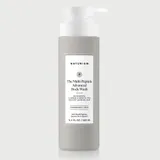
| Luna DailyThe Everywhere Wash - pH + Microbiome-Balancing Body Wash For All SkinYOUR PRODUCT | Josie MaranEveryBODY Wash Now! Moisture Mousse All-Over Cleanser | DoveSensitive Moisture Tip to Toe Baby Wash Sensitive Moisture | NaturiumThe Multi-Peptide Advanced Body Wash | |
|---|---|---|---|---|
| Match | — | 37% | 36% | 34% |
| Price | $24.00 | — | $6.99−$17.01 | $13.23−$10.77 |
| Shared key ingredients | — | 4 of 15 | 3 of 15 | 6 of 15 |
| Key difference | — | Agran Oil | Lauric Acid | Ferulic Acid |
| Irritancy | Medium | Low | Low | Low |
| Drying alcohol | — | — | — | — |
| View product | Shop | Shop | Shop |


More alternatives: Beekman 1802 Vanilla Absolute Hand & Body WashNatura Siberica Little Siberica Organic Baby Moisturising Milk
Sources cited in this review
Every concentration estimate and effectiveness label is anchored to one of these 20 studies and safety reviews.
- 1
- 2
- 3Vitamin E in dermatologyncbi.nlm.nih.gov
- 4Vitamin E and Skin Healthlpi.oregonstate.edu
- 5
- 6Skin moisturizing effects of panthenol-based formulationspdfs.semanticscholar.org

Affiliate links · As an Amazon Associate, WIMJ earns from qualifying purchases.