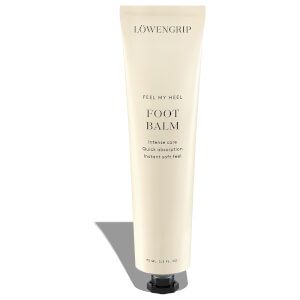
Works for
1 of 2 advertised claims delivered
Moisturizing11 ingredients credited for this claimStrong support
“The potent foot cream also contains Urea, an ingredient known for its ability to transform patches of rough, calloused skin by moisturizing and exfoliating.”
This product can help improve hydration of the skin with the two types of ingredients.
The first type is called “humectants”:
these ingredients help attract water.
When humectants are on the surface of the skin, they “pull in” the moisture from the outside environment, or from
within deeper layers of the skin. The following ingredients in this product do the job:
glycerin, caprylyl glycol.
This product also contains ingredients called “occlusives”. They help reduce the speed with which our skin loses moisture to the outside environment. These ingredients also help soften the upper layer of the skin, so it feels less tight and nicer to the touch. The following ingredients in this product do the job: butyrospermum parkii butter, isopropyl myristate.
The following ingredients in this product are especially good for supporting the skin barrier and helping with the hydration level: urea
Exfoliation2 ingredients credited for this claimLimited support
“The potent foot cream also contains Urea, an ingredient known for its ability to transform patches of rough, calloused skin by moisturizing and exfoliating.”
This product might help exfoliate the skin with urea, but This ingredient is not the most effective.
Can it cause trouble?
Irritancy3 strong irritants: Parfum, Linalool + 1 more — patch-test recommendedHigh risk
Comedogenic3 ingredients rated 2 or more on the 0–5 pore-clogging scale3 flagged


User reviews
Be the first — your take helps the next person decide.
Ingredients
Filter by role to see what each ingredient is doing.
Water~40–60%
Cetearyl alcohol~6.1–9.1%
- Irritation risk
- Low
- Comedogenicity
- 2/5
A non-drying alcohol. Works as an emollient. Helps water and oil mix together and creates a nice product texture
More about Cetearyl alcoholIsopropyl myristate~3.8–5.7%
- Irritation risk
- Low
- Comedogenicity
- 3/5
An emollient that helps soften the skin. Could be comedogenic
More about Isopropyl myristateStearic acid~2.5–3.7%
- Irritation risk
- Low
Helps oil and water mix together and works as an emollient
More about Stearic acidPeg-100 stearate~2.1–3.1%
- Irritation risk
- Low
Helps oil and water mix togehter and creates a nice product texture
More about Peg-100 stearateGlyceryl stearate~1.7–2.5%
- Irritation risk
- Low
An emollient that softens the skin and forms a protective layer on its surface. Helps water and oil mix together
More about Glyceryl stearateGlycerin~1.4–2.1%
- Irritation risk
- Low
One of the best moisturizing ingredients. Naturally present in skin. It attracts water to the upper layer of the skin working as a humectant
More about GlycerinUrea~1.1–1.6%
- Irritation risk
- Low
Naturally present in skin (urea makes up about 7% of natural moisturizing factors in skin). Attracts water to the upper layer of the skin. Also has a positive effect on the skin barrier beyond the humectant action. Can enhance penetration of other ingredients. Is an exfoliating ingredient when used in high concentrations
More about UreaButyrospermum parkii butter~1–1.5%
- Irritation risk
- Low
- Comedogenicity
- 3/5
A great moisturising ingredient that softens the skin and reduces water loss from its upper layer. It also can be helpful in protecting skin from free radicals
More about Butyrospermum parkii butterDiheptyl succinate~0.8–1.25%
- Irritation risk
- Low
Helps to soften the upper layer of the skin and creates a nice product finish on the skin
More about Diheptyl succinateLactic acid~0.45–1.05%
- Irritation risk
- Medium
An exfoliating and moisturizing alpha-hydroxy acid (AHA). Typically causes less irritation than other AHAs, for example, glycolic acid. At high concentrations (about 15%), lactic acid can help reduce lines and wrinkles. Recent studies show that lactic acid can support the "good" bacteria living on skin's surface (healthy skin microbiome)
More about Lactic acidPhenoxyethanol~0.35–0.8%
- Irritation risk
- Low
A preservative. It helps prevent bacterial growth in cosmetic products
More about PhenoxyethanolCaprylyl glycol~0.35–0.85%
- Irritation risk
- Medium
Helps preserve products and creates a nice product texture
More about Caprylyl glycolSodium hydroxide~0.2–0.7%
Sorbic acid~0.1–0.45%
Capryloyl glycerin/sebacic acid copolymer~0.1–0.45%
- Irritation risk
- Low
Helps soften the upper layer of the skin
More about Capryloyl glycerin/sebacic acid copolymerTocopheryl acetate~0.05–0.3%
- Irritation risk
- Medium
A more stable but less bio-available form of vitamin E compared to Tocopherol. Might help moisturize and protect the skin from free radicals, but mostly used in low concentrations to stabilize other ingredients.
More about Tocopheryl acetateParfum~0.05–0.15%
- Irritation risk
- High
An aromatic blend of unspecified and possibly irritating ingredients
More about ParfumLinalool~0.01–0.1%
Citral~0.01–0.05%
Ingredient list view
Water, Cetearyl alcohol, Isopropyl myristate, Stearic acid, Peg-100 stearate, Glyceryl stearate, Glycerin, Urea, Butyrospermum parkii butter, Diheptyl succinate, Lactic acid, Phenoxyethanol, Caprylyl glycol, Sodium hydroxide, Sorbic acid, Capryloyl glycerin/sebacic acid copolymer, Tocopheryl acetate, Parfum, Linalool, Citral
Compare prices
Retailers ranked by price — lowest first.

Affiliate links · prices updated regularly
Worth comparing, line by line.
Match % combines shared ingredients, the first five ingredients, shared actives and hero ingredients, irritancy (lower counts in the alternative's favour), texture and body area. Only products in the same routine step are compared.
| LöwengripFeel my Heel Foot BalmYOUR PRODUCT | SVRXerial Exfoliating Socks x1 for an Intensive Foot Peel in the place of Pumices + Foot Files | CCSFoot Cream | BeautyProBarber Pro Foot Peel | |
|---|---|---|---|---|
| Match | — | 53% | 53% | 51% |
| Price | $14.54 | $17.16+$2.62 | $8.58−$5.96 | $12.58−$1.96 |
| Shared key ingredients | — | 3 of 5 | 3 of 5 | 3 of 5 |
| Key difference | — | Glycolic Acid | Mineral Oil | Glycolic Acid |
| Irritancy | High | Medium | Medium | High |
| Drying alcohol | — | Contains drying alcohol | — | Contains drying alcohol |
| View product | Shop | Shop | Shop |

Product summary
"Löwengrip - Feel my Heel Foot Balm" is a well-rounded moisturizing product. The formulation is based on a combination of good humectants and emollients. Both are needed to increase the skin hydration level. Urea, glycerin and caprylyl glycol in this product (humectants) attract water molecules to the upper layer of the skin (the water comes from the outside air or from the deeper layers of the skin if the air is dry). Emollients in this formulation (isopropyl myristate, butyrospermum parkii butter, cetearyl alcohol, diheptyl succinate and caprylyl glycol) help to reduce the moisture loss from the skin. They also soften the skin surface and relieve the feeling of dryness and tightness.
Irritation risk
There are some common irritants in this product, including ingredients that do not have benefits for the skin. We assess the overall irritancy of this moisturizer to be high. For a detailed overview of all potential irritants: click here
You can see the detailed formula review with the breakdown of all actives in the product and the full ingredient list with estimated concentrations in the tables below.
Price
The product retails for 15.20$ in the United States, for 19.30CA$ in Canada and for 11.00£ in the United Kingdom.
For a detailed price comparison: click here.
Sources cited in this review
Every concentration estimate and effectiveness label is anchored to one of these 4 studies and safety reviews.
- 1
- 2Topical urea in skincare: A reviewpubmed.ncbi.nlm.nih.gov
- 3Epidermal and dermal effects of topical lactic acidncbi.nlm.nih.gov
- 4Dual Effects of Alpha-Hydroxy Acids on the Skinpdfs.semanticscholar.org

Affiliate links · As an Amazon Associate, WIMJ earns from qualifying purchases.