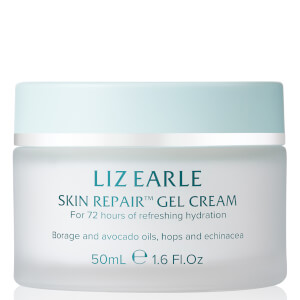
Works for
2 of 2 advertised claims delivered
Moisturizing12 ingredients credited for this claimGood support
“The cooling gel texture of the facial cream allows it to glide across your base effortlessly, locking in hydration for long-lasting, touchable softness.”
This product can help improve hydration of the skin with the two types of ingredients.
The first type is called “humectants”:
these ingredients help attract water.
When humectants are on the surface of the skin, they “pull in” the moisture from the outside environment, or from
within deeper layers of the skin. The following ingredients in this product do the job:
aspartic acid, glycerin.
This product also contains ingredients called “occlusives”. They help reduce the speed with which our skin loses moisture to the outside environment. These ingredients also help soften the upper layer of the skin, so it feels less tight and nicer to the touch. The following ingredients in this product do the job: borago officinalis seed oil, jojoba esters.
Anti-aging2 ingredients credited for this claimModerate support
“Echinacea and Toning Hops create the illusion of a more youthful complexion, while antioxidant-rich Vitamin E creates a powerful barrier against harsh external factors, that could potentially cause further damage.”
This product contains aspartic acid. This ingredient might be able to help reduce and prevent fine lines and wrinkles, improve skin elasticity and firmness, but there is not enough evidence that it actually works.
Can it cause trouble?
Irritancy8 strong irritants: Humulus lupulus extract, Parfum + 6 more — patch-test recommendedHigh risk
ComedogenicClean of flagged comedogenic ingredientsNone flagged
User reviews
Be the first — your take helps the next person decide.
Ingredients
Filter by role to see what each ingredient is doing.
Water~40–60%
Glycerin~3.9–5.8%
- Irritation risk
- Low
One of the best moisturizing ingredients. Naturally present in skin. It attracts water to the upper layer of the skin working as a humectant
More about GlycerinPropanediol~3.5–5.2%
- Irritation risk
- Low
Acts as a solvent for other ingredients. Speeds up the absorption of other ingredients into the skin
More about PropanediolDiheptyl succinate~2.7–4.1%
- Irritation risk
- Low
Helps to soften the upper layer of the skin and creates a nice product finish on the skin
More about Diheptyl succinatePolyglyceryl-6 distearate~2–3%
- Irritation risk
- Medium
Helps oil and water mix together while softening the upper layer of the skin
More about Polyglyceryl-6 distearateSodium polyacrylate~1.7–2.6%
- Irritation risk
- Low
Used to create a gel-like product texture, as well as to stabilize emulsions
More about Sodium polyacrylateBorago officinalis seed oil~1.4–2.1%
- Irritation risk
- Low
A plant oil that is effective in reducing irritation in skin, restore the barrier function and support its hydration
More about Borago officinalis seed oilPersea gratissima oil~1.3–1.9%
- Irritation risk
- Medium
An emollient that helps soften the skin and could be helpful in repairing its barrier function
More about Persea gratissima oilHumulus lupulus extract~1–1.5%
- Irritation risk
- High
Hops extract. Can contain common irritants and allergens geraniol, limonene, linalool
More about Humulus lupulus extractEchinacea purpurea extract~0.6–1.4%
- Irritation risk
- High
Plant extract that might have some anti-oxidant properties. Can be irritating
More about Echinacea purpurea extractCetyl alcohol~0.55–1.35%
- Irritation risk
- Low
A non-drying alcohol that works to soften the skin and stabilize product formulations helping oil and water mix together
More about Cetyl alcoholPhenoxyethanol~0.4–0.95%
- Irritation risk
- Low
A preservative. It helps prevent bacterial growth in cosmetic products
More about PhenoxyethanolJojoba esters~0.4–0.95%
- Irritation risk
- Medium
An emollient made of jojoba oil. Helps soften the skin and support its barrier function
More about Jojoba estersCaprylyl glycol~0.35–0.85%
- Irritation risk
- Medium
Helps preserve products and creates a nice product texture
More about Caprylyl glycolParfum~0.3–0.7%
- Irritation risk
- High
An aromatic blend of unspecified and possibly irritating ingredients
More about ParfumPolyglyceryl-3 beeswax~0.35–0.8%
- Irritation risk
- Medium
Helps water and oil mix together. Could be an allergen (beeswax)
More about Polyglyceryl-3 beeswaxCapryloyl glycerin/sebacic acid copolymer~0.3–0.75%
- Irritation risk
- Low
Helps soften the upper layer of the skin
More about Capryloyl glycerin/sebacic acid copolymerCitric acid~0.2–0.75%
- Irritation risk
- Medium
Can work as an exfoliant but is typically used to adjust the product pH
More about Citric acidTocopherol~0.15–0.7%
- Irritation risk
- Low
Pure form of vitamin E. Can help moisturise and protect the skin from free radicals. Often used to help stabilise other ingredients or the formula itself
More about TocopherolXanthan gum~0.15–0.65%
- Irritation risk
- Low
Used to create a thicker product consistency
More about Xanthan gumTrisodium ethylenediamine disuccinate~0.15–0.55%
- Irritation risk
- Medium
Used to improve stability of the formulation
More about Trisodium ethylenediamine disuccinateHydrolyzed hyaluronic acid~0.15–0.55%
- Irritation risk
- Low
One of the best moisturizing ingredients. Attracts water into the upper layer of the skin. A version of it is naturally present in skin
More about Hydrolyzed hyaluronic acidSodium hydroxide~0.1–0.5%
Benzyl salicylate~0.1–0.4%
Limonene~0.1–0.4%
- Irritation risk
- High
A common frangrance that can easily irritate skin, especially if exposed to air, light or heat
More about LimoneneLinalool~0.1–0.35%
Citronellol~0.1–0.35%
Eugenol~0.05–0.25%
Benzoic acid~0.05–0.3%
Benzyl benzoate~0.05–0.25%
- Irritation risk
- High
Fragrance with sweet balsamic smell. Help to preserve products and dissolve other ingredients. Could trigger allergic reactions and be irritating
More about Benzyl benzoateDehydroacetic acid~0.05–0.2%
Aspartic acid~0.05–0.1%
- Irritation risk
- Low
An amino-acid that helps increase skin hydration and might help to slightly improve skin firmness, potentially reducing lines and wrinkles
More about Aspartic acidSodium chloride~0.05–0.1%
- Irritation risk
- Low
Used to stabilize mixtures of oil and water, and create thicker, gel-like product textures
More about Sodium chlorideIngredient list view
Water, Glycerin, Propanediol, Diheptyl succinate, Polyglyceryl-6 distearate, Sodium polyacrylate, Borago officinalis seed oil, Persea gratissima oil, Humulus lupulus extract, Echinacea purpurea extract, Cetyl alcohol, Phenoxyethanol, Jojoba esters, Caprylyl glycol, Parfum, Polyglyceryl-3 beeswax, Capryloyl glycerin/sebacic acid copolymer, Citric acid, Tocopherol, Xanthan gum, Trisodium ethylenediamine disuccinate, Hydrolyzed hyaluronic acid, Sodium hydroxide, Benzyl salicylate, Limonene, Linalool, Citronellol, Eugenol, Benzoic acid, Benzyl benzoate, Dehydroacetic acid, Aspartic acid, Sodium chloride
Compare prices
Retailers ranked by price — lowest first.

Sources cited in this review
Every concentration estimate and effectiveness label is anchored to one of these 12 studies and safety reviews.
- 1
- 2
- 3
- 4
- 5
- 6Vitamin E in dermatologyncbi.nlm.nih.gov

Affiliate links · As an Amazon Associate, WIMJ earns from qualifying purchases.