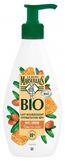
Le Petit Marseillais 48H Hydration Nourishing Milk Honey Argan Organic
Works for
1 of 1 advertised claim delivered
MoisturizingHelianthus annuus seed oil, Butyrospermum parkii butter + 10 moreGood evidence
“48H Hydration Nourishing Milk Honey Argan Organic”
This product can help improve hydration of the skin with the two types of ingredients.
The first type is called “humectants”:
these ingredients help attract water.
When humectants are on the surface of the skin, they “pull in” the moisture from the outside environment, or from
within deeper layers of the skin. The following ingredients in this product do the job:
glycerin.
This product also contains ingredients called “occlusives”. They help reduce the speed with which our skin loses moisture to the outside environment. These ingredients also help soften the upper layer of the skin, so it feels less tight and nicer to the touch. The following ingredients in this product do the job: butyrospermum parkii butter, helianthus annuus seed oil.
Anti-oxidationNot advertised by the brand · Naringenin, Butyrospermum parkii butter + 1 moreModerate evidence
This product contains antioxidants (naringenin) that might be able to help neutralize free radicals in skin to lessen the damage it gets from the UV light (sun). There is not enough evidence to confirm their effectiveness in skin though.
Can it cause trouble?
Irritancy3 strong irritants: Parfum, Linalool + 1 more — patch-test recommendedHigh risk
Comedogenic2 ingredients rated 2 or more on the 0–5 pore-clogging scale2 flagged
User reviews
Be the first — your take helps the next person decide.
Ingredients
Filter by role to see what each ingredient is doing.
Water~40–60%
Olus oil~5.1–7.6%
- Irritation risk
- Low
An oil from a mixture of different vegetables. Helps soften the upper layer of the skin
More about Olus oilCocoglycerides~3.2–4.8%
- Irritation risk
- High
Help soften the upper layer of the skin and make it easier for oil and water mix together. Recently, a rising number of allergic reactions to cocoglycerides and other coconut-derived surfactants has been reported. As there is a significant overlap between frequent irritants and allergens, we flag this ingredient for attention of those with very sensitive, reactive skin
More about CocoglyceridesGlycerin~2.8–4.1%
- Irritation risk
- Low
One of the best moisturizing ingredients. Naturally present in skin. It attracts water to the upper layer of the skin working as a humectant
More about GlycerinBehenyl alcohol~2.2–3.3%
- Irritation risk
- Low
Non-drying alcohol that helps water and oil mix together. Also serves as an emollient
More about Behenyl alcoholButyrospermum parkii butter~1.8–2.8%
- Irritation risk
- Low
- Comedogenicity
- 3/5
A great moisturising ingredient that softens the skin and reduces water loss from its upper layer. It also can be helpful in protecting skin from free radicals
More about Butyrospermum parkii butterMel extract~1.5–2.2%
- Irritation risk
- Low
Argania spinosa kernel oil~1.4–2%
- Irritation risk
- Medium
An emollient that helps soften the upper layer of the skin. Might have some weak anti-oxidant properties
More about Argania spinosa kernel oilHelianthus annuus seed oil~1.2–1.7%
- Irritation risk
- Low
A great emollient due to its high linoleic acid content. One of the most effective plant oils in helping skin hydration and repairing skin barrier function
More about Helianthus annuus seed oilAloe barbadensis leaf juice~0.85–1.25%
- Irritation risk
- Medium
Traditionally used to treat sunburns, dermatitis and inflammation, but evidence for its effectiveness is lacking. The extract can contain humectants that help attract water into the skin
More about Aloe barbadensis leaf juiceCandelilla cera~0.55–1.3%
- Irritation risk
- Low
Hydrogenated vegetable oil~0.45–1.1%
- Irritation risk
- Low
- Comedogenicity
- 2/5
An oil from a mixture of different vegetables. Helps soften the upper layer of the skin
More about Hydrogenated vegetable oilCaprylyl glyceryl ether~0.45–1.1%
Hydrogenated palm glycerides~0.4–0.9%
- Irritation risk
- Low
An emollient that softens the skin
More about Hydrogenated palm glyceridesPotassium cetyl phosphate~0.3–0.7%
- Irritation risk
- Medium
Helps oil and water mix together
More about Potassium cetyl phosphateSuccinoglycan~0.15–0.65%
Xanthan gum~0.15–0.6%
- Irritation risk
- Low
Used to create a thicker product consistency
More about Xanthan gumCitric acid~0.1–0.45%
- Irritation risk
- Medium
Can work as an exfoliant but is typically used to adjust the product pH
More about Citric acidNaringenin~0.1–0.35%
- Irritation risk
- Medium
A flavanoid that can be found in high concentrations in grapefruits, oranges, other citrus fruits, and tomato skin. Early studies suggest that it might be able to help reduce inflammation in skin and neutralize free radicals
More about NaringeninPotassium sorbate~0.1–0.35%
Parfum~0.05–0.2%
- Irritation risk
- High
An aromatic blend of unspecified and possibly irritating ingredients
More about ParfumLinalool~0.05–0.2%
Limonene~0.05–0.15%
- Irritation risk
- High
A common frangrance that can easily irritate skin, especially if exposed to air, light or heat
More about LimoneneIngredient list view
Water, Olus oil, Cocoglycerides, Glycerin, Behenyl alcohol, Butyrospermum parkii butter, Mel extract, Argania spinosa kernel oil, Helianthus annuus seed oil, Aloe barbadensis leaf juice, Candelilla cera, Hydrogenated vegetable oil, Caprylyl glyceryl ether, Hydrogenated palm glycerides, Potassium cetyl phosphate, Succinoglycan, Xanthan gum, Citric acid, Naringenin, Potassium sorbate, Parfum, Linalool, Limonene
Compare prices
Retailers ranked by price — lowest first.

Sources cited in this review
Every concentration estimate and effectiveness label is anchored to one of these 8 studies and safety reviews.
- 1
- 2
- 3
- 4
- 5Effect of topically applied lipids on surfactant-irritated skinonlinelibrary.wiley.com
- 6

Affiliate links · As an Amazon Associate, WIMJ earns from qualifying purchases.