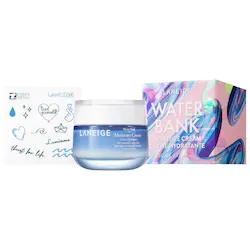
LANEIGE Limited Edition Water Bank Moisture Cream
Works for
1 of 2 advertised claims delivered
MoisturizingPhenyl trimethicone, Saccharide isomerate + 15 moreGood evidence
“Limited Edition Water Bank Moisture Cream”
This product can help improve hydration of the skin with the two types of ingredients.
The first type is called “humectants”:
these ingredients help attract water.
When humectants are on the surface of the skin, they “pull in” the moisture from the outside environment, or from
within deeper layers of the skin. The following ingredients in this product do the job:
glycerin, hyaluronic acid.
This product also contains ingredients called “occlusives”. They help reduce the speed with which our skin loses moisture to the outside environment. These ingredients also help soften the upper layer of the skin, so it feels less tight and nicer to the touch. The following ingredients in this product do the job: phenyl trimethicone, glycine soja oil.
Evens skin toneAscorbyl glucosideWeak evidence
“Dryness and Dullness and Uneven Texture Formulation.”
Effective ingredients missing or their concentration is too low
Can it cause trouble?
Irritancy10 strong irritants: Parfum, Linalool + 8 more — patch-test recommendedHigh risk
Comedogenic2 ingredients rated 2 or more on the 0–5 pore-clogging scale2 flagged
User reviews
Be the first — your take helps the next person decide.
Ingredients
Filter by role to see what each ingredient is doing.
Water~45–55%
Propanediol~4.6–5.6%
- Irritation risk
- Low
Acts as a solvent for other ingredients. Speeds up the absorption of other ingredients into the skin
More about PropanediolGlycerin~3.8–4.6%
- Irritation risk
- Low
One of the best moisturizing ingredients. Naturally present in skin. It attracts water to the upper layer of the skin working as a humectant
More about GlycerinMethyl trimethicone~3–3.7%
- Irritation risk
- Low
A type of silicone that helps create a silky product finish and dissolve other ingredients
More about Methyl trimethiconePhenyl trimethicone~2.3–2.8%
- Irritation risk
- Low
A type of silicone that can decrease loss of moisture from the skin surface. It helps create a nice product texture
More about Phenyl trimethiconeCaprylyl methicone~1.9–2.3%
- Irritation risk
- Low
A type of silicone that helps to soften the upper layer of the skin and create a nice product finish on the skin
More about Caprylyl methicone1,2-hexanediol~0.7–1.05%
Dicaprylyl carbonate~1.4–1.7%
- Irritation risk
- Low
Helps products spread more easily and works as an emollient to soften skin
More about Dicaprylyl carbonateSea water~1.1–1.3%
- Irritation risk
- Low
Dissolves other ingredients. It does not have additional skin benefits compared to plain water
More about Sea waterMaris aqua~0.9–1.1%
Sea water~0.65–1%
- Irritation risk
- Low
Dissolves other ingredients. It does not have additional skin benefits compared to plain water
More about Sea waterSaccharide isomerate~0.55–0.85%
- Irritation risk
- Low
Helps attract water to the upper layer of the skin
More about Saccharide isomerateHydrogenated lecithin~0.55–0.8%
- Irritation risk
- Low
Helps to retain moisture by creating a protective barrier on the skin. Rich in fatty acids. Improves product texture and helps with the penetration of other ingredients.
More about Hydrogenated lecithinAmmonium acryloyldimethyltaurate/vp copolymer~0.5–0.75%
- Irritation risk
- Low
Increases thickness of a product. Texture enhancer for oil-in-water emulsions
More about Ammonium acryloyldimethyltaurate/vp copolymerHydrogenated polyisobutene~0.5–0.75%
- Irritation risk
- Low
Used to improve the product consistency and soften the upper layer of the skin
More about Hydrogenated polyisobuteneHydroxyethyl acrylate/sodium acryloyldimethyl taurate copolymer~0.45–0.7%
- Irritation risk
- Medium
A gelling agent that thickens the product consistency and leaves the skin with a velvety finish
More about Hydroxyethyl acrylate/sodium acryloyldimethyl taurate copolymerCetearyl alcohol~0.5–0.75%
- Irritation risk
- Low
- Comedogenicity
- 2/5
A non-drying alcohol. Works as an emollient. Helps water and oil mix together and creates a nice product texture
More about Cetearyl alcoholButylene glycol~0.4–0.6%
- Irritation risk
- Low
Used to create a nice product texture and help delivery of other ingredients. Might be somewhat helpful in attracting water to the upper layer of the skin
More about Butylene glycolParfum~0.3–0.6%
- Irritation risk
- High
An aromatic blend of unspecified and possibly irritating ingredients
More about ParfumGlyceryl caprylate~0.4–0.6%
- Irritation risk
- Low
An emollient that can also help water and oil mix together, as well as prevent bacteria growth in products
More about Glyceryl caprylateGlyceryl stearate~0.35–0.65%
- Irritation risk
- Low
An emollient that softens the skin and forms a protective layer on its surface. Helps water and oil mix together
More about Glyceryl stearateStearic acid~0.45–0.7%
- Irritation risk
- Low
Helps oil and water mix together and works as an emollient
More about Stearic acidEthylhexylglycerin~0.3–0.5%
Disodium edta~0.25–0.5%
Acrylates/c10-30 alkyl acrylate crosspolymer~0.3–0.55%
- Irritation risk
- Medium
Maintains the texture of skincare products. Allows the product to spread evenly. Helps oil and water mix together
More about Acrylates/c10-30 alkyl acrylate crosspolymerTromethamine~0.3–0.5%
Sorbitan isostearate~0.3–0.55%
- Irritation risk
- Low
Helps oil and water mix together
More about Sorbitan isostearatePolyglyceryl-3 methylglucose distearate~0.3–0.55%
- Irritation risk
- Medium
Helps water and oil mix together
More about Polyglyceryl-3 methylglucose distearateHyaluronic acid~0.25–0.5%
- Irritation risk
- Low
One of the best moisturizing ingredients. Attracts water into the upper layer of the skin. Naturally present in skin. Typically has large molecule size unless advertised otherwise on the product label. Helps support skin's barrier function and may help to reduce inflammation
More about Hyaluronic acidMagnesium sulfate~0.3–0.55%
Calcium chloride~0.3–0.5%
- Irritation risk
- Medium
Helps create a thicker product consistency. Might be irritating
More about Calcium chlorideLinalool~0.25–0.45%
Sodium citrate~0.25–0.5%
- Irritation risk
- Medium
Helps to control the skin's pH level. Maintains the skin's natural film of amino-lactic acids and oils. Helps to preserve products
More about Sodium citrateCitric acid~0.25–0.5%
- Irritation risk
- Medium
Can work as an exfoliant but is typically used to adjust the product pH
More about Citric acidHexyl cinnamal~0.25–0.45%
Benzyl salicylate~0.25–0.45%
Butylphenyl methylpropional~0.25–0.45%
- Irritation risk
- High
A fragrance. Can trigger allergic reactions and be irritating
More about Butylphenyl methylpropionalLimonene~0.25–0.45%
- Irritation risk
- High
A common frangrance that can easily irritate skin, especially if exposed to air, light or heat
More about LimoneneBeta vulgaris root extract~0.25–0.5%
- Irritation risk
- Medium
A plant extract that might have some antioxidant properties, but mostly used in cosmetics for its color
More about Beta vulgaris root extractBeta vulgaris~0.25–0.5%
- Irritation risk
- Low
Geraniol~0.25–0.4%
Citronellol~0.2–0.4%
Alpha-isomethyl ionone~0.2–0.4%
- Irritation risk
- High
A fragrance. Potential allergen and can be irritating
More about Alpha-isomethyl iononeManganese sulfate~0.2–0.4%
- Irritation risk
- Low
Chenopodium quinoa seed extract~0.2–0.4%
- Irritation risk
- Low
Helps soften the upper layer of the skin
More about Chenopodium quinoa seed extractTocopherol~0.2–0.35%
- Irritation risk
- Low
Pure form of vitamin E. Can help moisturise and protect the skin from free radicals. Often used to help stabilise other ingredients or the formula itself
More about TocopherolZinc sulfate~0.1–0.25%
Lecithin~0.2–0.35%
- Irritation risk
- Low
Used mostly for creating emulsions - helping oil and water mix together. Helps soften the upper layer of the skin
More about LecithinBrassica oleracea acephala leaf extract~0.1–0.2%
- Irritation risk
- Medium
Might be helpful in neutralizing free radicals in skin but solid research is lacking. Helps attract water to the upper layer of the skin
More about Brassica oleracea acephala leaf extractNasturtium officinale extract~0.1–0.2%
- Irritation risk
- High
Used as a fragrance. Might have anti-oxidant properties
More about Nasturtium officinale extractGlycine soja oil~0.15–0.25%
- Irritation risk
- Medium
- Comedogenicity
- 2/5
A good emollient that helps soften the skin and helps repair its barrier function. It can clog pores if used in high concentrations.
More about Glycine soja oilLepidium sativum sprout extract~0.05–0.1%
- Irritation risk
- Low
Ascorbyl glucoside~0.05–0.1%
- Irritation risk
- Medium
A vitamin C derivative that is more stable but less potent than pure form of vitamin C. Has a potential to boost collagen production, nutralise free radicals and reduce hyperpigmentation, but the required concentration is likely to be much higher than for the pure form of vitamin C, limiting the ingredient's effectiveness in products
More about Ascorbyl glucosideIngredient list view
Water, Propanediol, Glycerin, Methyl trimethicone, Phenyl trimethicone, Caprylyl methicone, 1,2-hexanediol, Dicaprylyl carbonate, Sea water, Maris aqua, Sea water, Saccharide isomerate, Hydrogenated lecithin, Ammonium acryloyldimethyltaurate/vp copolymer, Hydrogenated polyisobutene, Hydroxyethyl acrylate/sodium acryloyldimethyl taurate copolymer, Cetearyl alcohol, Butylene glycol, Parfum, Glyceryl caprylate, Glyceryl stearate, Stearic acid, Ethylhexylglycerin, Disodium edta, Acrylates/c10-30 alkyl acrylate crosspolymer, Tromethamine, Sorbitan isostearate, Polyglyceryl-3 methylglucose distearate, Hyaluronic acid, Magnesium sulfate, Calcium chloride, Linalool, Sodium citrate, Citric acid, Hexyl cinnamal, Benzyl salicylate, Butylphenyl methylpropional, Limonene, Beta vulgaris root extract, Beta vulgaris, Geraniol, Citronellol, Alpha-isomethyl ionone, Manganese sulfate, Chenopodium quinoa seed extract, Tocopherol, Zinc sulfate, Lecithin, Brassica oleracea acephala leaf extract, Nasturtium officinale extract, Glycine soja oil, Lepidium sativum sprout extract, Ascorbyl glucoside
Compare prices
Retailers ranked by price — lowest first.
Sources cited in this review
Every concentration estimate and effectiveness label is anchored to one of these 14 studies and safety reviews.
- 1
- 2
- 3
- 4Safety Assessment of Tromethamine as Used in Cosmeticscir-safety.org
- 5Efficacy of a New Topical Nano-hyaluronic Acid in Humansncbi.nlm.nih.gov
- 6Physiochemical properties and application of hyaluronic acid: a systematic reviewonlinelibrary.wiley.com

Affiliate links · As an Amazon Associate, WIMJ earns from qualifying purchases.